Health Science Center, University of Fortaleza (UNIFOR), Fortaleza, Ceara, Brazil.
Postgraduate Program in Collective Health, Health Sciences Center, University of Fortaleza (UNIFOR), Fortaleza, Ceará, Brazil.
Nutrition. 2022 Feb;94:111512. doi: 10.1016/j.nut.2021.111512. Epub 2021 Oct 11.
Nutrition has become an important component in treating individuals during the coronavirus disease of 2019 (COVID-19) pandemic, which is increasingly affecting the world population and causing a collapse in health services. Prolonged hospitalization, including immobilization and catabolism, induces a decrease in body weight and muscle mass that may result in sarcopenia, a condition that impairs respiratory and cardiac function and worsens the prognosis. The present study aimed to analyze enteral nutritional support and the clinical evolution of patients admitted with COVID-19 in Brazil.
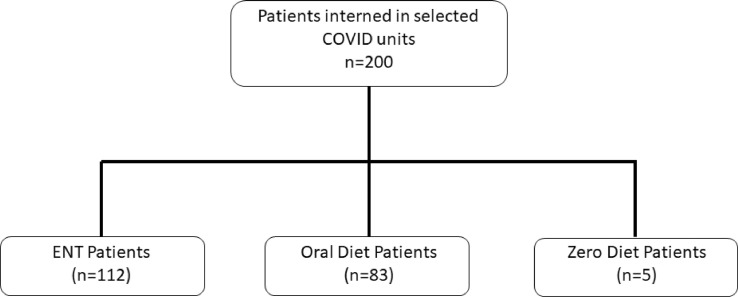
This was a retrospective study, conducted from March to May 2020, of patients admitted to a referral hospital in cardiology and pulmonology in Fortaleza-Ce/Brazil. Two hundred patients infected with COVID-19 were selected for the study. Sociodemographic, clinical, and nutritional data were collected from electronic medical records, and associations between outcomes and the use of the prone body position with nutritional variables were analyzed by linear regression. Odds ratio and 95% confidence interval estimates for the death outcome were analyzed by logistic regression.
Of the 112 patients who were fed by enterally, the majority were male (n = 61; 54.5%), elderly (n = 88; 78.6%), and with no current smoking habit (n = 81; 72.3%). The median hospital stay was 14 d, mostly in intensive care units (median: 9 d). Prone body positioning impacted the nutritional therapy. In general, patients who maintained a prone body position tested lower for kcal/kg of body weight, protein/kg of body weight, percentage of diet adequacy, and total caloric value. In addition, patients who died had a lower mean maximum kcal/kg body weight, protein/kg body weight, percentage of diet adequacy, and total caloric value compared with surviving patients.
An association between inadequacies in protein and energy supply with mortality was confirmed, suggesting that nutritional support optimization should be prescribed in such situations.
在 2019 年冠状病毒病(COVID-19)大流行期间,营养已成为治疗患者的重要组成部分,COVID-19 正日益影响世界人口,并导致卫生服务系统崩溃。长时间住院,包括固定和分解代谢,会导致体重和肌肉量下降,从而导致肌肉减少症,这种情况会损害呼吸和心脏功能,使预后恶化。本研究旨在分析巴西 COVID-19 住院患者的肠内营养支持和临床演变情况。
这是一项回顾性研究,于 2020 年 3 月至 5 月期间在巴西福塔莱萨-塞(Fortaleza-Ce)的一家心脏病学和肺病学转诊医院进行,共选择了 200 名感染 COVID-19 的患者。从电子病历中收集了患者的社会人口统计学、临床和营养数据,并通过线性回归分析了结局与俯卧位与营养变量之间的相关性。通过逻辑回归分析了死亡结局的比值比和 95%置信区间估计值。
在接受肠内喂养的 112 名患者中,大多数为男性(n=61;54.5%)、老年患者(n=88;78.6%)和无当前吸烟习惯的患者(n=81;72.3%)。中位住院时间为 14 天,大多数患者在重症监护病房(中位数:9 天)。俯卧位对营养治疗有影响。总体而言,保持俯卧位的患者体重的千卡/公斤、体重的蛋白质/公斤、饮食充足率和总热量值较低。此外,与存活患者相比,死亡患者的最大体重千卡/公斤、蛋白质/公斤体重、饮食充足率和总热量值平均值较低。
确证了蛋白质和能量供应不足与死亡率之间的关联,这表明在这种情况下应规定进行营养支持优化。