Wong Sara, Brown Alexander D, Abrahams Abigail B, Nurzak An Nisaa, Eltaher Hoda M, Sykes David A, Veprintsev Dmitry B, Fone Kevin C F, Dixon James E, King Madeleine V
Division of Physiology Pharmacology and Neuroscience, School of Life Sciences, University of Nottingham Medical School, Queen's Medical Centre, Nottingham NG7 2UH, UK.
Regenerative Medicine and Cellular Therapies, School of Pharmacy, Biodiscovery Institute (BDI), University of Nottingham, University Park Campus, Nottingham NG7 2RD, UK.
Pharmaceutics. 2024 Sep 28;16(10):1267. doi: 10.3390/pharmaceutics16101267.
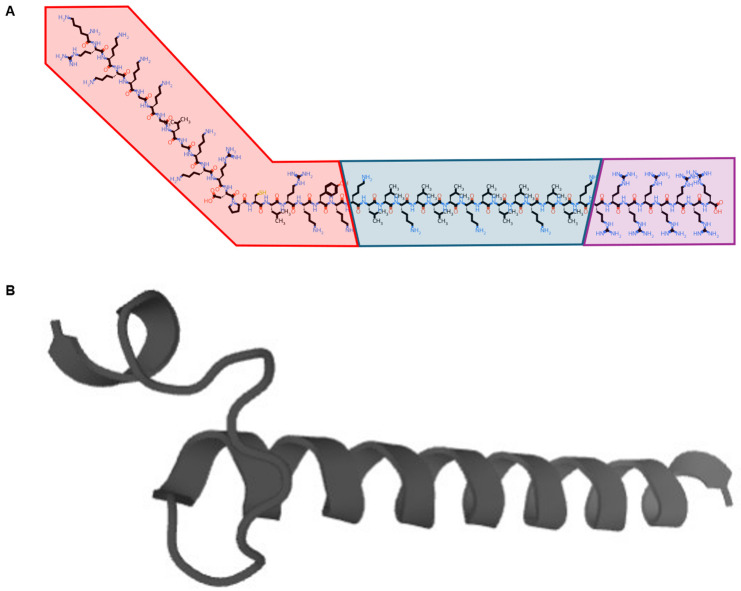
Peptide-based treatments represent an expanding area and require innovative approaches to enhance bioavailability. Combination with cell-penetrating peptides (CPPs) is an attractive strategy to improve non-invasive delivery across nasal epithelial barriers for systemic and direct nose-to-brain transport. We previously developed a modified CPP system termed Glycosaminoglycan-binding Enhanced Transduction (GET) that improves insulin delivery across gastrointestinal epithelium. It contains a membrane docking sequence to promote cellular interactions (P21), a cationic polyarginine domain to stimulate uptake (8R) and an endosomal escaping sequence to maximize availability for onward distribution (LK15). It is synthesized as a single 44-residue peptide (P21-LK15-8R; PLR).
The current research used in vitro assays for a novel exploration of PLR's ability to improve the transport of two contrasting peptides, insulin (51 residues, net negative charge) and oxytocin (9 residues, weak positive charge) across an RPMI 2650 human nasal epithelial cell barrier cultured at the air-liquid interface.
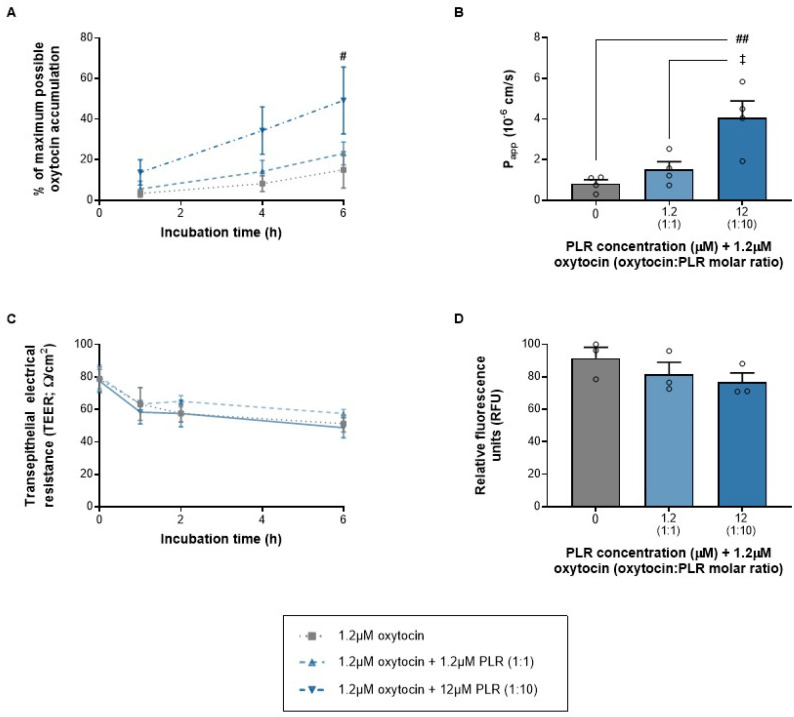
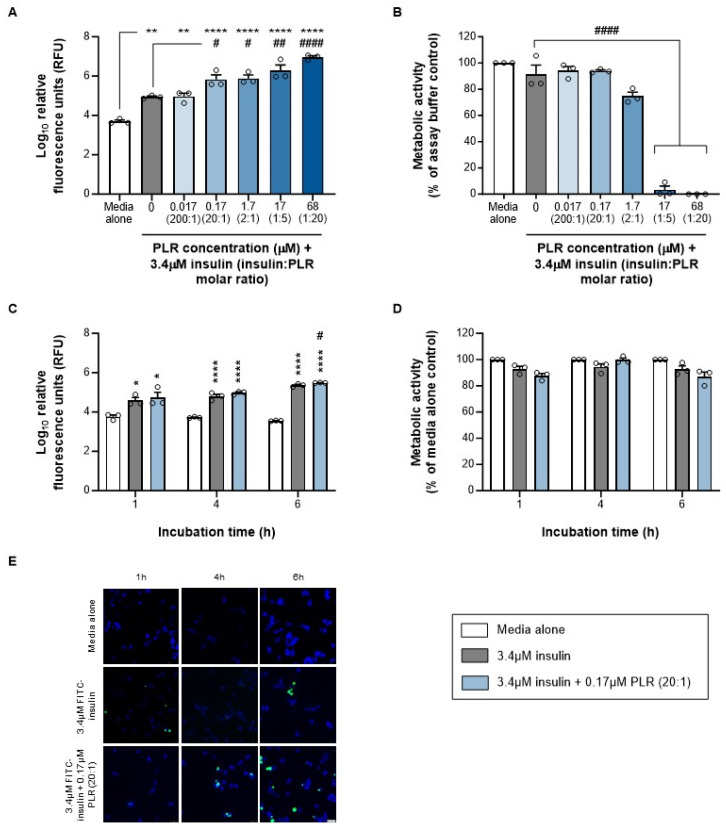
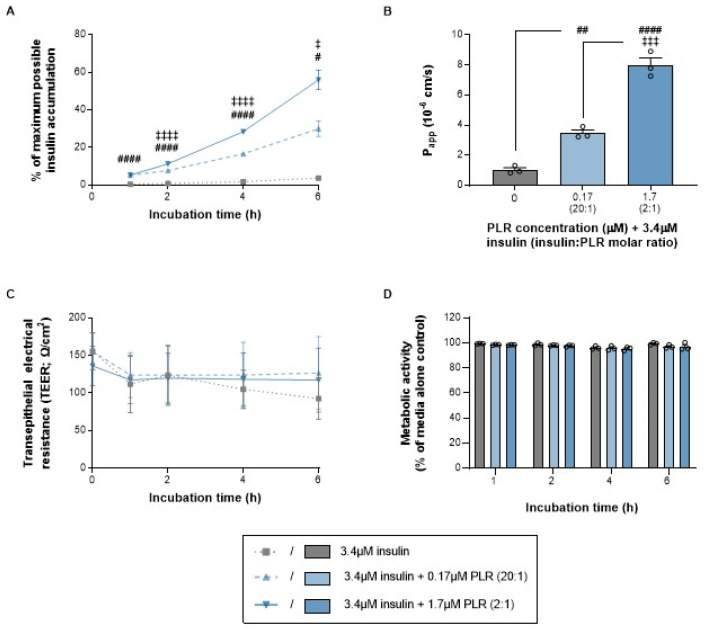
PLR enhanced insulin transcytosis over a 6 h period by 7.8-fold when used at a 2:1 molar ratio of insulin/PLR ( < 0.0001 versus insulin alone). Enhanced oxytocin transcytosis (5-fold) occurred with a 1:10 ratio of oytocin/PLR ( < 0.01). Importantly, these were independent of any impact on transepithelial electrical resistance (TEER) or cell viability ( > 0.05).
We advocate the continued evaluation of insulin-PLR and oxytocin-PLR formulations, including longer-term assessments of ciliotoxicity and cytotoxicity in vitro followed by in vivo assessments of systemic and nose-to-brain delivery.
基于肽的治疗方法是一个不断扩展的领域,需要创新方法来提高生物利用度。与细胞穿透肽(CPP)结合是一种有吸引力的策略,可改善跨鼻上皮屏障的非侵入性递送,实现全身和直接的鼻-脑转运。我们之前开发了一种改良的CPP系统,称为糖胺聚糖结合增强转导(GET),可改善胰岛素跨胃肠道上皮的递送。它包含一个促进细胞相互作用的膜对接序列(P21)、一个刺激摄取的阳离子聚精氨酸结构域(8R)和一个内体逃逸序列,以最大限度地提高继续分布的可用性(LK15)。它被合成为一个单一的44个残基的肽(P21-LK15-8R;PLR)。
本研究采用体外试验,对PLR改善两种对比肽(胰岛素,51个残基,净负电荷;催产素,9个残基,弱正电荷)跨在气液界面培养的RPMI 2650人鼻上皮细胞屏障的转运能力进行了新的探索。
当以胰岛素/PLR摩尔比为2:1使用时,PLR在6小时内将胰岛素转胞吞作用提高了7.8倍(与单独使用胰岛素相比,P<0.0001)。以催产素/PLR比例为1:10时,催产素转胞吞作用增强(5倍)(P<0.01)。重要的是,这些与对跨上皮电阻(TEER)或细胞活力的任何影响无关(P>0.05)。
我们主张继续评估胰岛素-PLR和催产素-PLR制剂,包括体外对纤毛毒性和细胞毒性的长期评估,随后进行体内全身和鼻-脑递送评估。