Orthopedic and Traumatology Department, Medical University of Warsaw, 02-091 Warszawa, Poland.
Orthopedic and Sport Traumatology Department, Carolina Medical Center, 02-757 Warszawa, Poland.
Medicina (Kaunas). 2024 Oct 15;60(10):1692. doi: 10.3390/medicina60101692.
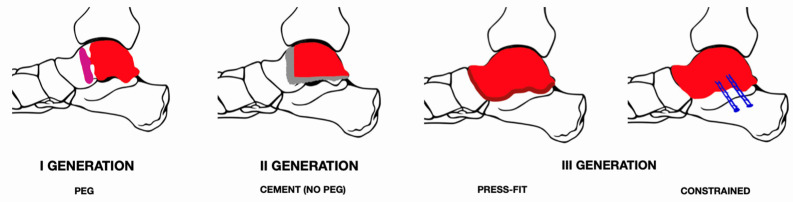
Talar avascular necrosis (AVN) is a devastating condition that frequently follows type III and IV talar neck fractures. As 60% of the talus is covered by hyaline cartilage, its vascular supply is limited and prone to trauma, which may eventually lead to AVN development. Early detection of AVN (Hawkins sign, MRI) is crucial, as it may prevent the development of the irreversible stages III and IV of AVN. Alertness is advised regarding non-obvious conditions that may cause this complication (sub chondroplasty, systemic lupus erythematosus, diabetes mellitus). Although, in stages I-II, AVN may be treated with non-surgical procedures (ESWT therapy, non-weight bearing) or joint-sparing techniques (core drilling, bone marrow aspirate injections), stages III-IV require more advanced procedures, such as joint-sacrificing procedures (hindfoot arthrodesis/ankle arthrodesis), or replacement surgery, including total talar replacement (TTR) or combined total ankle replacement (TAR). The advancement of 3D-printing technology and increased access to implant manufacturing are contributing to a rise in the production rates of third-generation total talar prostheses. As a result, there is a growing frequency of alloplasty procedures and combined total ankle replacement (TAR) surgeries. By performing TTR as opposed to deses, the operator avoids (i) delayed union, (ii) a shortening of the limb, (iii) a lack of mobility, and (iv) the stiffening of adjacent joints, which are the main disadvantages of joint-sacrificing procedures. Simultaneously, TTR and combined TAR offer (i) a brief period of weight-bearing restriction, (ii) quick pain relief, and (iii) preservation of the length of the limb. Here, we summarize the most up-to-date knowledge regarding AVN diagnosis and treatment, with a special focus on the role of TTR.
距骨骨坏死(AVN)是一种破坏性疾病,常继发于 III 型和 IV 型距骨颈骨折。由于距骨 60%被透明软骨覆盖,其血供有限,容易受到创伤,最终可能导致 AVN 发展。早期发现 AVN(Hawkins 征,MRI)至关重要,因为它可能防止不可逆的 III 期和 IV 期 AVN 发展。对于可能导致这种并发症的非明显情况(软骨下骨切除术、系统性红斑狼疮、糖尿病),应保持警惕。虽然在 I-II 期,AVN 可通过非手术治疗(ESWT 治疗、不负重)或保关节技术(核心钻孔、骨髓抽吸注射)治疗,但 III-IV 期需要更先进的治疗方法,如关节破坏性手术(后足融合/踝关节融合)或置换手术,包括全距骨置换(TTR)或联合全踝关节置换(TAR)。3D 打印技术的进步和植入物制造的增加,促进了第三代全距骨假体的产量增加。因此,全距骨置换术和联合全踝关节置换术的频率越来越高。与关节切除相比,行 TTR 可避免(i)延迟愈合,(ii)肢体缩短,(iii)活动受限,(iv)相邻关节僵硬,这些都是关节破坏性手术的主要缺点。同时,TTR 和联合 TAR 提供(i)短时间的负重限制,(ii)快速缓解疼痛,(iii)肢体长度的保留。在这里,我们总结了最新的关于 AVN 诊断和治疗的知识,特别关注 TTR 的作用。