Department of Medicine, Division of Rheumatology, University of California Los Angeles, David Geffen School of Medicine, Los Angeles, California, USA
Corrona Research Foundation, Albany, New York, USA.
RMD Open. 2024 Oct 26;10(4):e004829. doi: 10.1136/rmdopen-2024-004829.
Paraoxonase-1 (PON1) is a high-density lipoprotein (HDL)-associated enzyme, that has been implicated as a biomarker of cardiovascular risk in patients with rheumatoid arthritis (RA). We aimed to investigate how different biologic therapies affect levels of PON1 and oxylipins.
1213 adult patients with RA in the Comparative Effectiveness Registry to study Therapies for Arthritis and Inflammatory CoNditions cohort study with moderate-to-high disease activity (Clinical Disease Activity Index (CDAI) >10) who initiated a new biologic (tocilizumab (TCZ), n=296; abatacept, n=374; tumour necrosis factor inhibitors, n=427; rituximab, n=116) were followed prospectively with serum specimens analysed for PON1 activity by arylesterase (ARYL), lactonase (LAC) and PON assays at baseline and after 6 months of biologic therapy. A targeted panel of oxylipins was evaluated by liquid chromatography-mass spectrometry/mass spectrometry in a subset of patients with the lowest and highest 6-month Disease Activity Score 28 (DAS28)-C reactive protein (CRP) responses in each treatment group.
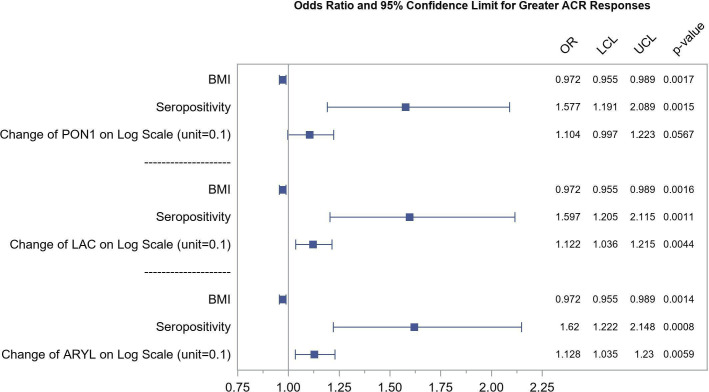
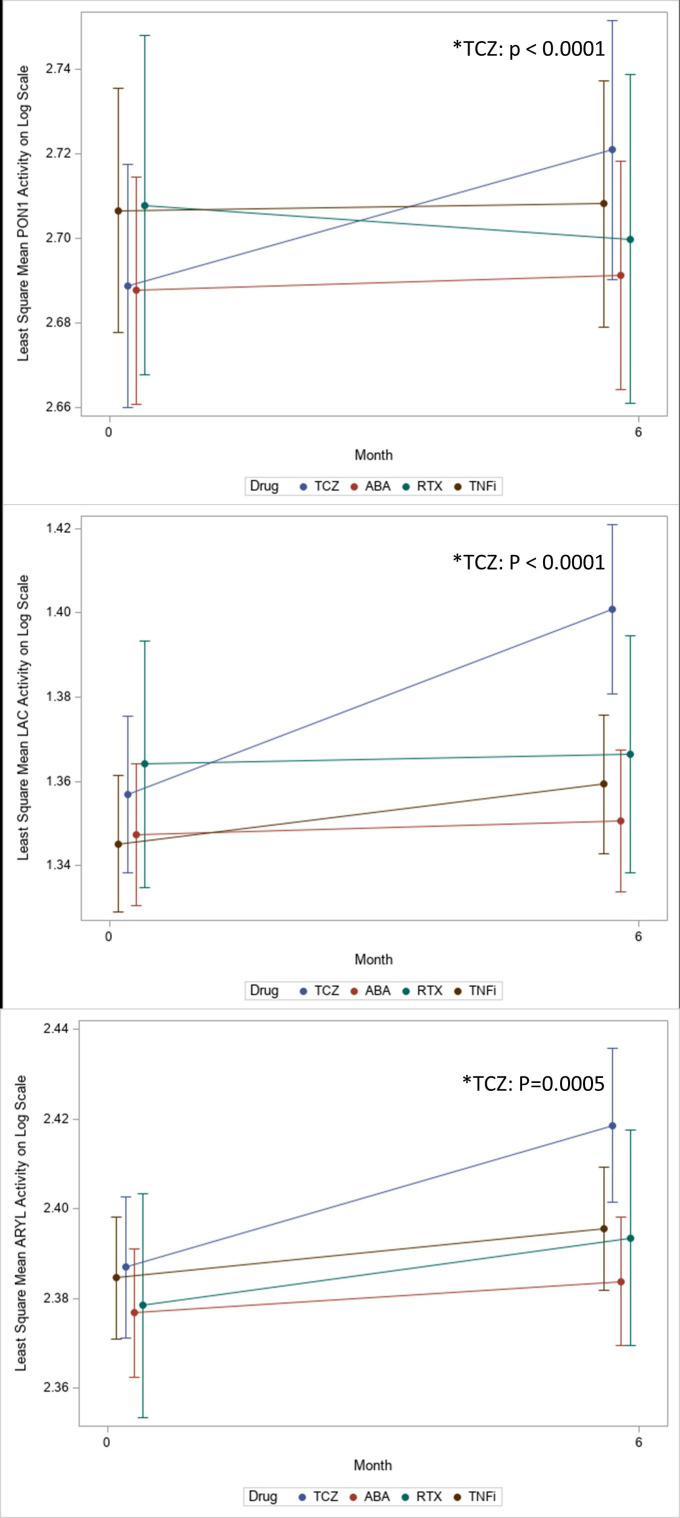
PON1 activity generally increased in the entire cohort after 6 months of new biologic therapy, showing the greatest, most consistent increases in the TCZ group. Increases in all three PON1 domains associated with significant decreases in disease activity in DAS28-CRP/CDAI (p<0.05), and increases in LAC/ARYL were significantly associated with the American College of Rheumatology 20/50/70 responses (OR (95% CI) of 1.12 (1.04, 1.22) and 1.13 (1.04, 1.23), p<0.01, respectively), after controlling for other RA disease characteristics. Some oxylipins, including 12-hydroxyeicosatetraenoic acid correlated with RA disease activity measures.
Improvement in disease activity across four classes of biologics is associated with enhanced PON1 activity, which has significant implications for cardiovascular safety.
对氧磷酶 1(PON1)是一种高密度脂蛋白(HDL)相关的酶,已被认为是类风湿关节炎(RA)患者心血管风险的生物标志物。我们旨在研究不同的生物疗法如何影响 PON1 和氧化脂质的水平。
在比较疗效登记研究治疗关节炎和炎症条件的队列研究中,我们对 1213 名患有 RA 的成年患者进行了研究,这些患者具有中度至高度疾病活动度(临床疾病活动指数(CDAI)>10),他们开始接受新的生物疗法(托珠单抗(TCZ),n=296;阿巴西普,n=374;肿瘤坏死因子抑制剂,n=427;利妥昔单抗,n=116)。前瞻性地对血清标本进行分析,通过芳基酯酶(ARYL)、内酯酶(LAC)和 PON 测定法在基线和生物治疗 6 个月后测定 PON1 活性。在每个治疗组中,根据最低和最高 6 个月疾病活动评分 28(DAS28)-C 反应蛋白(CRP)反应的患者亚组,通过液相色谱-质谱/质谱法评估了靶向氧化脂质组。
在接受新的生物治疗后 6 个月,整个队列的 PON1 活性通常会增加,TCZ 组的增加最为显著和一致。在 DAS28-CRP/CDAI 中,所有三个 PON1 域的活性增加与疾病活动的显著降低相关(p<0.05),并且 LAC/ARYL 的增加与美国风湿病学会 20/50/70 反应显著相关(OR(95%CI)分别为 1.12(1.04,1.22)和 1.13(1.04,1.23),p<0.01),在控制其他 RA 疾病特征后。一些氧化脂质,包括 12-羟基二十碳四烯酸,与 RA 疾病活动度测量相关。
四类生物制剂改善疾病活动度与增强的 PON1 活性相关,这对心血管安全性具有重要意义。