Tveter Mats, Tveitstøl Thomas, Hatlestad-Hall Christoffer, Pérez T Ana S, Taubøll Erik, Yazidi Anis, Hammer Hugo L, Haraldsen Ira R J Hebold
Department of Neurology, Oslo University Hospital, Oslo, Norway.
Institute of Clinical Medicine, Faculty of Medicine, University of Oslo, Oslo, Norway.
Brain Inform. 2024 Oct 26;11(1):27. doi: 10.1186/s40708-024-00239-6.
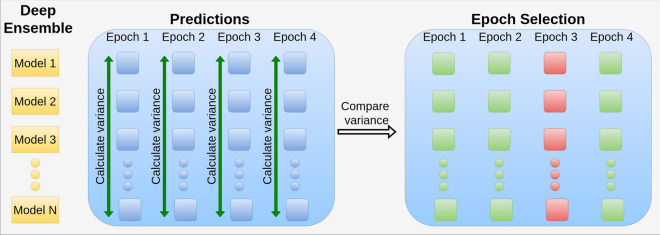
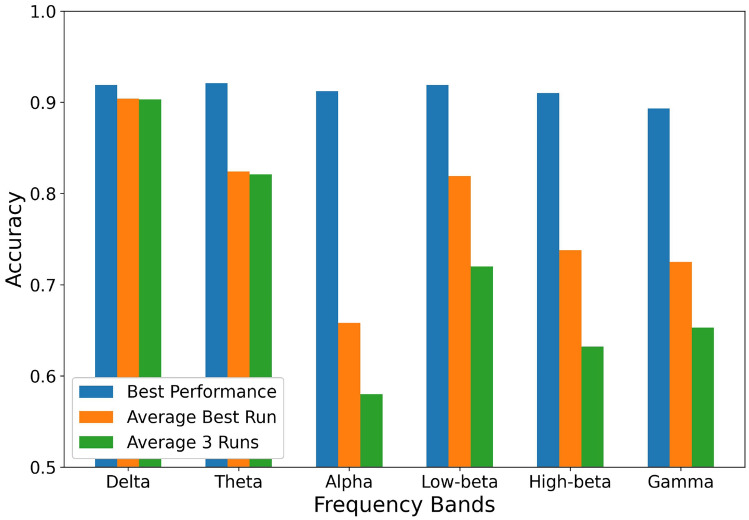
Deep Learning (DL) has the potential to enhance patient outcomes in healthcare by implementing proficient systems for disease detection and diagnosis. However, the complexity and lack of interpretability impede their widespread adoption in critical high-stakes predictions in healthcare. Incorporating uncertainty estimations in DL systems can increase trustworthiness, providing valuable insights into the model's confidence and improving the explanation of predictions. Additionally, introducing explainability measures, recognized and embraced by healthcare experts, can help address this challenge. In this study, we investigate DL models' ability to predict sex directly from electroencephalography (EEG) data. While sex prediction have limited direct clinical application, its binary nature makes it a valuable benchmark for optimizing deep learning techniques in EEG data analysis. Furthermore, we explore the use of DL ensembles to improve performance over single models and as an approach to increase interpretability and performance through uncertainty estimation. Lastly, we use a data-driven approach to evaluate the relationship between frequency bands and sex prediction, offering insights into their relative importance. InceptionNetwork, a single DL model, achieved 90.7% accuracy and an AUC of 0.947, and the best-performing ensemble, combining variations of InceptionNetwork and EEGNet, achieved 91.1% accuracy in predicting sex from EEG data using five-fold cross-validation. Uncertainty estimation through deep ensembles led to increased prediction performance, and the models were able to classify sex in all frequency bands, indicating sex-specific features across all bands.
深度学习(DL)有潜力通过实施用于疾病检测和诊断的高效系统来改善医疗保健中的患者治疗效果。然而,其复杂性和缺乏可解释性阻碍了它们在医疗保健关键的高风险预测中的广泛应用。在DL系统中纳入不确定性估计可以提高可信度,为模型的置信度提供有价值的见解,并改善预测的解释。此外,引入医疗保健专家认可和接受的可解释性措施可以帮助应对这一挑战。在本研究中,我们调查了DL模型直接从脑电图(EEG)数据预测性别的能力。虽然性别预测的直接临床应用有限,但其二元性质使其成为优化EEG数据分析中深度学习技术的有价值基准。此外,我们探索使用DL集成来提高性能,超过单个模型,并作为一种通过不确定性估计来提高可解释性和性能的方法。最后,我们使用数据驱动的方法来评估频段与性别预测之间的关系,深入了解它们的相对重要性。单个DL模型InceptionNetwork的准确率达到90.7%,AUC为0.947,表现最佳的集成模型,结合了InceptionNetwork和EEGNet的变体,在使用五折交叉验证从EEG数据预测性别时,准确率达到91.1%。通过深度集成进行的不确定性估计导致预测性能提高,并且模型能够在所有频段对性别进行分类,表明所有频段都存在性别特异性特征。