Department of Psychosomatic Medicine and Psychotherapy, University Medical Center Hamburg-Eppendorf, Martinistraße 52, Building W 37, Room 6010 a, 20246, Hamburg, Germany.
Department of General Internal and Psychosomatic Medicine, University Medical Center Heidelberg, Heidelberg, Germany.
Sci Rep. 2024 Oct 26;14(1):25517. doi: 10.1038/s41598-024-76554-z.
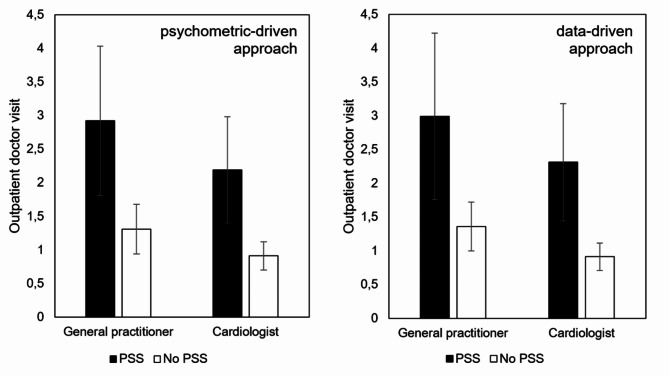
Persistent somatic symptoms (PSS) are a diagnostic core criterion of the somatic symptom disorder. This longitudinal study aims to determine the frequency of PSS in patients with cardiac disease, identify potential predictive factors, and investigate its impact on healthcare utilization. Somatic symptoms were assessed with the Somatic Symptom Scale-8 four times over the course of three months in consecutively approached cardiac outpatients. Patients were grouped having PSS vs. not having PSS following a psychometric-driven approach based on the SSS-8 cut-off score and a data-driven approach applying cluster analysis. T-tests were performed to compare the characteristics between patients having vs. not having PSS. To identify predictors of group affiliation, we conducted multivariable logistic regressions. Additionally, analyses of covariance were used to further examine associations between healthcare utilization and group affiliation. The study included 95 patients (30.5% female) with a mean age of 60.5 years (SD = 8.7). All patients had at least one of the following cardiac diseases recorded in their medical history: coronary heart disease (n = 51), myocardial infarction (n = 21), valve disease (n = 22), cardiomyopathy (n = 15), cardiac dysrhythmia (n = 43), and heart failure (n = 12). 30 (32%) were grouped having PSS according to the psychometric-driven approach and 27 (28%) according to the data-driven approach. For both approaches, patients with PSS were more likely to be female, unemployed, reporting angina pectoris, having higher depression, and higher anxiety severity (for all: p ≤ 0.05). Predictors of PSS group affiliation were female gender, higher age, depression severity, and angina pectoris (for all: p ≤ 0.015). Patients with PSS more frequently visited general practitioners and cardiologists compared to patients without PSS (p ≤ 0.013). Enhancing our knowledge of PSS in patients with cardiac disease could help to improve identification of patients' specific needs and the factors to consider in diagnosis and individualized treatment.
持续性躯体症状(PSS)是躯体症状障碍的一个诊断核心标准。这项纵向研究旨在确定心脏病患者中 PSS 的频率,确定潜在的预测因素,并研究其对医疗保健利用的影响。使用躯体症状量表-8 在三个月的时间内对连续就诊的心脏门诊患者进行了四次评估。根据 SSS-8 的截止分数进行基于心理计量学的方法和应用聚类分析的基于数据的方法将患者分为有 PSS 和无 PSS 两组。使用 t 检验比较有 PSS 和无 PSS 的患者之间的特征。为了确定分组归属的预测因素,我们进行了多变量逻辑回归分析。此外,还使用协方差分析进一步研究了医疗保健利用与分组归属之间的关联。该研究纳入了 95 名患者(30.5%为女性),平均年龄为 60.5 岁(SD=8.7)。所有患者的病史中都记录了至少一种以下心脏病:冠心病(n=51)、心肌梗死(n=21)、瓣膜病(n=22)、心肌病(n=15)、心律失常(n=43)和心力衰竭(n=12)。根据心理计量学驱动的方法,有 30 名(32%)患者被分为有 PSS 组,根据数据驱动的方法,有 27 名(28%)患者被分为有 PSS 组。对于这两种方法,有 PSS 的患者更有可能是女性、失业、报告心绞痛、抑郁程度更高、焦虑程度更高(所有:p≤0.05)。PSS 分组归属的预测因素是女性、更高的年龄、抑郁严重程度和心绞痛(所有:p≤0.015)。与无 PSS 的患者相比,有 PSS 的患者更频繁地就诊于全科医生和心脏病专家(p≤0.013)。提高我们对心脏病患者中 PSS 的认识有助于更好地确定患者的具体需求以及在诊断和个体化治疗中需要考虑的因素。