Krause Hans-Martin, Mäder Paul, Fliessbach Andreas, Jarosch Klaus A, Oberson Astrid, Mayer Jochen
Department of Soil Sciences, Research Institute of Organic Agriculture FiBL, Ackerstrasse 113, Frick, 5070, Switzerland.
Department Agroecology and Environment, Agroscope, Reckenholzstrasse 191, Zurich, 8046, Switzerland.
Sci Rep. 2024 Oct 26;14(1):25537. doi: 10.1038/s41598-024-76776-1.
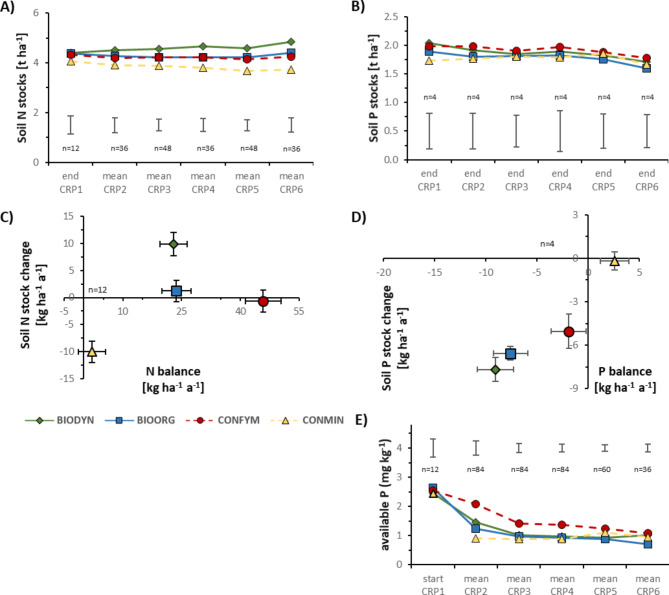
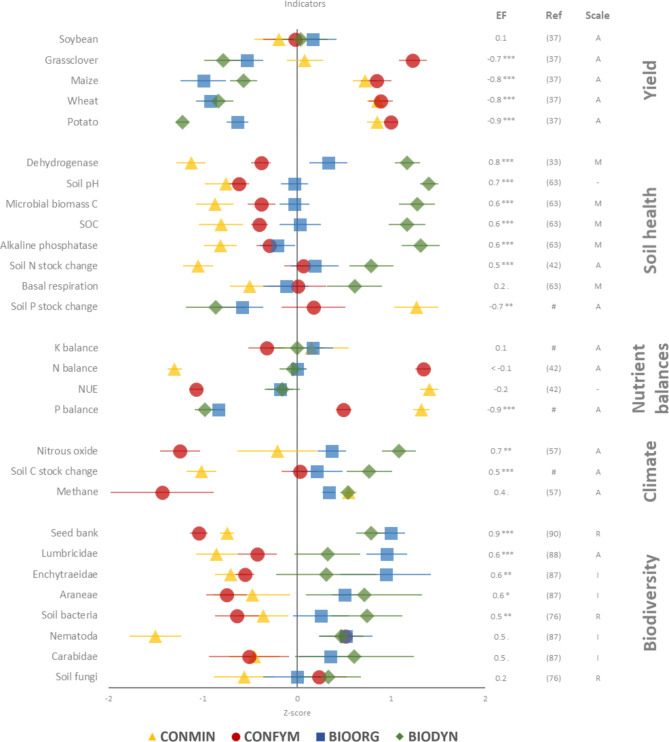
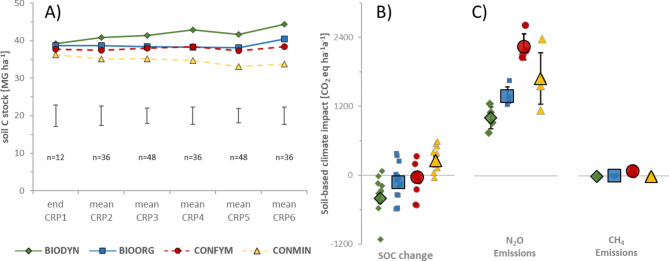
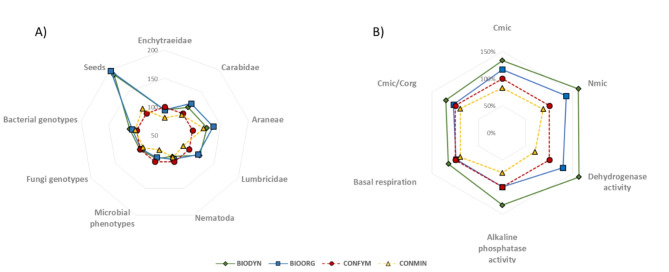
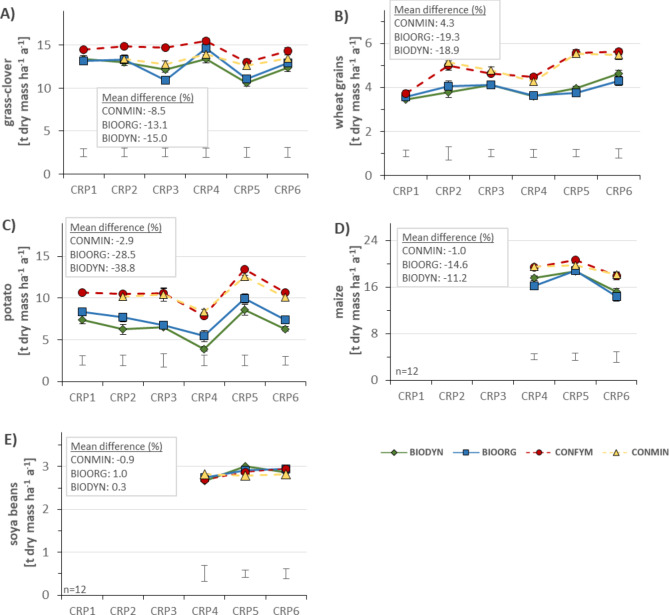
Agriculture provides food to a still growing population but is a major driver of the acceleration of global nutrient flows, climate change, and biodiversity loss. Policies such as the European Farm2Fork strategy aim to mitigate the environmental impact of land-use by fostering organic farming. To assess long-term environmental impact of organic food production we synthesized more than four decades of research on agronomic and environmental performance of the oldest system comparison experiment on organic and conventional cropping systems (DOK experiment). Two organic systems (bioorganic and biodynamic) are compared with two conventional (manure-based integrated and mineral-based) systems all with the same arable crop rotation including grass-clover, and manure from livestock integrated in all except the mineral-based system. Organic systems used 92% less pesticides and 76% less mineral nitrogen than conventional systems. Nitrogen use efficiency, that also considers biological nitrogen fixation, was above 85% for all systems. Organic fertilization with farmyard manure maintained or increased soil carbon and nitrogen stocks in the long term, especially in the biodynamic system with manure compost. Conventional mineral-based cropping reduced soil organic carbon and nitrogen stocks. Higher soil organic carbon stocks in organic cropping did not translate to increased NO emissions, which were the main driver for 56% lower soil-based, area-scaled climate impact compared to the integrated conventional system with manure. Organic cropping systems, especially compost-based biodynamic, showed enhanced soil health, richness of micro- and macrofauna and weed species. Highest yields were achieved in integrated conventional system, with highest total nitrogen inputs and enhanced soil health compared to pure mineral fertilization. Yet, these benefits come at the cost of lower nitrogen use efficiency and higher NO emissions. Despite a rigorous reduction of inputs yields of the organic systems achieved 85% of the conventional systems. We demonstrate at field level that organic cropping systems with reduced external nutrient inputs have less climate impact and a larger in-situ biodiversity, while providing a fertile ground for the future development of sustainable agricultural production systems.
农业为持续增长的人口提供食物,但也是全球养分流动加速、气候变化和生物多样性丧失的主要驱动因素。诸如欧洲“农场到餐桌”战略等政策旨在通过促进有机农业来减轻土地利用对环境的影响。为评估有机食品生产的长期环境影响,我们综合了四十多年来关于有机和传统种植系统最古老的系统对比试验(DOK试验)的农艺和环境绩效研究。将两种有机系统(生物有机和生物动力)与两种传统系统(粪肥基综合和矿物基)进行比较,所有系统都采用相同的包括草三叶草的作物轮作方式,除矿物基系统外,其他系统都整合了家畜粪便。有机系统使用的农药比传统系统少92%,矿物氮少76%。考虑到生物固氮的氮利用效率在所有系统中都高于85%。长期来看,使用农家肥进行有机施肥能维持或增加土壤碳和氮储量,特别是在采用粪肥堆肥的生物动力系统中。传统的矿物基种植减少了土壤有机碳和氮储量。有机种植中较高的土壤有机碳储量并未转化为一氧化二氮排放量增加,一氧化二氮排放是导致与粪肥基传统综合系统相比土壤面积加权气候影响降低56%的主要驱动因素。有机种植系统,尤其是基于堆肥的生物动力系统,显示出土壤健康状况改善,微型和大型动物以及杂草物种丰富度增加。综合传统系统产量最高,与纯矿物施肥相比,总氮投入最高且土壤健康状况得到改善。然而,这些好处是以较低的氮利用效率和较高的一氧化二氮排放为代价的。尽管投入大幅减少,但有机系统的产量达到了传统系统的85%。我们在田间层面证明,外部养分投入减少的有机种植系统对气候的影响较小,原地生物多样性更大,同时为可持续农业生产系统的未来发展提供了肥沃的土壤。