University Hospital Bonn, Venusberg-Campus 1, 53127, Bonn, Germany.
Department of Internal Medicine and Cardiology, City hospital Solingen, Gotenstraße 1, 42653, Solingen, Germany.
BMC Cardiovasc Disord. 2024 Oct 26;24(1):590. doi: 10.1186/s12872-024-04275-2.
BACKGROUND & OBJECTIVES: Obesity is a common comorbidity in heart failure, yet effective pharmacological options for weight loss in these patients are limited. Semaglutide, a glucagon-like peptide 1 receptor agonist, has shown promise for weight reduction in obese adults. This study aims to evaluate semaglutide's impact on weight loss, functional status, and clinical outcomes in obese patients with heart failure.
A retrospective analysis was conducted on all consecutive obese (BMI > 30 kg/m²) patients with heart failure at the University Hospital Bonn outpatient clinic from July 2019 to July 2022. Propensity score matching paired patients receiving semaglutide as an add-on therapy (SEMA) with those on medical therapy alone (Control).
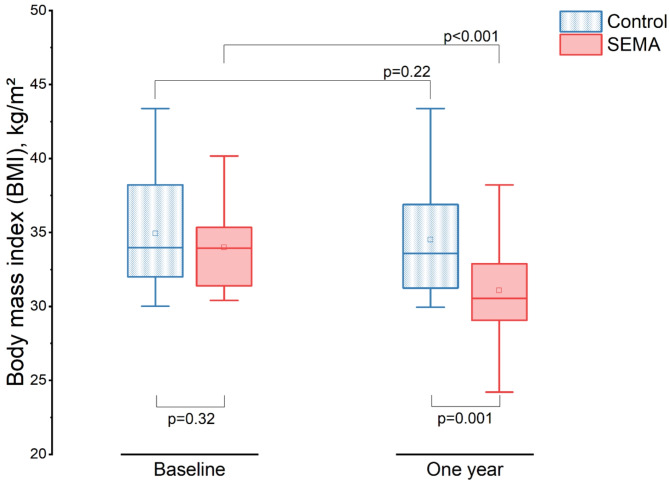
Among 1,942 patients with heart failure screened, 26 matched pairs were identified. At one year, the SEMA group exhibited significant weight loss, with a mean BMI reduction of -2.91 kg/m² (95% CI: -4.27 to -1.55; p < 0.001), while the control group showed a non-significant mean change of -0.41 kg/m² (95% CI: -1.08 to 0.26; p = 0.22). The difference in BMI between the two groups was statistically significant (mean difference: 3.42 kg/m², 95% CI: 1.43 to 5.42; p = 0.001). Improvements by at least one NYHA class were observed in 65% of the SEMA group (p < 0.001) compared to 15% of the control group (p = 0.18). The SEMA group also showed a significant increase in 6-minute walk distance (6MWD), with a mean difference of 75 m between the groups at one year (95% CI: 0.53 to 150.02; p = 0.049). NT-proBNP levels significantly decreased in the SEMA group (p < 0.001) compared to the control group (p = 0.78), with a statistically significant difference in NT-proBNP between the groups (p = 0.048). Both improvements in 6MWD and reductions in NT-proBNP were significantly correlated with BMI percentage reductions.
Semaglutide was associated with significant weight reduction in obese patients with heart failure, accompanied by improved NYHA classification and 6-minute walk distance. Larger, multi-center trials and prospective, randomized controlled trials are warranted. These studies should focus on assessing long-term outcomes, optimizing dosage, and exploring the potential cardiovascular benefits beyond weight reduction.
肥胖是心力衰竭的常见合并症,但有效的减肥药物选择在这些患者中受到限制。胰高血糖素样肽-1 受体激动剂司美格鲁肽在肥胖成年人中显示出了减肥的潜力。本研究旨在评估司美格鲁肽对肥胖心力衰竭患者体重减轻、功能状态和临床结局的影响。
对 2019 年 7 月至 2022 年 7 月期间波恩大学医院门诊连续肥胖(BMI>30kg/m²)心力衰竭患者进行了回顾性分析。采用倾向评分匹配将接受司美格鲁肽作为附加治疗(SEMA)的患者与仅接受药物治疗的患者(对照组)配对。
在筛选出的 1942 例心力衰竭患者中,确定了 26 对匹配患者。在一年时,SEMA 组体重显著减轻,平均 BMI 降低了-2.91kg/m²(95%CI:-4.27 至-1.55;p<0.001),而对照组平均变化为-0.41kg/m²(95%CI:-1.08 至 0.26;p=0.22)。两组之间的 BMI 差异具有统计学意义(平均差异:3.42kg/m²,95%CI:1.43 至 5.42;p=0.001)。SEMA 组至少改善一个纽约心功能分级的比例为 65%(p<0.001),而对照组为 15%(p=0.18)。SEMA 组 6 分钟步行距离(6MWD)也有显著增加,两组在一年时的平均差异为 75m(95%CI:0.53 至 150.02;p=0.049)。与对照组相比(p=0.78),SEMA 组的 NT-proBNP 水平显著降低(p<0.001),两组之间的 NT-proBNP 差异具有统计学意义(p=0.048)。6MWD 的改善和 NT-proBNP 的降低均与 BMI 百分比降低显著相关。
司美格鲁肽可使肥胖心力衰竭患者体重显著减轻,同时改善 NYHA 分级和 6 分钟步行距离。需要更大规模、多中心的试验和前瞻性、随机对照试验来验证。这些研究应侧重于评估长期结局、优化剂量,并探索除体重减轻以外的潜在心血管获益。