Reddy Sudheer, Kumar Suresh B, Venkatesh Tirumala, Kumar Punukollu Uday, Sharma Suyash B, Tripathi Richa
Oncology, Omega Cancer Hospital, Kurnool, IND.
Medical Oncology, Kauvery Hospital, Chennai, IND.
Cureus. 2024 Sep 26;16(9):e70290. doi: 10.7759/cureus.70290. eCollection 2024 Sep.
Chemotherapy-induced nausea and vomiting (CINV) significantly impacts patient's quality of life and treatment adherence. This study investigated the efficacy of Generic Netupitant and Palonosetron tablets (Nykron) with dexamethasone single dose for CINV prophylaxis in patients receiving highly emetogenic chemotherapy (HEC) and moderately emetogenic chemotherapy (MEC). Additionally, this approach aligns with the principles of the SHIELD study (Sparing High Efficacy Intervention for Low Dose Dexamethasone), which focuses on maximizing antiemetic effectiveness while minimizing dexamethasone use.
This multicenter retrospective study evaluates data from patients who received HEC/MEC and were administered a fixed-dose combination of Generic NEPA (Netupitant 300 mg and Palonosetron 0.5 mg tablets, Nykron combi-pack) along with a single dose of dexamethasone (12 mg/8 mg) before chemotherapy. The data were collected from September 2022 till September 2023. Outcomes measured included complete response (no vomiting and no need for rescue medications), complete protection (no significant nausea (<2.5 cm on VAS), no vomiting, and no use of rescue medication), and complete control (no emetic episodes, no rescue therapy, and no nausea [0 cm on VAS]) during the acute phase (0-24 hours) and delayed phase (24-120 hours) post-chemotherapy.
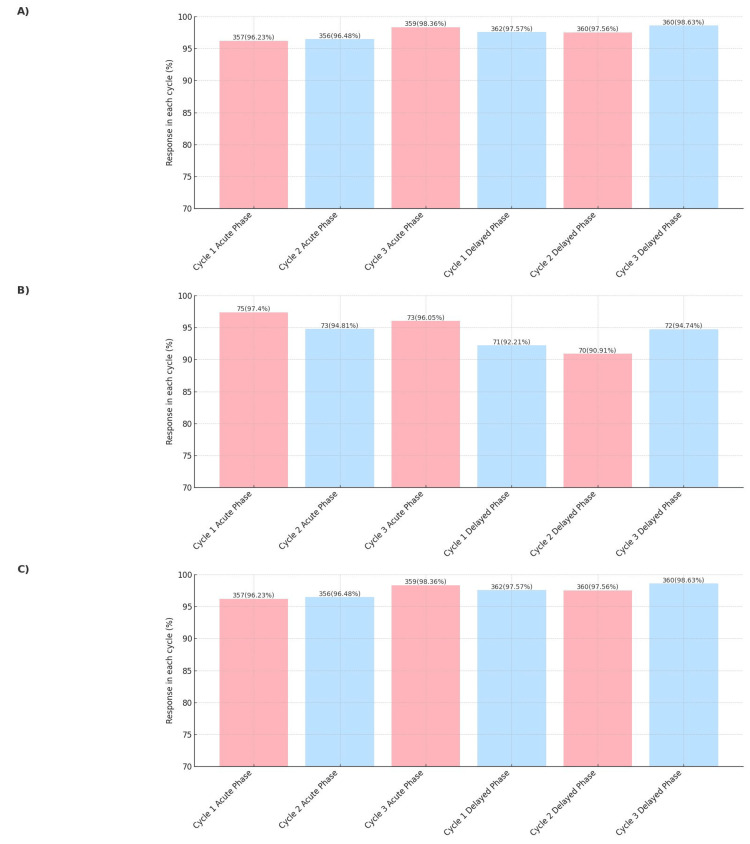
The data of 372 patients was evaluated in which breast cancer was the most common cancer with 223 (59.95%) patients for which doxorubicin and cyclophosphamide (192, 51.61%) was the most administered chemotherapy combination. The second most common cancer was gastrointestinal (GI) cancer with stomach cancer in 47 (12.6%), colorectal cancer in 4 (1%), and pancreatic cancer in 2 (0.54%). A total of 360 (96.8%) patients received an HEC regimen across the cycle, while only 5 (1.3%) received an MEC regimen. The regimen demonstrated exceptional efficacy with a 96.9% overall response rate across all cycles. Complete control rates for acute CINV were 92% and 90% for delayed CINV across chemotherapy cycles. Complete response rates remained consistently high (94%-98%) across all cycles and overall phases. Only 3% of patients experienced anticipatory CINV.
This dexamethasone-sparing Generic NEPA regimen showed remarkable efficacy in CINV management for HEC/MEC regimen-receiving patients, maintaining high response rates in both acute and delayed across all cycles. These findings indicate a potential paradigm shift in CINV prophylaxis, necessitating further investigation through prospective, randomized controlled trials to validate long-term safety and efficacy.
化疗引起的恶心和呕吐(CINV)对患者的生活质量和治疗依从性有显著影响。本研究调查了通用奈妥匹坦帕洛诺司琼片(Nykron)联合地塞米松单剂量方案在接受高致吐性化疗(HEC)和中度致吐性化疗(MEC)的患者中预防CINV的疗效。此外,该方法符合SHIELD研究(低剂量地塞米松的高效能干预 sparing)的原则,该研究旨在在尽量减少地塞米松使用的同时最大化止吐效果。
这项多中心回顾性研究评估了接受HEC/MEC治疗并在化疗前给予固定剂量通用奈妥匹坦帕洛诺司琼片(Netupitant 300 mg和Palonosetron 0.5 mg片剂,Nykron组合包装)联合单剂量地塞米松(12 mg/8 mg)的患者的数据。数据收集时间为2022年9月至2023年9月。测量的结果包括化疗后急性期(0 - 24小时)和延迟期(24 - 120小时)的完全缓解(无呕吐且无需救援药物)、完全保护(无明显恶心[视觉模拟量表(VAS)上<2.5 cm]、无呕吐且未使用救援药物)以及完全控制(无呕吐发作、无救援治疗且无恶心[VAS上0 cm])。
对372例患者的数据进行了评估,其中乳腺癌是最常见的癌症,有223例(59.95%)患者,其中多柔比星和环磷酰胺(192例,51.61%)是最常用的化疗组合。第二常见的癌症是胃肠道(GI)癌,其中胃癌47例(12.6%),结直肠癌4例(1%),胰腺癌2例(0.54%)。整个周期共有360例(96.8%)患者接受HEC方案,而只有5例(1.3%)接受MEC方案。该方案显示出卓越的疗效,所有周期的总体缓解率为96.9%。化疗各周期中急性CINV的完全控制率为92%,延迟性CINV为90%。所有周期和各阶段的完全缓解率一直保持在较高水平(94% - 98%)。只有3%的患者经历预期性CINV。
这种减少地塞米松用量的通用奈妥匹坦帕洛诺司琼片方案在接受HEC/MEC方案的患者的CINV管理中显示出显著疗效,在所有周期的急性和延迟期均保持高缓解率。这些发现表明CINV预防可能发生范式转变,有必要通过前瞻性随机对照试验进一步研究以验证长期安全性和疗效。