
衰弱与血清神经丝轻链水平的关联:估算肾小球滤过率的中介作用
Association of frailty and serum neurofilament light chain levels: the mediating role of estimated glomerular filtration rate.
作者信息
Yang Wei, Huang Shan, Xiao Huanshun, Tao Pei, Cai Shuangming
机构信息
Department of Internal Medicine, Guangdong Women and Children Hospital, Guangzhou, China.
Department of MICU, Guangdong Women and Children Hospital, Guangzhou, China.
出版信息
Front Aging Neurosci. 2024 Oct 11;16:1475505. doi: 10.3389/fnagi.2024.1475505. eCollection 2024.
BACKGROUND
Both frailty and elevated serum neurofilament light chain (sNfL) levels are linked to cognitive impairment. However, evidence of their relationship is lacking, and whether it was mediated by renal function was unknown. This study aimed to investigate the association between frailty and sNfL levels in a representative U.S. population, and to explore the potential mediating role of estimated glomerular filtration rate (eGFR) in this relationship.
METHODS
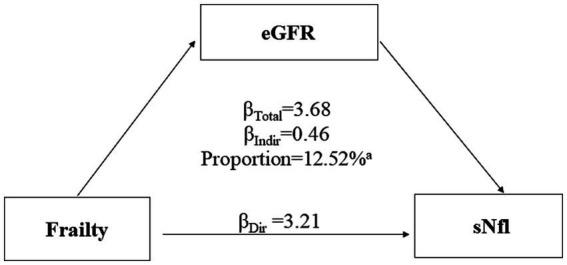
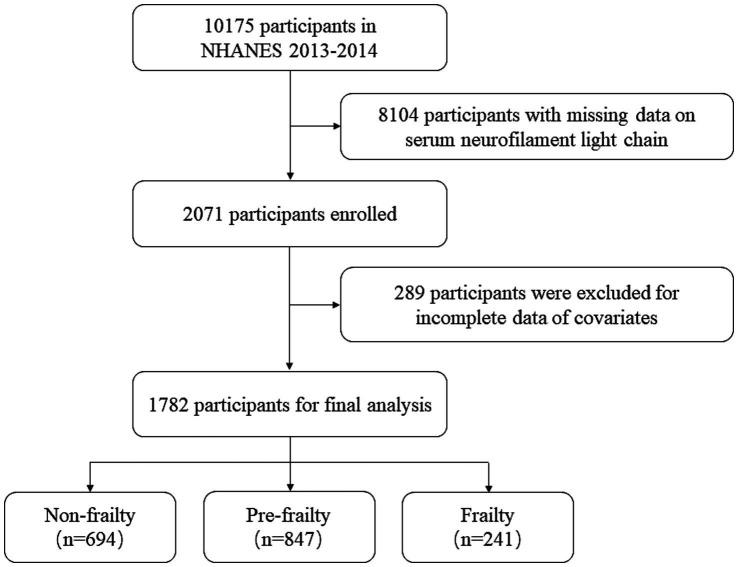
Data from 1,782 participants aged 20-75 years in the 2013-2014 National Health and Nutrition Examination Survey (NHANES) were analyzed. Frailty was assessed using a 49-item frailty index, and participants were categorized as non-frail, pre-frail, or frail. sNfL levels were measured using acoustic emission technology. Multivariable linear regression models and restricted cubic spline analyses were employed to examine the associations between frailty, eGFR, and sNfL levels. Mediation analysis was conducted to evaluate the role of eGFR in the frailty-sNfL relationship.
RESULTS
The prevalence of pre-frailty and frailty was 45.39 and 11.60%, respectively. A significant positive association was observed between frailty score and sNfL levels (adjusted : 39.97, SE: 11.07, = 0.003), with a linear relationship confirmed by restricted cubic spline analysis. Frail individuals had significantly higher sNfL levels compared to non-frail participants (adjusted : 11.86, SE: 5.42, = 0.04). eGFR was negatively associated with sNfL levels (adjusted β: -0.23, SE: 0.05, < 0.001). Mediation analysis revealed that eGFR accounted for 12.52% of the total effect of frailty on sNfL levels ( < 0.0001).
CONCLUSION
This study demonstrates a significant association between frailty and elevated sNfL levels in a representative U.S. population, with eGFR partially mediating this relationship. These findings suggest that sNfL may serve as a potential biomarker for frailty-related neuronal damage and highlight the importance of kidney function in this association. Further research is warranted to explore the clinical implications of these findings in frailty assessment and management strategies.
背景
衰弱和血清神经丝轻链(sNfL)水平升高均与认知障碍有关。然而,它们之间关系的证据尚缺,且其是否由肾功能介导尚不清楚。本研究旨在调查美国代表性人群中衰弱与sNfL水平之间的关联,并探讨估计肾小球滤过率(eGFR)在这种关系中的潜在中介作用。
方法
分析了2013 - 2014年美国国家健康与营养检查调查(NHANES)中1782名年龄在20 - 75岁参与者的数据。使用49项衰弱指数评估衰弱情况,参与者被分为非衰弱、衰弱前期或衰弱。使用声发射技术测量sNfL水平。采用多变量线性回归模型和受限立方样条分析来检验衰弱、eGFR和sNfL水平之间的关联。进行中介分析以评估eGFR在衰弱 - sNfL关系中的作用。
结果
衰弱前期和衰弱的患病率分别为45.39%和11.60%。观察到衰弱评分与sNfL水平之间存在显著正相关(调整后β:39.97,标准误:11.07,P = 0.003),受限立方样条分析证实了线性关系。与非衰弱参与者相比,衰弱个体的sNfL水平显著更高(调整后β:11.86,标准误:5.42,P = 0.04)。eGFR与sNfL水平呈负相关(调整后β: - 0.23,标准误:0.05,P < 0.001)。中介分析显示,eGFR占衰弱对sNfL水平总效应的12.52%(P < 0.0001)。
结论
本研究表明,在美国代表性人群中,衰弱与升高的sNfL水平之间存在显著关联,eGFR部分介导了这种关系。这些发现表明,sNfL可能作为衰弱相关神经元损伤的潜在生物标志物,并突出了肾功能在这种关联中的重要性。有必要进一步研究以探索这些发现在衰弱评估和管理策略中的临床意义。

 Zotero 插件