Qian Jin, Lubkowska Lucyna, Zhang Shuming, Tan Chuang, Hong Yifeng, Fulbright Robert M, Inman James T, Kay Taryn M, Jeong Joshua, Gotte Deanna, Berger James M, Kashlev Mikhail, Wang Michelle D
Department of Physics & LASSP, Cornell University, Ithaca, NY 14853, USA.
Howard Hughes Medical Institute, Cornell University, Ithaca, NY 14853, USA.
bioRxiv. 2024 Oct 18:2024.10.15.618270. doi: 10.1101/2024.10.15.618270.
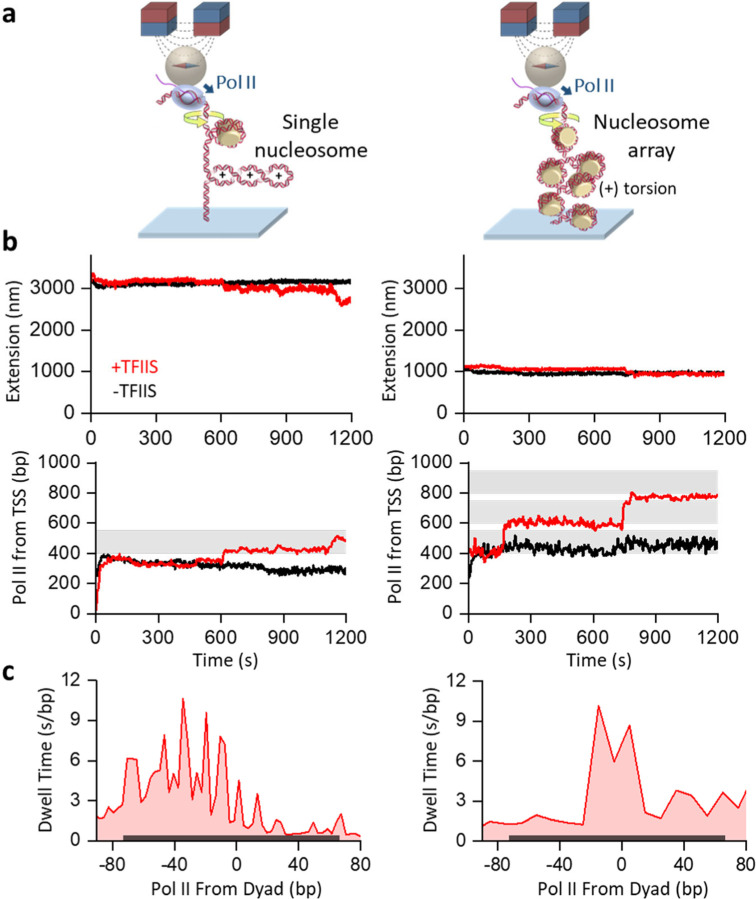
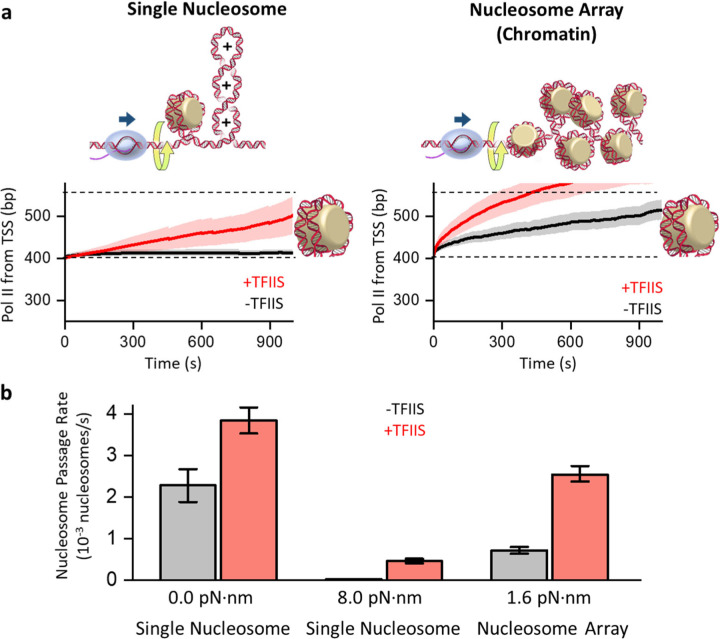
Transcription through chromatin under torsion represents a fundamental problem in biology. Pol II must overcome nucleosome obstacles and, because of the DNA helical structure, must also rotate relative to the DNA, generating torsional stress. However, there is a limited understanding of how Pol II transcribes through nucleosomes while supercoiling DNA. In this work, we developed methods to visualize Pol II rotation of DNA during transcription and determine how torsion slows down the transcription rate. We found that Pol II stalls at ± 9 pN·nm torque, nearly sufficient to melt DNA. The stalling is due to extensive backtracking, and the presence of TFIIS increases the stall torque to + 13 pN·nm, making Pol II a powerful rotary motor. This increased torsional capacity greatly enhances Pol II's ability to transcribe through a nucleosome. Intriguingly, when Pol II encounters a nucleosome, nucleosome passage becomes more efficient on a chromatin substrate than on a single-nucleosome substrate, demonstrating that chromatin efficiently buffers torsional stress via its torsional mechanical properties. Furthermore, topoisomerase II relaxation of torsional stress significantly enhances transcription, allowing Pol II to elongate through multiple nucleosomes. Our results demonstrate that chromatin greatly reduces torsional stress on transcription, revealing a novel role of chromatin beyond the more conventional view of it being just a roadblock to transcription.
在扭转力作用下通过染色质进行转录是生物学中的一个基本问题。RNA聚合酶II(Pol II)必须克服核小体障碍,并且由于DNA的螺旋结构,它还必须相对于DNA旋转,从而产生扭转应力。然而,对于Pol II在使DNA超螺旋的同时如何通过核小体进行转录,人们的了解还很有限。在这项工作中,我们开发了一些方法来可视化转录过程中Pol II对DNA的旋转,并确定扭转力如何降低转录速率。我们发现,Pol II在±9皮牛·纳米的扭矩下停滞,这几乎足以使DNA解链。这种停滞是由于广泛的回溯造成的,而转录延伸因子S(TFIIS)的存在将停滞扭矩增加到+13皮牛·纳米,使Pol II成为一个强大的旋转马达。这种增加的扭转能力极大地增强了Pol II通过核小体进行转录的能力。有趣的是,当Pol II遇到一个核小体时,在染色质底物上核小体的通过比在单核小体底物上更有效,这表明染色质通过其扭转力学特性有效地缓冲了扭转应力。此外,拓扑异构酶II对扭转应力的松弛显著增强了转录,使Pol II能够延伸通过多个核小体。我们的结果表明,染色质大大降低了转录过程中的扭转应力,揭示了染色质除了更传统的作为转录障碍的观点之外的新作用。