College of Biological and Pharmaceutical Engineering, Jilin Agricultural Science and Technology University, 77 Hanlin Road, City of Jilin, 132101, Jilin, China.
School of Food Science and Engineering, School of Biological and Pharmaceutical Sciences, Shaanxi University of Science and Technology, Xi'an, 710021, Shaanxi, China.
Microb Cell Fact. 2024 Oct 28;23(1):293. doi: 10.1186/s12934-024-02566-z.
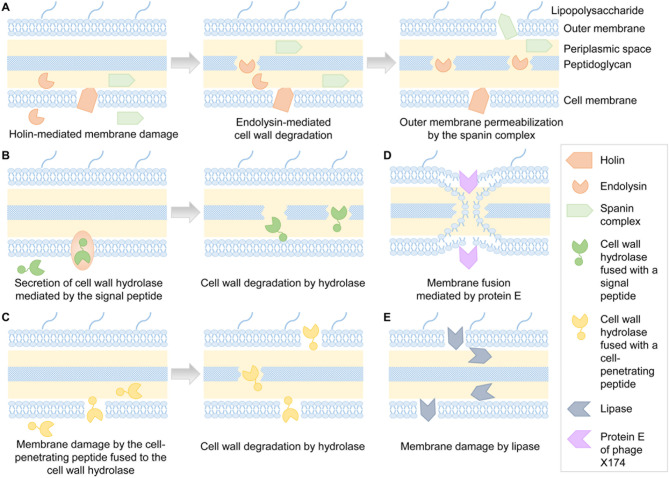
Programmed autolytic bacteria, also termed controlled self-disruptive or self-destructive bacteria, are bacterial systems that express certain lytic genes and undergo cell lysis at a predetermined time point to release the intracellular contents or to commit suicide. Such systems have wide applications in high-throughput screening of protein libraries, synthesis and recovery of bio-products, population control of heterogeneous cultures or synthetic co-cultures, drug delivery, and food fermentation. Recently, great achievements have been reported regarding on-demand control of cell autolysis for different purposes, highlighting the potential of autolytic strains in biomanufacturing and biomedicine. In this review article, we first introduce the various applications of such bacteria, followed by a summarization of the approaches used in the establishment of autolytic bacterial systems, including cell autolysis mediated by cell wall hydrolases with or without facilitating proteins and by membrane-disturbing proteins. Next, we describe in detail the methodologies adopted to control and initiate cell lysis, including induction by chemical inducers, stimulation by physical signals, auto-induction by metabolic status or nutrient limitation, and constitutive expression of the lytic genes. This article is ended with discussions on the remaining problems and possible future directions. This review provides comprehensive information on autolytic bacteria and insightful guidance to the development of highly efficient, robust, and smart autolytic bacterial platforms.
编程自溶细菌,也称为受控自裂解或自毁细菌,是表达某些裂解基因并在预定时间点发生细胞裂解以释放细胞内物质或自杀的细菌系统。此类系统在蛋白质文库的高通量筛选、生物产物的合成和回收、异质培养物或合成共培养物的种群控制、药物输送和食品发酵等方面具有广泛的应用。最近,已经报道了许多关于针对不同目的的按需控制细胞自溶的重大进展,突出了自溶菌株在生物制造和生物医学中的潜力。在这篇综述文章中,我们首先介绍了此类细菌的各种应用,然后总结了建立自溶细菌系统所采用的方法,包括细胞壁水解酶介导的细胞自溶,无论是否有促进蛋白,以及通过膜扰乱蛋白。接下来,我们详细描述了控制和启动细胞裂解的方法,包括化学诱导物诱导、物理信号刺激、代谢状态或营养限制的自动诱导以及裂解基因的组成型表达。本文最后讨论了剩余的问题和可能的未来方向。本文综述提供了关于自溶细菌的全面信息,并为开发高效、稳健和智能的自溶细菌平台提供了有见地的指导。