Department of Clinical Pharmacology, Medical University of Vienna, Vienna, Austria.
Division of Clinical Pharmacology and Toxicology, Geneva University Hospitals, Geneva, Switzerland.
Fluids Barriers CNS. 2024 Oct 28;21(1):87. doi: 10.1186/s12987-024-00588-8.
P-glycoprotein (P-gp) is an efflux transporter which is abundantly expressed at the blood-brain barrier (BBB) and which has been implicated in the pathophysiology of various brain diseases. The radiolabelled antiemetic drug [C]metoclopramide is a P-gp substrate for positron emission tomography (PET) imaging of P-gp function at the BBB. To assess whether [C]metoclopramide can detect increased P-gp function in the human brain, we employed drug-resistant temporal lobe epilepsy (TLE) as a model disease with a well characterised, regional P-gp up-regulation at the BBB.
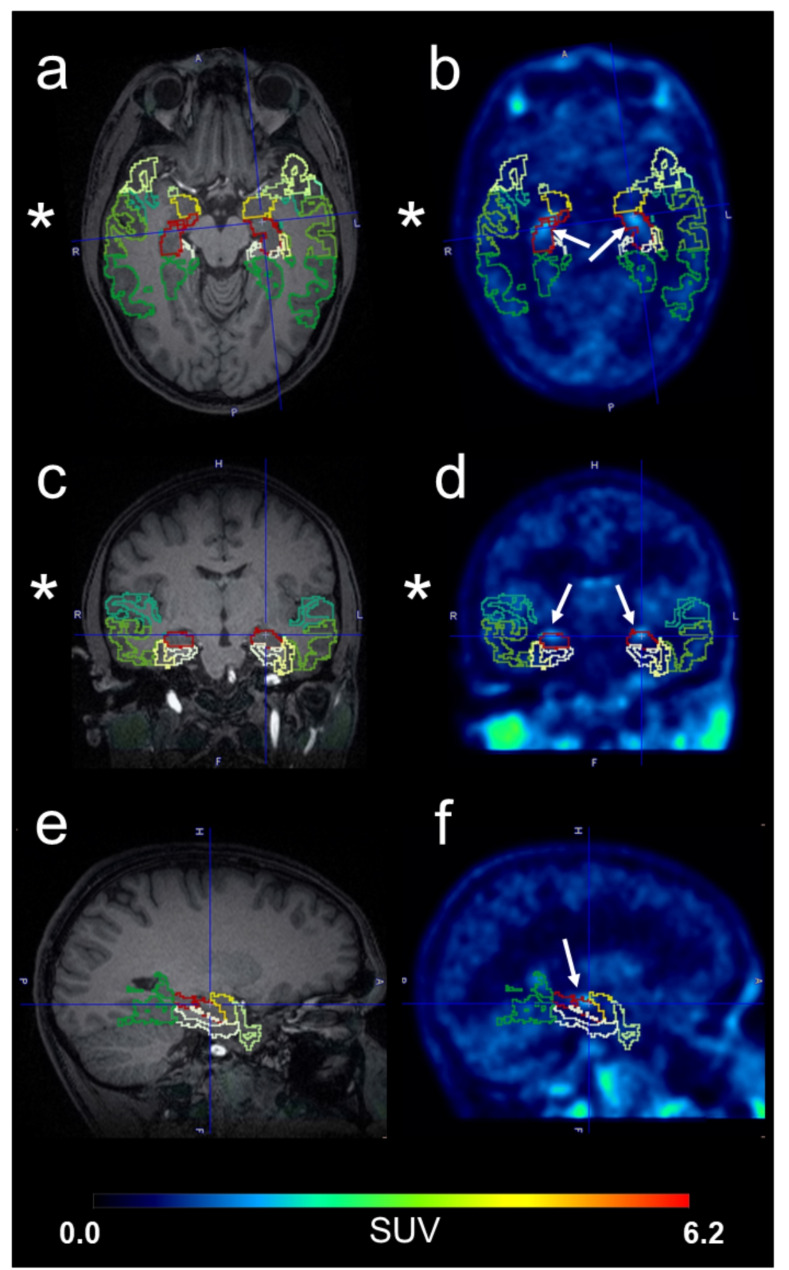
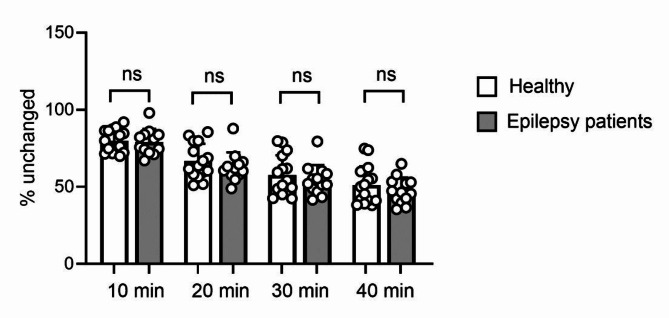
Eight patients with drug-resistant (DRE) TLE, 5 seizure-free patients with drug-sensitive (DSE) focal epilepsy, and 15 healthy subjects underwent brain PET imaging with [C]metoclopramide on a fully-integrated PET/MRI system. Concurrent with PET, arterial blood sampling was performed to generate a metabolite-corrected arterial plasma input function for kinetic modelling. The choroid plexus was outmasked on the PET images to remove signal contamination from the neighbouring hippocampus. Using a brain atlas, 10 temporal lobe sub-regions were defined and analysed with a 1-tissue-2-rate constant compartmental model to estimate the rate constants for radiotracer transfer from plasma to brain (K) and from brain to plasma (k), and the total volume of distribution (V = K/k).
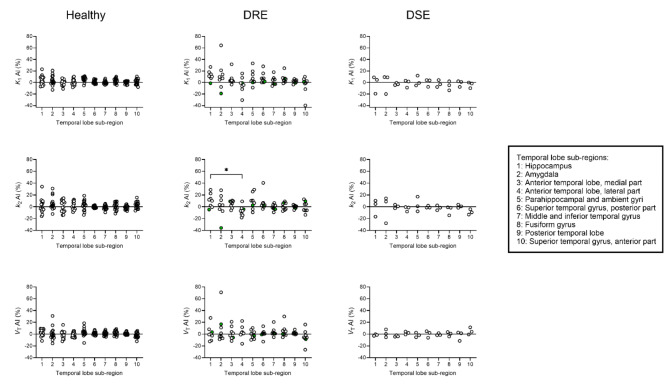
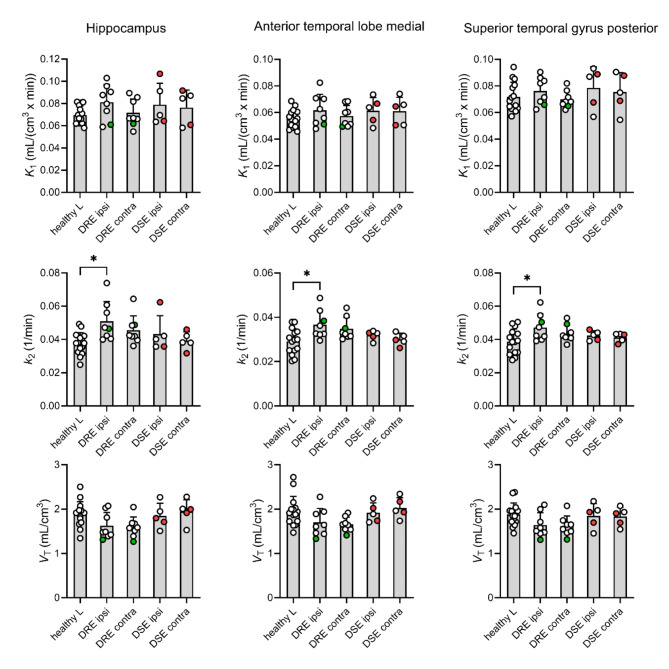
DRE patients but not DSE patients showed significantly higher k values and a trend towards lower V values in several temporal lobe sub-regions located ipsilateral to the epileptic focus as compared to healthy subjects (k: hippocampus: +34%, anterior temporal lobe, medial part: +28%, superior temporal gyrus, posterior part: +21%).
[C]Metoclopramide PET can detect a seizure-induced P-gp up-regulation in the epileptic brain. The efflux rate constant k seems to be the most sensitive parameter to measure increased P-gp function with [C]metoclopramide. Our study provides evidence that disease-induced alterations in P-gp expression at the BBB can lead to changes in the distribution of a central nervous system-active drug to the human brain, which could affect the efficacy and/or safety of drugs. [C]Metoclopramide PET may be used to assess or predict the contribution of increased P-gp function to drug resistance and disease pathophysiology in various brain diseases.
EudraCT 2019-003137-42. Registered 28 February 2020.
P-糖蛋白(P-gp)是一种外排转运蛋白,在血脑屏障(BBB)中大量表达,与各种脑部疾病的病理生理学有关。放射性标记的止吐药[C]metoclopramide 是一种用于正电子发射断层扫描(PET)成像 BBB 中 P-gp 功能的 P-gp 底物。为了评估[C]metoclopramide 是否可以检测到人脑 P-gp 功能的增加,我们采用耐药性颞叶癫痫(TLE)作为模型疾病,该疾病在 BBB 处具有特征性的区域性 P-gp 上调。
8 名耐药性(DRE)TLE 患者、5 名无癫痫发作的药物敏感性(DSE)局灶性癫痫患者和 15 名健康受试者在完全集成的 PET/MRI 系统上进行[C]metoclopramide 脑 PET 成像。与 PET 同时进行动脉采血,生成代谢校正的动脉血浆输入函数进行动力学建模。在 PET 图像上对脉络丛进行外掩蔽,以去除来自邻近海马体的信号干扰。使用脑图谱,定义了 10 个颞叶亚区,并使用 1 组织 2 速率常数室模型进行分析,以估计放射性示踪剂从血浆向脑转移的速率常数(K)和从脑向血浆转移的速率常数(k)以及总分布容积(V=K/k)。
与健康受试者相比,DRE 患者而不是 DSE 患者在位于癫痫灶同侧的几个颞叶亚区中表现出明显更高的 k 值和趋势更低的 V 值(k:海马体:+34%,前颞叶,内侧部分:+28%,上颞叶,后部分:+21%)。
[C]metoclopramide PET 可以检测到癫痫脑中诱导的 P-gp 上调。外排速率常数 k 似乎是用[C]metoclopramide 测量增加的 P-gp 功能的最敏感参数。我们的研究提供了证据,表明 BBB 上疾病诱导的 P-gp 表达改变可导致中枢神经系统活性药物向人脑的分布发生变化,这可能会影响药物的疗效和/或安全性。[C]metoclopramide PET 可用于评估或预测增加的 P-gp 功能对各种脑部疾病的药物耐药性和疾病病理生理学的贡献。
EudraCT 2019-003137-42。于 2020 年 2 月 28 日注册。