Institute of Cognitive Neurology and Dementia Research, Otto-Von-Guericke University Magdeburg, Magdeburg, Germany.
German Centre for Neurodegenerative Diseases (DZNE), Magdeburg, Germany.
Alzheimers Res Ther. 2024 Oct 28;16(1):240. doi: 10.1186/s13195-024-01606-5.
For over three decades, the concomitance of cortical neurodegeneration and white matter hyperintensities (WMH) has sparked discussions about their coupled temporal dynamics. Longitudinal studies supporting this hypothesis nonetheless remain scarce.
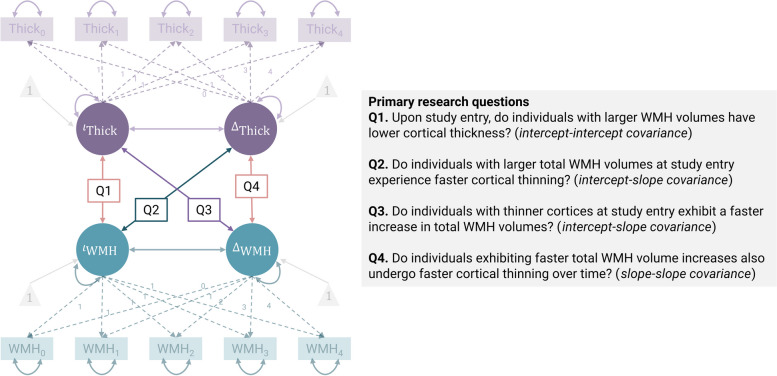
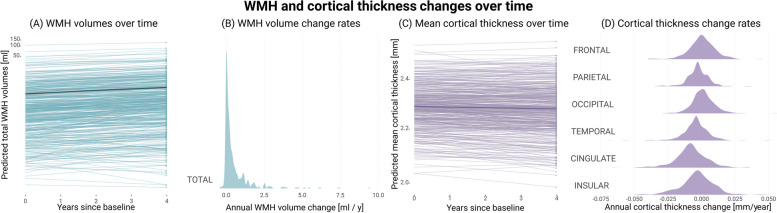
We applied global and regional bivariate latent growth curve modelling to determine the extent to which WMH and cortical thickness were interrelated over a four-year period. For this purpose, we leveraged longitudinal MRI data from 451 cognitively unimpaired participants (DELCODE; median age 69.71 [IQR 65.51, 75.50] years; 52.32% female). Participants underwent MRI sessions annually over a four-year period (1815 sessions in total, with roughly four MRI sessions per participant). We adjusted all models for demographics and cardiovascular risk.
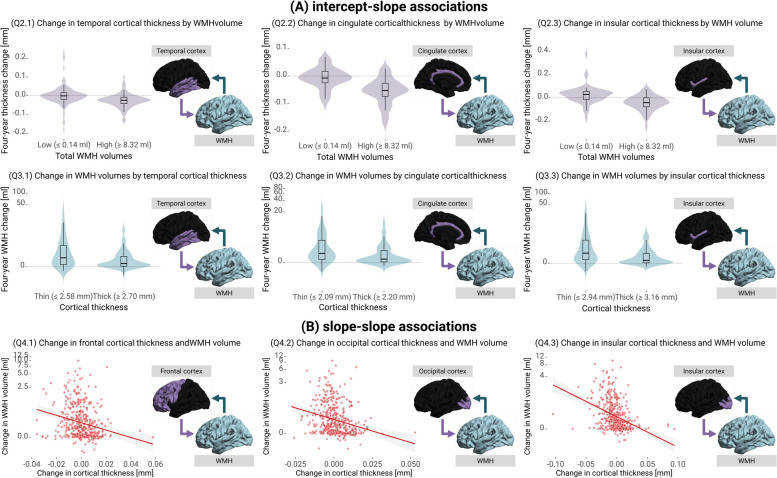
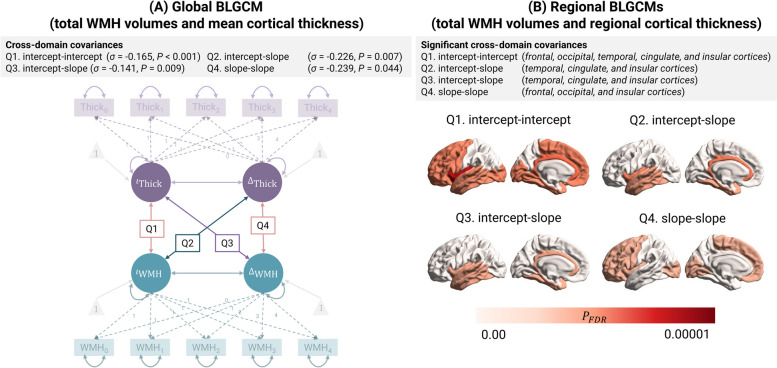
Our findings were three-fold. First, larger WMH volumes were linked to lower cortical thickness (σ = -0.165, SE = 0.047, Z = -3.515, P < 0.001). Second, individuals with higher WMH volumes experienced more rapid cortical thinning (σ = -0.226, SE = 0.093, Z = -2.443, P = 0.007), particularly in temporal, cingulate, and insular regions. Similarly, those with lower initial cortical thickness had faster WMH progression (σ = -0.141, SE = 0.060, Z = -2.336, P = 0.009), with this effect being most pronounced in temporal, cingulate, and insular cortices. Third, faster WMH progression was associated with accelerated cortical thinning (σ = -0.239, SE = 0.139, Z = -1.710, P = 0.044), particularly in frontal, occipital, and insular cortical regions.
Our study suggests that cortical thinning and WMH progression could be mutually reinforcing rather than parallel, unrelated processes, which become entangled before cognitive deficits are detectable.
German Clinical Trials Register (DRKS00007966, 04/05/2015).
三十多年来,皮质神经退行性变和脑白质高信号(WMH)的同时存在引发了关于它们时间动态耦合的讨论。然而,支持这一假设的纵向研究仍然很少。
我们应用全局和区域双变量潜增长曲线模型来确定 WMH 和皮质厚度在四年期间相互关联的程度。为此,我们利用来自 451 名认知正常的参与者的纵向 MRI 数据(DELCODE;中位年龄 69.71 [IQR 65.51, 75.50] 岁;52.32%女性)。参与者在四年期间每年接受 MRI 检查(共 1815 次,每位参与者约有四次 MRI 检查)。我们调整了所有模型以适应人口统计学和心血管风险因素。
我们的研究结果有三个方面。首先,较大的 WMH 体积与较低的皮质厚度相关(σ=-0.165,SE=0.047,Z=-3.515,P<0.001)。其次,WMH 体积较高的个体经历了更快的皮质变薄(σ=-0.226,SE=0.093,Z=-2.443,P=0.007),特别是在颞叶、扣带回和岛叶区域。同样,初始皮质厚度较低的个体有更快的 WMH 进展(σ=-0.141,SE=0.060,Z=-2.336,P=0.009),这种效应在颞叶、扣带回和岛叶皮质最为明显。第三,WMH 进展较快与皮质变薄加速相关(σ=-0.239,SE=0.139,Z=-1.710,P=0.044),特别是在额叶、枕叶和岛叶皮质区域。
我们的研究表明,皮质变薄和 WMH 进展可能是相互促进的,而不是平行的、不相关的过程,在可检测到认知缺陷之前,这些过程就已经纠缠在一起了。
德国临床试验注册处(DRKS00007966,2015 年 4 月 5 日)。