Department of Critical Care Medicine, Children's National Hospital, Washington, DC.
Department of Pediatrics, The George Washington University School of Medicine and Health Sciences, Washington, DC.
Crit Care Explor. 2024 Oct 25;6(11):e1171. doi: 10.1097/CCE.0000000000001171. eCollection 2024 Nov 1.
Approximately 50% of clinicians experience excessive emotional, physical, and mental stress, with repercussions across the entire medical system. Mindfulness exercises may mitigate this excessive stress. Heart rate variability (HRV) is an objective stress measure that can quantify which mindfulness exercises provide the greatest stress reduction.
To define the impact of specific mindfulness exercises on HRV, a surrogate for physiologic stress, and the relationship between physiologic (HRV) and subjective stress measured by the State-Trait Anxiety Inventory during a one-day mindfulness workshop.
DESIGN, SETTING, AND PARTICIPANTS: This was a prospective observational pilot study performed at a quaternary children's hospital with diverse subspecialists of pediatric nurses, nurse practitioners, and physicians.
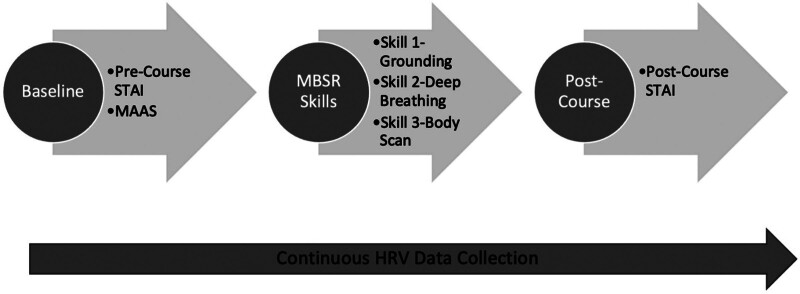
Our primary outcome measure was change in HRV from baseline during three mindfulness exercises.
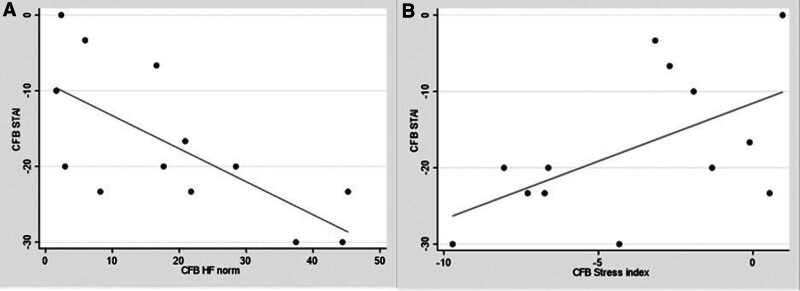
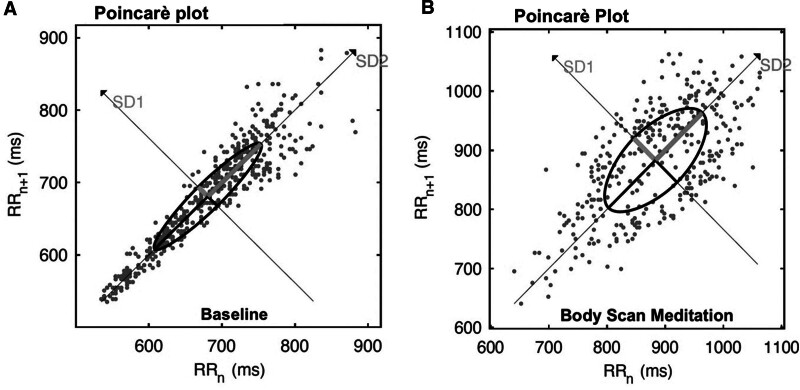
The grounding, deep breathing, and body scan exercises all produced statistically significant changes in HRV among our 13 female participants. The body scan exercise produced statistically significant changes in all studied HRV parameters compared with baseline. We observed significant increases in Root Mean Square of Successive Differences between normal heartbeats (p = 0.026), high frequency (p ≤ 0.001), and the parasympathetic nervous system index (p ≤ 0.001) reflecting increased parasympathetic tone (e.g., relaxation), whereas sd 2/sd 1 ratio (p ≤ 0.001) and the stress index (p = 0.004) were decreased reflecting sympathetic withdrawal (e.g., decreased stress). Subjective stress decreased after 1-day mindfulness training (44.6 to 27.2) (p < 0.001). Individuals with the largest decrease in subjective stress also had the most improvement in HRV during the body scan exercise.
Clinician stress levels (HRV) improved after participating in grounding, deep breathing, and body scan meditations, which may highlight their importance as stress reduction tools for clinicians. Monitoring of HRV during mindfulness exercises may provide deeper understanding of which specific exercises produce the greatest physiologic stress reduction for individual participants and the trend of these changes over time.
大约 50%的临床医生经历过度的情绪、身体和精神压力,对整个医疗系统都有影响。正念练习可能会减轻这种过度压力。心率变异性(HRV)是一种客观的压力测量指标,可以量化哪些正念练习可以最大程度地减轻压力。
定义特定的正念练习对 HRV 的影响,HRV 是生理压力的替代指标,以及在为期一天的正念工作坊中,心率变异性(HRV)与状态-特质焦虑量表测量的生理(HRV)和主观压力之间的关系。
设计、地点和参与者:这是一项在一家拥有儿科护士、执业护士和医生等多样化专科医生的四级儿童医院进行的前瞻性观察性试点研究。
我们的主要结果测量指标是在三种正念练习期间从基线开始的 HRV 变化。
在我们的 13 名女性参与者中, grounding、深呼吸和身体扫描练习都使 HRV 产生了统计学上的显著变化。与基线相比,身体扫描练习对所有研究的 HRV 参数都产生了统计学上的显著变化。我们观察到正常心跳之间的连续差异均方根(RMSD)(p = 0.026)、高频(p ≤ 0.001)和副交感神经指数(p ≤ 0.001)显著增加,反映了副交感神经张力的增加(例如,放松),而 sd2/sd1 比(p ≤ 0.001)和应激指数(p = 0.004)降低,反映了交感神经撤退(例如,应激减少)。经过一天的正念训练后,主观压力降低(从 44.6 降至 27.2)(p < 0.001)。主观压力下降最大的个体在身体扫描练习中 HRV 也有最大的改善。
临床医生的压力水平(HRV)在参与 grounding、深呼吸和身体扫描冥想后得到改善,这可能强调了它们作为临床医生减压工具的重要性。在正念练习过程中监测 HRV 可能会更深入地了解哪些特定练习可以最大程度地减轻个体参与者的生理压力,以及这些变化随时间的趋势。