Department of Radiology, Affiliated People's Hospital of Jiangsu University, No. 8, Dianli Road, Zhenjiang, Jiangsu, 212001, China.
Department of Radiology, Affiliated Hospital of Jiangsu University, No. 438, Jiefang Road, Zhenjiang, Jiangsu, 212001, China.
J Nanobiotechnology. 2024 Oct 28;22(1):665. doi: 10.1186/s12951-024-02941-3.
Treating mitochondrial dysfunction is a promising approach for the treatment of post-stroke cognitive impairment (PSCI). HuMSC-derived exosomes (H-Ex) have shown powerful therapeutic effects in improving mitochondrial function, but the specific effects are unclear and its brain tissue targeting needs to be further optimized.
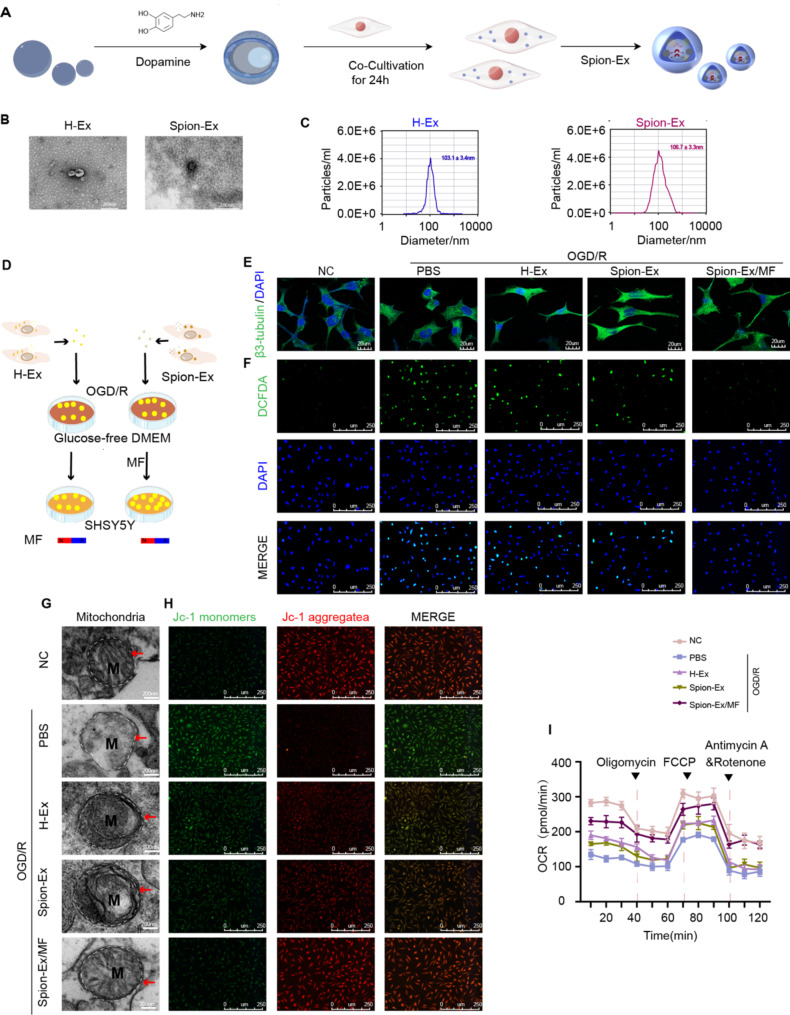
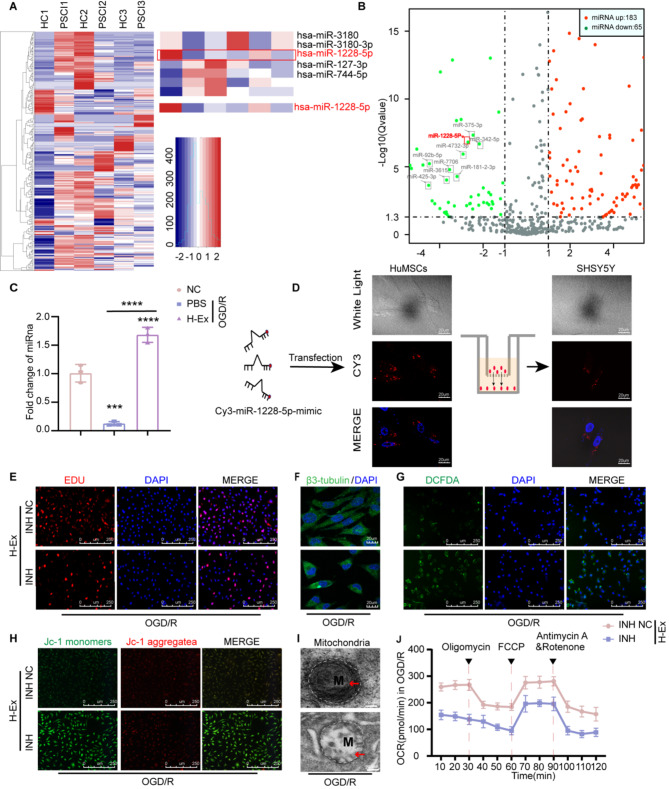
In this study, we found that H-Ex can improve mitochondrial dysfunction of neurons and significantly enhance the cognitive behavior performance of MCAO mice in OGD/R-induced SHSY5Y cells and MCAO mouse models. Based on this, we have developed an exosome delivery system loaded with superparamagnetic iron oxide nanoparticles (Spion-Ex) that can effectively penetrate the blood-brain barrier (BBB). The research results showed that under magnetic attraction, Spion-Ex can more effectively target the brain tissue and significantly improve mitochondrial function of neurons after stroke. Meanwhile, we further confirmed that miR-1228-5p is a key factor for H-Ex to improve mitochondrial function and cognitive behavior both in vivo and in vitro. The specific mechanism is that the increase of miR-1228-5p mediated by H-Ex can inhibit the expression of TRAF6 and activate the TRAF6-NADPH oxidase 1 (NOX1) pathway, thereby exerting protective effects against oxidative damage. More importantly, we found that under magnetic attraction, Spion-Ex exhibited excellent cognitive improvement effects by delivering miR-1228-5p.
Our research found that H-Ex has a good therapeutic effect on PSCI by increasing the expression of miR-1228-5p in PSCI, while H-Ex loaded with Spion-Ex exhibited more excellent effects on improving mitochondrial function and cognitive impairment under magnetic attraction, which can be used as a novel strategy for the treatment of PSCI.
治疗线粒体功能障碍是治疗中风后认知障碍(PSCI)的一种有前途的方法。人骨髓间充质干细胞来源的外泌体(H-Ex)已显示出在改善线粒体功能方面的强大治疗效果,但具体效果尚不清楚,其脑组织靶向性有待进一步优化。
在本研究中,我们发现 H-Ex 可改善神经元线粒体功能障碍,并显著增强 OGD/R 诱导的 SHSY5Y 细胞和 MCAO 小鼠模型中 MCAO 小鼠的认知行为表现。基于此,我们开发了一种负载超顺磁性氧化铁纳米颗粒(Spion-Ex)的外泌体递送系统,该系统可以有效地穿透血脑屏障(BBB)。研究结果表明,在磁场吸引力的作用下,Spion-Ex 可以更有效地靶向脑组织,并显著改善中风后神经元的线粒体功能。同时,我们进一步证实 miR-1228-5p 是 H-Ex 改善体内和体外线粒体功能和认知行为的关键因素。具体机制是,H-Ex 增加的 miR-1228-5p 可以抑制 TRAF6 的表达并激活 TRAF6-NADPH 氧化酶 1(NOX1)途径,从而发挥抗氧化损伤的保护作用。更重要的是,我们发现,在磁场吸引力的作用下,Spion-Ex 通过递送 miR-1228-5p 表现出优异的认知改善效果。
我们的研究发现,H-Ex 通过增加 PSCI 中 miR-1228-5p 的表达对 PSCI 有很好的治疗效果,而负载 Spion-Ex 的 H-Ex 在磁场吸引力下对改善线粒体功能和认知障碍表现出更优异的效果,可作为治疗 PSCI 的新策略。