Colorectal Surgery Unit, Department of Surgery, Faculty of Medicine Siriraj Hospital, Mahidol University, Bangkok, Thailand.
Asian Pac J Cancer Prev. 2024 Oct 1;25(10):3661-3665. doi: 10.31557/APJCP.2024.25.10.3661.
A multitarget stool DNA test offers high sensitivity and specificity for screening and detecting colorectal cancer (CRC) in Western populations. However, its accuracy in Asian people is not well known. This study aimed to examine the diagnostic performance of multitarget stool DNA tests in Thailand.
A prospective cross-sectional study was conducted from January 2023 to November 2023 at a tertiary university hospital in Bangkok. The study included both asymptomatic and symptomatic patients who underwent stool DNA testing followed by colonoscopy. The multitarget stool DNA test targeted methylation statuses of SDC2, ADHFE1, and PPP2R5C genes. Sensitivity, specificity, and other diagnostic parameters were analyzed.
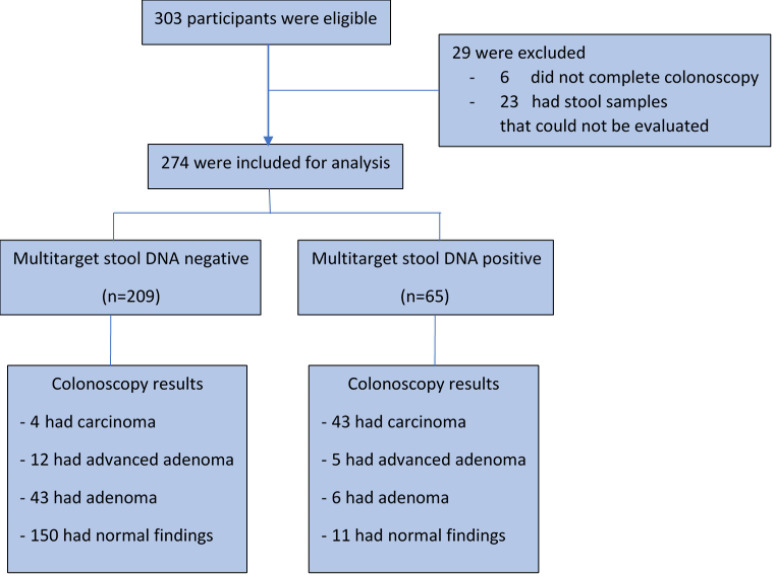
A total of 274 patients (mean age 62.1 years, 60.6% female) were enrolled. CRC was diagnosed in 17.2% of participants and 6.2% had advanced adenomas. The multitarget stool DNA test demonstrated a sensitivity of 91.5% (95% CI: 79.6-97.6) and specificity of 90.3% (95% CI: 85.7-93.8) for CRC detection. Its sensitivity for detecting CRC did not differ between right-sided lesions (92.3%) and left-sided lesions (91.2%) (P=0.901). The sensitivity for detecting CRC lesions size less than 2 cm was significantly lower than for larger lesions (25% vs 91.7%, p<0.001). Notably, the test's sensitivity and specificity for advanced colorectal neoplasms/cancer were 75.0% (95% CI: 62.6-85.0) and 91.9% (95% CI: 87.4-95.2), respectively.
Multitarget stool DNA testing is highly sensitive and specific for CRC detection in Thai individuals. This testing could represent as a viable non-invasive alternative to colonoscopy especially in settings where colonoscopy is less accessible or less accepted by patients.
多靶点粪便 DNA 检测在西方人群中具有较高的灵敏度和特异性,可用于结直肠癌(CRC)的筛查和检测。然而,其在亚洲人群中的准确性尚不清楚。本研究旨在探讨多靶点粪便 DNA 检测在泰国的诊断性能。
一项前瞻性的横断面研究于 2023 年 1 月至 2023 年 11 月在曼谷的一家三级大学医院进行。研究纳入了接受粪便 DNA 检测并随后进行结肠镜检查的无症状和有症状患者。多靶点粪便 DNA 检测针对 SDC2、ADHFE1 和 PPP2R5C 基因的甲基化状态。分析了灵敏度、特异性和其他诊断参数。
共纳入 274 例患者(平均年龄 62.1 岁,60.6%为女性)。17.2%的参与者诊断为 CRC,6.2%患有高级腺瘤。多靶点粪便 DNA 检测对 CRC 的灵敏度为 91.5%(95%CI:79.6-97.6),特异性为 90.3%(95%CI:85.7-93.8)。其对右侧病变(92.3%)和左侧病变(91.2%)CRC 的检测灵敏度无差异(P=0.901)。检测 2cm 以下 CRC 病变的灵敏度显著低于较大病变(25% vs 91.7%,p<0.001)。值得注意的是,该检测对高级结直肠肿瘤/癌症的灵敏度和特异性分别为 75.0%(95%CI:62.6-85.0)和 91.9%(95%CI:87.4-95.2)。
多靶点粪便 DNA 检测对泰国人群 CRC 的检测具有较高的灵敏度和特异性。该检测方法可能是一种可行的非侵入性替代结肠镜检查的方法,特别是在结肠镜检查较难获得或患者不太接受的情况下。