Department of Medical Imaging, Henan Provincial People's Hospital, Zhengzhou, Henan, China.
Department of Magnetic Resonance, The First Affiliated Hospital of Xinxiang Medical University, Xinxiang, Henan, China.
BMC Med Imaging. 2024 Oct 29;24(1):290. doi: 10.1186/s12880-024-01445-8.
Multiple models intravoxel incoherent motion (IVIM) based F-fluorodeoxyglucose positron emission tomography-magnetic resonance(F-FDG PET/MR) could reflect the microscopic information of the tumor from multiple perspectives. However, its value in the prognostic assessment of non-small cell lung cancer (NSCLC) still needs to be further explored.
To compare the value of F-FDG PET/MR metabolic parameters and diffusion parameters in the prognostic assessment of patients with NSCLC.
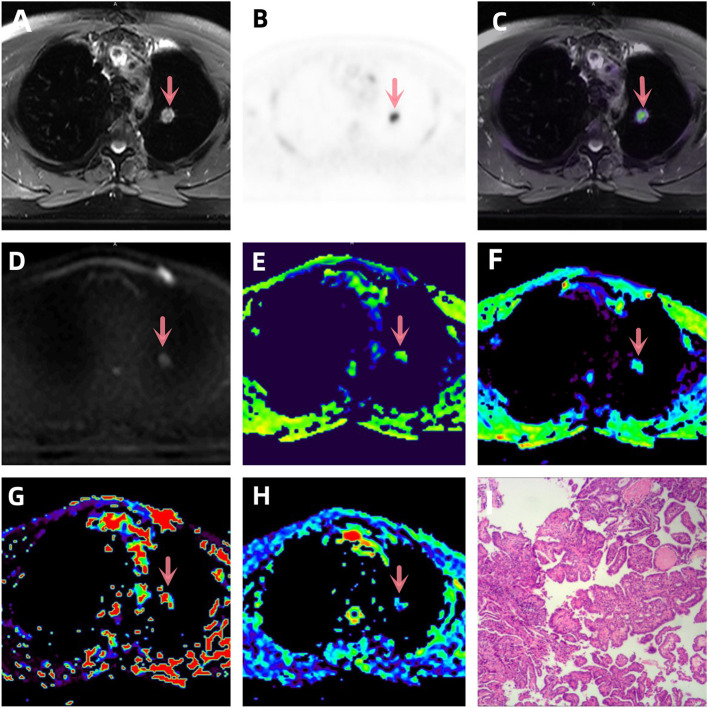
Chest PET and IVIM scans were performed on 61 NSCLC patients using PET/MR. The maximum standard uptake value (SUV), metabolic tumor volume (MTV), total lesion glycolysis (TLG), diffusion coefficient (D), perfusion fraction (f), pseudo diffusion coefficient (D*) and apparent diffusion coefficient (ADC) were calculated. The impact of SUV, MTV, TLG, D, f, D*and ADC on survival was measured in terms of the hazard ratio (HR) effect size. Overall survival time (OS) and progression-free survival time (PFS) were evaluated with the Kaplan-Meier and Cox proportional hazard models. Log-rank test was used to analyze the differences in parameters between groups.
61 NSCLC patients had an overall median OS of 18 months (14.75, 22.85) and a median PFS of 17 months (12.00, 21.75). Univariate analysis showed that pathological subtype, TNM stage, surgery, SUV, MTV, TLG, D, D* and ADC were both influential factors for OS and PFS in NSCLC patients. Multifactorial analysis showed that MTV, D* and ADC were independent predicting factors for OS and PFS in NSCLC patients.
MTV, D* and ADC are independent predicting factors affecting OS and PFS in NSCLC patients. F-FDG PET/MR-derived metabolic parameters and diffusion parameters have clinical value for prognostic assessment of NSCLC patients.
基于体素内不相干运动(IVIM)的多模型 F-氟代脱氧葡萄糖正电子发射断层扫描-磁共振(F-FDG PET/MR)可以从多个角度反映肿瘤的微观信息。然而,其在非小细胞肺癌(NSCLC)预后评估中的价值仍需进一步探讨。
比较 F-FDG PET/MR 代谢参数和扩散参数在 NSCLC 患者预后评估中的价值。
对 61 例 NSCLC 患者进行胸部 PET 和 IVIM 扫描。计算最大标准摄取值(SUV)、代谢肿瘤体积(MTV)、总肿瘤糖酵解(TLG)、扩散系数(D)、灌注分数(f)、假性扩散系数(D*)和表观扩散系数(ADC)。采用危害比(HR)效应大小衡量 SUV、MTV、TLG、D、f、D*和 ADC 对生存的影响。采用 Kaplan-Meier 和 Cox 比例风险模型评估总生存时间(OS)和无进展生存时间(PFS)。采用对数秩检验分析组间参数差异。
61 例 NSCLC 患者的总中位 OS 为 18 个月(14.75,22.85),中位 PFS 为 17 个月(12.00,21.75)。单因素分析显示,病理亚型、TNM 分期、手术、SUV、MTV、TLG、D、D和 ADC 均为 NSCLC 患者 OS 和 PFS 的影响因素。多因素分析显示,MTV、D和 ADC 是 NSCLC 患者 OS 和 PFS 的独立预测因素。
MTV、D*和 ADC 是影响 NSCLC 患者 OS 和 PFS 的独立预测因素。F-FDG PET/MR 衍生的代谢参数和扩散参数对 NSCLC 患者的预后评估具有临床价值。