Discipline of Zoology, School of Natural Sciences, Trinity College Dublin, Dublin, Ireland.
Carleton College, Sayles Hill Campus Center, North College Street, Northfield, MN, 55057, USA.
BMC Biol. 2024 Oct 29;22(1):250. doi: 10.1186/s12915-024-02041-6.
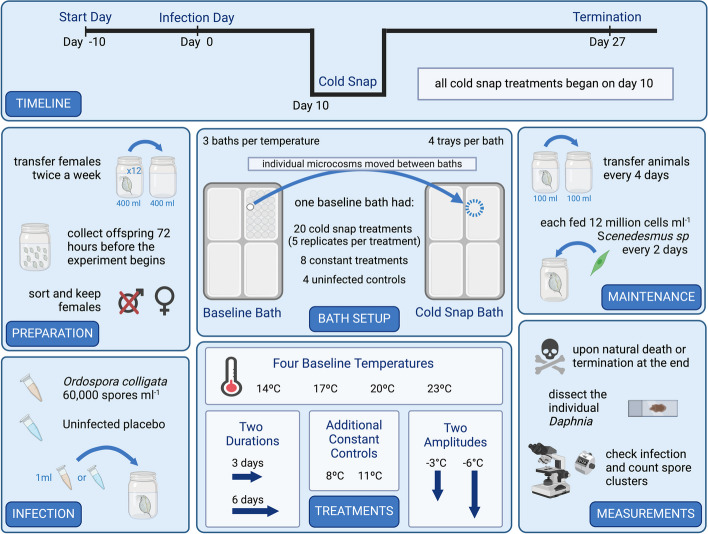
Climate change is driving increased extreme weather events that can impact ecology by moderating host-pathogen interactions. To date, few studies have explored how cold snaps affect disease prevalence and proliferation. Using the Daphnia magna-Ordospora colligata host-parasite system, a popular model system for environmentally transmitted diseases, the amplitude and duration of cold snaps were manipulated at four baseline temperatures, 10 days post-exposure, with O. colligata fitness recorded at the individual level.
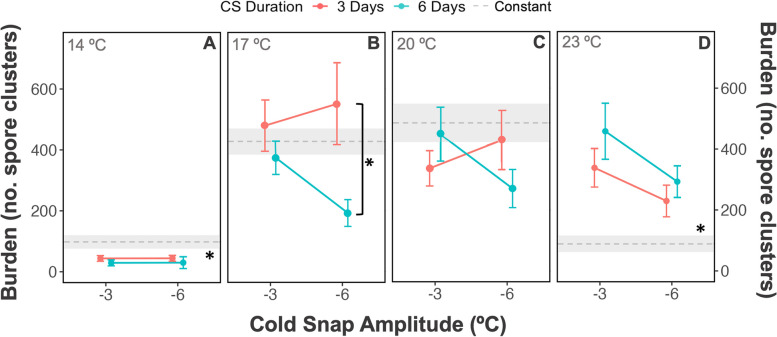
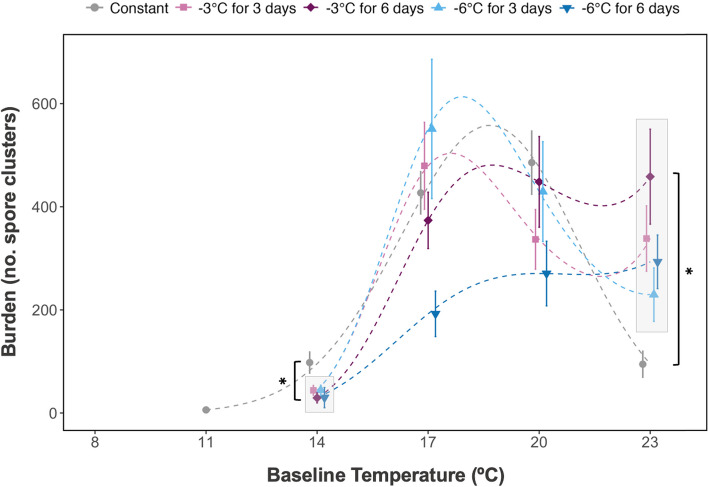
Cold snaps induced a fivefold increase or a threefold decrease in parasite burden relative to baseline temperature, with complex nuances and varied outcomes resulting from different treatment combinations. Both amplitude and duration can interact with the baseline temperature highlighting the complexity and baseline dependence of cold snaps. Furthermore, parasite fitness, i.e., infection prevalence and burden, were simultaneously altered in opposite directions in the same cold snap treatment.
We found that cold snaps can yield complicated outcomes that are unique from other types of temperature variation (for example, heatwaves). These results underpin the challenges and complexity in understanding and predicting how climate and extreme weather may alter disease under global change.
气候变化正在引发更多的极端天气事件,这些事件可能通过调节宿主-病原体相互作用来影响生态系统。迄今为止,很少有研究探讨寒潮如何影响疾病的流行和传播。本研究利用广受欢迎的环境传播疾病模型系统——大型溞(Daphnia magna)-胶孢炭疽菌(Ordospora colligata)宿主-寄生虫系统,在暴露后 10 天,于四个基线温度下操纵寒潮的幅度和持续时间,并在个体水平上记录胶孢炭疽菌的适应性。
与基线温度相比,寒潮导致寄生虫负荷增加了五倍或减少了三倍,不同处理组合产生了复杂的细微差别和不同的结果。幅度和持续时间都可以与基线温度相互作用,突出了寒潮的复杂性和对基线的依赖性。此外,寄生虫适应性,即感染率和负担,在同一寒潮处理中同时以相反的方向发生变化。
我们发现,寒潮可能产生与其他类型的温度变化(例如热浪)不同的复杂结果。这些结果凸显了在理解和预测气候变化和极端天气如何改变疾病方面所面临的挑战和复杂性。