Pu Xin-Xin, Huang Shu, Zhong Chun-Yu, Wang Xia, Fu Su-Fen, Lv Ying-Qin, Zou Kang, Lü Mu-Han, Peng Yan, Tang Xiao-Wei
Department of Gastroenterology, Dechang People's Hospital of Sichuan Province, Liangshan 615500, Sichuan Province, China.
Department of Gastroenterology, The Affiliated Hospital of Southwest Medical University, Luzhou 646000, Sichuan Province, China.
World J Gastrointest Endosc. 2024 Oct 16;16(10):566-580. doi: 10.4253/wjge.v16.i10.566.
As a less invasive technique, peroral endoscopic myotomy (POEM) has recently been widely accepted for treating achalasia with an excellent safety profile, durability, and efficacy in adults. In pediatric and geriatric patients, the treatment is more difficult.
To discuss the clinical outcomes of POEM in pediatric and geriatric patients with achalasia.
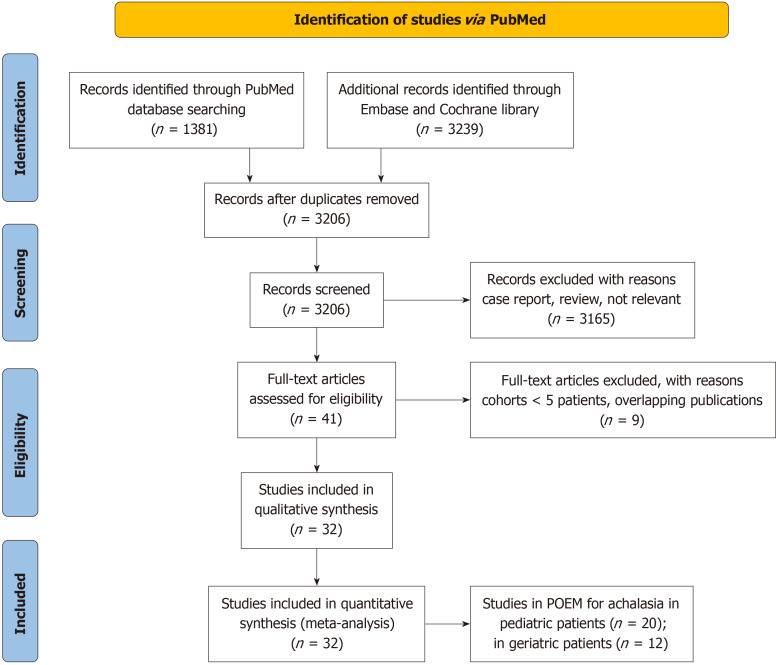
We conducted a comprehensive search of PubMed, Embase and Cochrane Library databases from inception to July 2024. The primary outcomes were technical and clinical success. Secondary outcomes of interest included adverse events and gastroesophageal reflux disease (GERD). The pooled event rates were calculated by comprehensive meta-analysis software.
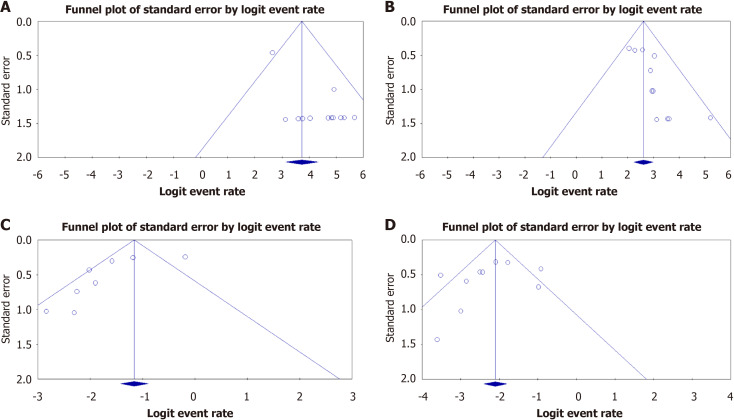
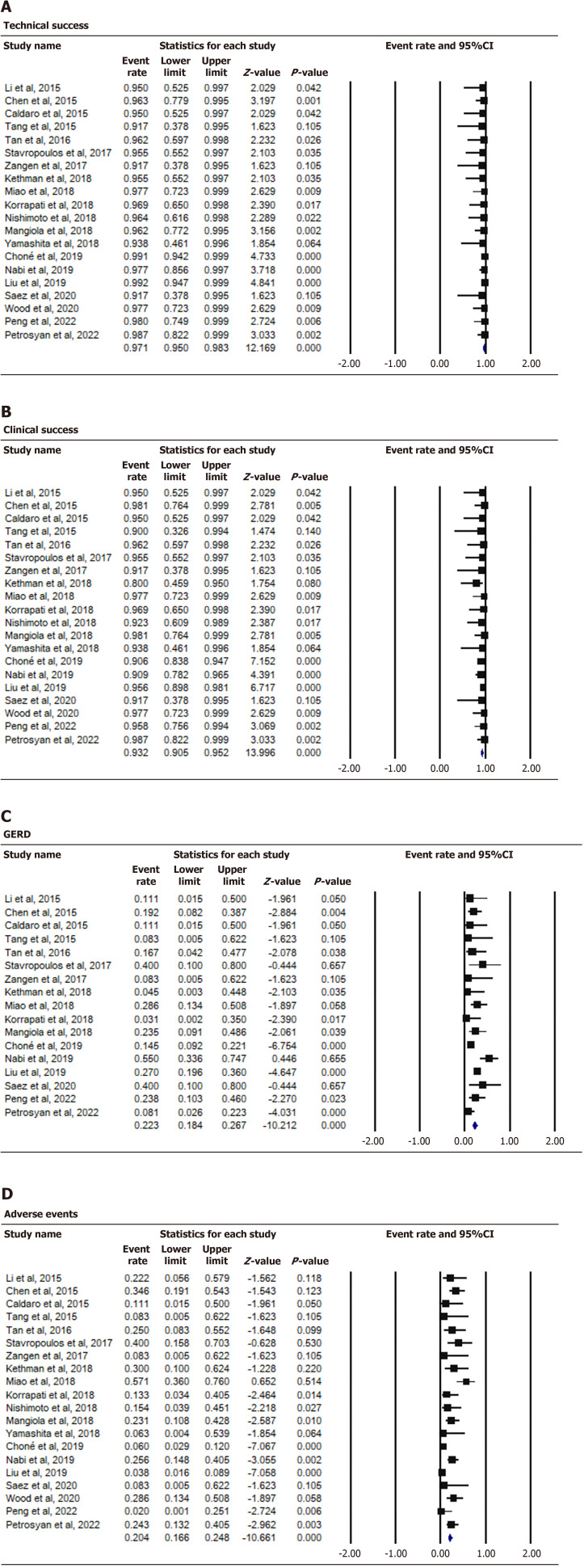
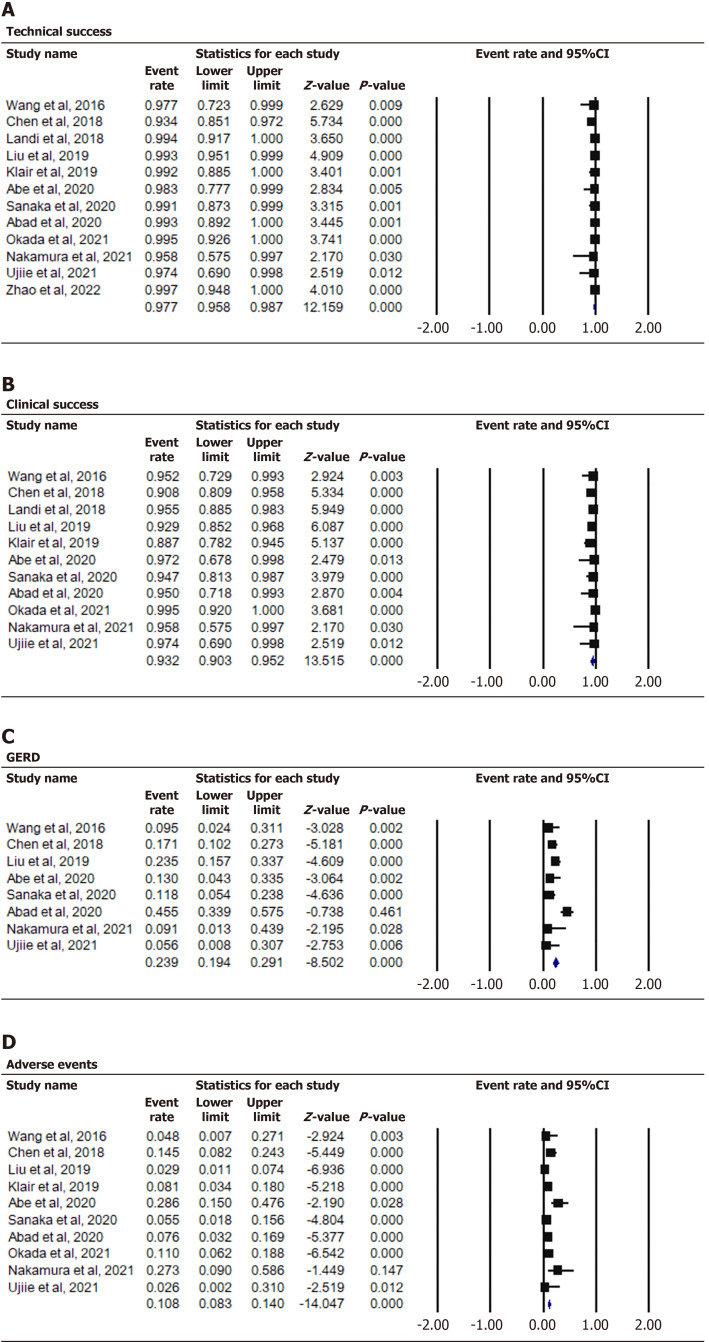
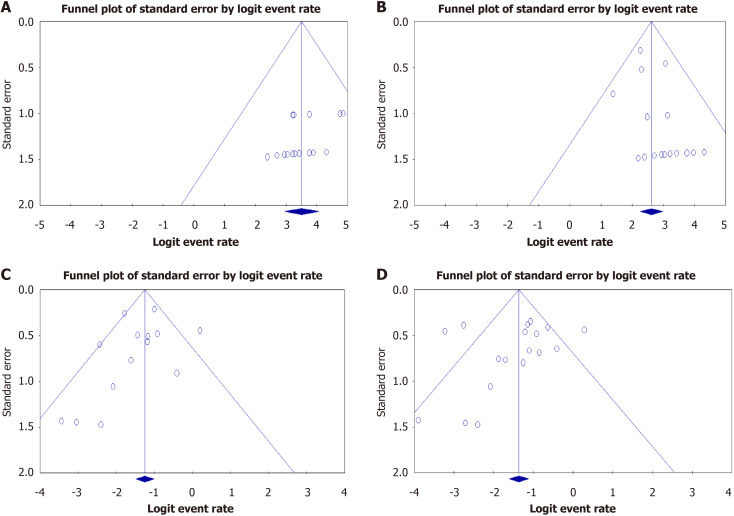
A total of 32 studies with 547 pediatric patients and 810 geriatric patients were included in this study. The pooled event rates of technical success, clinical success, GERD and adverse events of POEM for treating achalasia in pediatric patients were 97.1% [95% confidence interval (CI): 95.0%-98.3%; ² = 0%; < 0.000], 93.2% (95%CI: 90.5%-95.2%; ² = 0%; < 0.000), 22.3% (95%CI: 18.4%-26.7%; ² = 43.874%; < 0.000) and 20.4% (95%CI: 16.6%-24.8%; ² = 67.217%; < 0.000), respectively. Furthermore, in geriatric patients, the pooled event rates were 97.7% (95%CI: 95.8%-98.7%; ² = 15.200%; < 0.000), 93.2% (95%CI: 90.3%-95.2%; ² = 0%; < 0.000), 23.9% (95%CI: 19.4%-29.1%; ² = 75.697%; < 0.000) and 10.8% (95%CI: 8.3%-14.0%; ² = 62.938%; < 0.000], respectively.
Our findings demonstrated that POEM was an effective and safe technique for pediatric and geriatric patients with achalasia.
作为一种侵入性较小的技术,经口内镜下肌切开术(POEM)最近已被广泛接受用于治疗贲门失弛缓症,在成人中具有出色的安全性、持久性和疗效。在儿科和老年患者中,治疗更为困难。
探讨POEM治疗儿科和老年贲门失弛缓症患者的临床疗效。
我们对PubMed、Embase和Cochrane图书馆数据库从创建到2024年7月进行了全面检索。主要结局是技术成功和临床成功。感兴趣的次要结局包括不良事件和胃食管反流病(GERD)。汇总事件发生率通过综合荟萃分析软件计算。
本研究共纳入32项研究,其中儿科患者547例,老年患者810例。POEM治疗儿科贲门失弛缓症患者的技术成功率、临床成功率、GERD和不良事件的汇总事件发生率分别为97.1%[95%置信区间(CI):95.0%-98.3%;I² = 0%;P < 0.000]、93.2%(95%CI:90.5%-95.2%;I² = 0%;P < 0.000)、22.3%(95%CI:18.4%-26.7%;I² = 43.874%;P < 0.000)和20.4%(95%CI:16.6%-24.8%;I² = 67.217%;P < 0.000)。此外,在老年患者中,汇总事件发生率分别为97.7%(95%CI:95.8%-98.7%;I² = 15.200%;P < 0.000)、93.2%(95%CI:90.3%-95.2%;I² = 0%;P < 0.000)、23.9%(95%CI:19.4%-29.1%;I² = 75.697%;P < 0.000)和10.8%(95%CI:8.3%-14.0%;I² = 62.938%;P < 0.000)。
我们的研究结果表明,POEM是治疗儿科和老年贲门失弛缓症患者的一种有效且安全的技术。