Fernández de la Puente María, Valle-Hita Cristina, Salas-Huetos Albert, Martínez María Ángeles, Sánchez-Resino Elena, Canudas Silvia, Torres-Oteros Daniel, Relat Joana, Babio Nancy, Salas-Salvadó Jordi
Universitat Rovira i Virgili, Departament de Bioquímica i Biotecnologia, Alimentació, Nutrició, Desenvolupament i Salut Mental (ANUT-DSM), Unitat de Nutrició Humana, Reus, Spain.
Consorcio CIBER, M.P. Fisiopatología de la Obesidad y Nutrición (CIBERObn), Instituto de Salud Carlos III (ISCIII), Madrid, Spain.
Hum Reprod Open. 2024 Oct 14;2024(4):hoae062. doi: 10.1093/hropen/hoae062. eCollection 2024.
Could sperm and leukocyte telomere length (TL) be associated with sperm quality parameters and reproductive health in men from the general population?
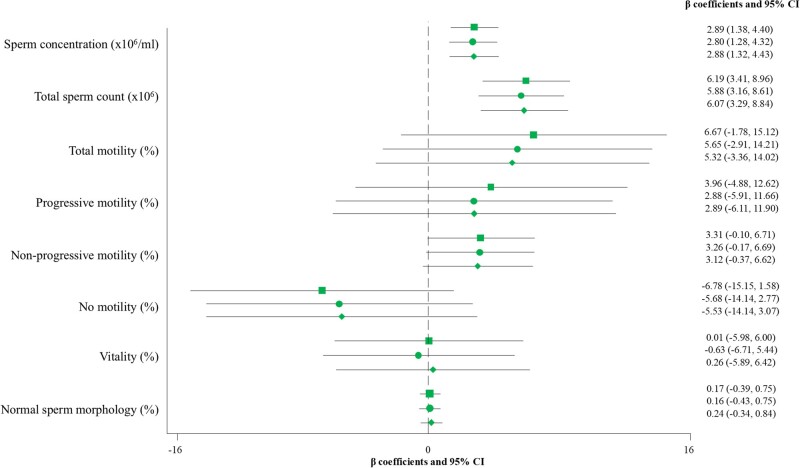
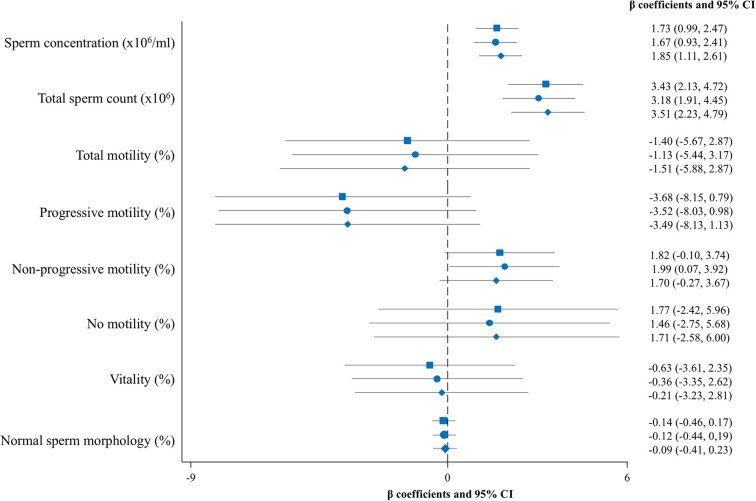
A positive association between sperm and leukocyte TL with sperm concentration and total count has been demonstrated.
Male factors account for almost half of cases of couple infertility, and shorter TLs have been observed in sperm from men with impaired sperm parameters. However, evidence in men from the general population is limited.
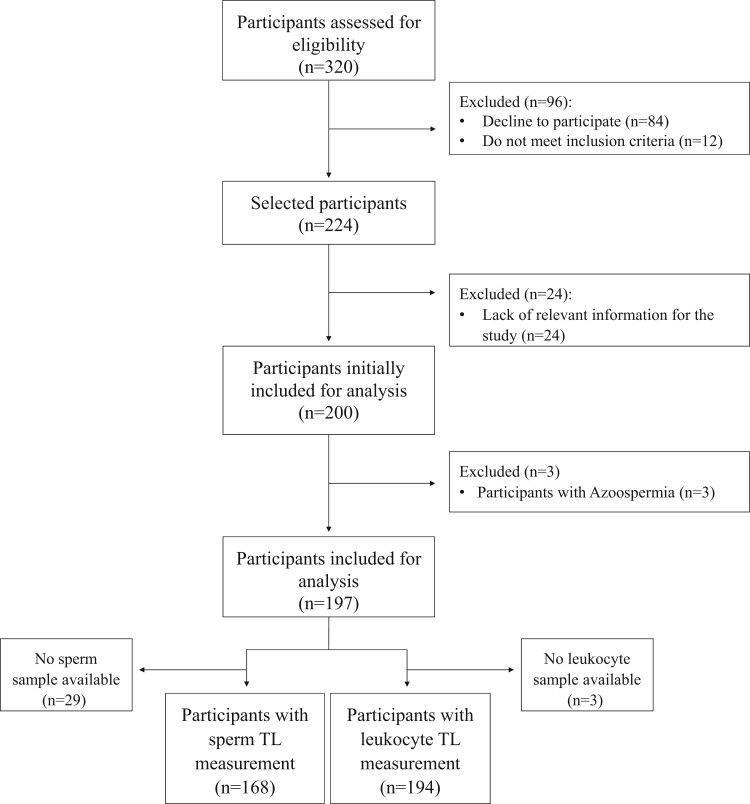
A total of 200 volunteers of reproductive age were recruited between February 2021 and April 2023 to participate in the Lifestyle and Environmental Determinants of Seminogram and Other Male Fertility-Related Parameters (Led-Fertyl) cross-sectional study.
PARTICIPANTS/MATERIALS SETTING METHODS: TLs in sperm and leukocytes were measured using quantitative polymerase chain reaction (qPCR) in 168 and 194 participants, respectively. Sperm parameters, including concentration, total count, motility, vitality, and morphology, were analyzed using a computer-assisted sperm analysis (CASA) SCA system according to the World Health Organization (WHO) 2010 guidelines. Multivariable regression models were performed to assess the associations between sperm and leukocyte TL, either in tertiles or as continuous variables, and sperm quality parameters while adjusting for potential confounders.
Participants in tertiles 2 (T2) and 3 (T3) of sperm TL showed a higher sperm concentration (β: 1.09; 95% CI: 0.09-2.09 and β: 2.06; 95% CI: 1.04-3.09 for T2 and T3, respectively; -trend < 0.001), compared to those in the reference tertile (T1). Participants in the highest tertile of sperm TL showed higher total sperm count (β: 3.83; 95% CI: 2.08-5.58 for T3 vs T1; -trend < 0.001). Participants in the top tertile of leukocyte TL showed higher sperm concentration (β: 1.49; 95% CI: 0.44-2.54 for T3 vs T1; -trend = 0.004), and total count (β: 3.49; 95% CI: 1.62-5.35 for T3 vs T1; -trend < 0.001) compared with participants in T1. These results remained consistent when sperm and leukocyte TL were modelled as continuous variables.
One limitation is the impossibility of establishing a cause-effect relationship due to the cross-sectional study design. Additionally, the sample size of the study cannot be considered large.
Sperm and leukocyte TLs are associated with sperm quality parameters in the general population. Additional determinations and further studies with larger sample sizes are needed to clarify the mechanisms underlying these associations and to investigate the further implications.
STUDY FUNDING/COMPETING INTERESTS: The Led-Fertyl study was supported by the Spanish government's official funding agency for biomedical research, Instituto de Salud Carlos III (ISCIII), through the Fondo de Investigación para la Salud (FIS) and co-funded by the European Union ERDF/ESF, 'A way to make Europe'/'Investing in your future' (PI21/01447), and the Diputació de Tarragona (2021/11-No.Exp. 8004330008-2021-0022642). J.S.-S., senior author of the present study, is partially supported by ICREA under the ICREA Academia program. M.F.d.l.P. was supported by a predoctoral grant from the Rovira i Virgili University and Diputació de Tarragona (2020-PMF-PIPF-8). C.V.-H. received a predoctoral grant from the Generalitat de Catalunya (2022 FI_B100108). M.Á.M. was supported by the Sara Borrell postdoctoral fellowship (CD21/00045-Instituto de Salud Carlos III (ISCIII)). All authors declare that they have no conflicts of interest.
N/A.
在普通人群中,精子和白细胞端粒长度(TL)是否与精子质量参数及生殖健康相关?
已证实精子和白细胞TL与精子浓度及总数之间存在正相关。
男性因素约占夫妻不孕病例的一半,精子参数受损的男性精子中观察到较短的TL。然而,普通人群中男性的相关证据有限。
研究设计、规模、持续时间:2021年2月至2023年4月期间,共招募了200名育龄志愿者,参与精液分析及其他男性生育相关参数的生活方式和环境决定因素(Led-Fertyl)横断面研究。
参与者/材料、设置、方法:分别对168名和194名参与者的精子和白细胞中的TL进行定量聚合酶链反应(qPCR)测量。根据世界卫生组织(WHO)2010年指南,使用计算机辅助精子分析(CASA)SCA系统分析精子参数,包括浓度、总数、活力、存活率和形态。进行多变量回归模型,以评估精子和白细胞TL(以三分位数或连续变量形式)与精子质量参数之间的关联,同时对潜在混杂因素进行调整。
与参考三分位数(T1)的参与者相比,精子TL处于第二三分位数(T2)和第三三分位数(T3)的参与者精子浓度更高(T2和T3的β值分别为1.09;95%CI:0.09 - 2.09和β值为2.06;95%CI:1.04 - 3.09;-趋势<0.001)。精子TL处于最高三分位数的参与者精子总数更高(T3与T1相比,β值为3.83;95%CI:2.08 - 5.58;-趋势<0.001)。白细胞TL处于最高三分位数的参与者与T1的参与者相比,精子浓度更高(T3与T1相比,β值为1.49;95%CI:0.44 - 2.54;-趋势=0.004),总数更高(T3与T1相比,β值为3.49;95%CI:1.62 - 5.35;-趋势<0.001)。当将精子和白细胞TL作为连续变量建模时,这些结果仍然一致。
局限性、谨慎原因:一个局限性是由于横断面研究设计,无法建立因果关系。此外,该研究的样本量不算大。
在普通人群中,精子和白细胞TL与精子质量参数相关。需要进行更多测定和更大样本量的进一步研究,以阐明这些关联背后的机制,并研究其进一步影响。
研究资金/利益冲突:Led-Fertyl研究由西班牙政府生物医学研究官方资助机构卡洛斯三世健康研究所(ISCIII)通过健康研究基金(FIS)支持,并由欧盟ERDF/ESF共同资助,“打造欧洲的一种方式”/“投资你的未来”(PI21/01447),以及塔拉戈纳省议会(2021/11 - 编号8004330008 - 2021 - 0022642)。本研究的资深作者J.S.-S. 部分得到了ICREA在ICREA Academia项目下的支持。M.F.d.l.P. 得到了罗维拉 - 维尔吉利大学和塔拉戈纳省议会的博士前资助(2020 - PMF - PIPF - 8)。C.V.-H. 获得了加泰罗尼亚自治区政府提供的博士前资助(2022 FI_B100108)。M.Á.M. 得到了萨拉·博雷尔博士后奖学金(CD21/00045 - 卡洛斯三世健康研究所(ISCIII))的支持。所有作者声明他们没有利益冲突。
无。