King Matthew G, Ackland David C, Hart Harvi F, Schache Anthony G, Sritharan Prasanna, Pandy Marcus G, Crossley Kay M
Australian IOC Research Centre, La Trobe Sport and Exercise Medicine Research Centre, School of Allied Health, Human Services and Sport, La Trobe University, Bundoora, Victoria, Australia.
Department of Biomedical Engineering, University of Melbourne, Victoria, Australia.
Braz J Phys Ther. 2024 Nov-Dec;28(6):101132. doi: 10.1016/j.bjpt.2024.101132. Epub 2024 Oct 30.
Differences in walking biomechanics between women and men with patellofemoral joint (PF) osteoarthritis (OA) may contribute to the development or progression of persistent symptoms in people with PF OA.
Evaluate how walking biomechanics of women with PF OA differ from: (i) men with PFJ OA; and (ii) women without PF OA. Second, explore the relationship between knee-related symptoms/function and walking biomechanics in individuals with PF OA, and whether these are modified by sex.
Sixty-seven individuals with PF OA (43 women) and 14 women without PF OA were included. Biomechanics data were recorded during walking. Patient-reported symptoms and function were obtained using the Knee injury and Osteoarthritis Outcome Score. Differences in continuous biomechanical data were assessed using statistical parametric mapping, with discrete data and relationships evaluated using linear models.
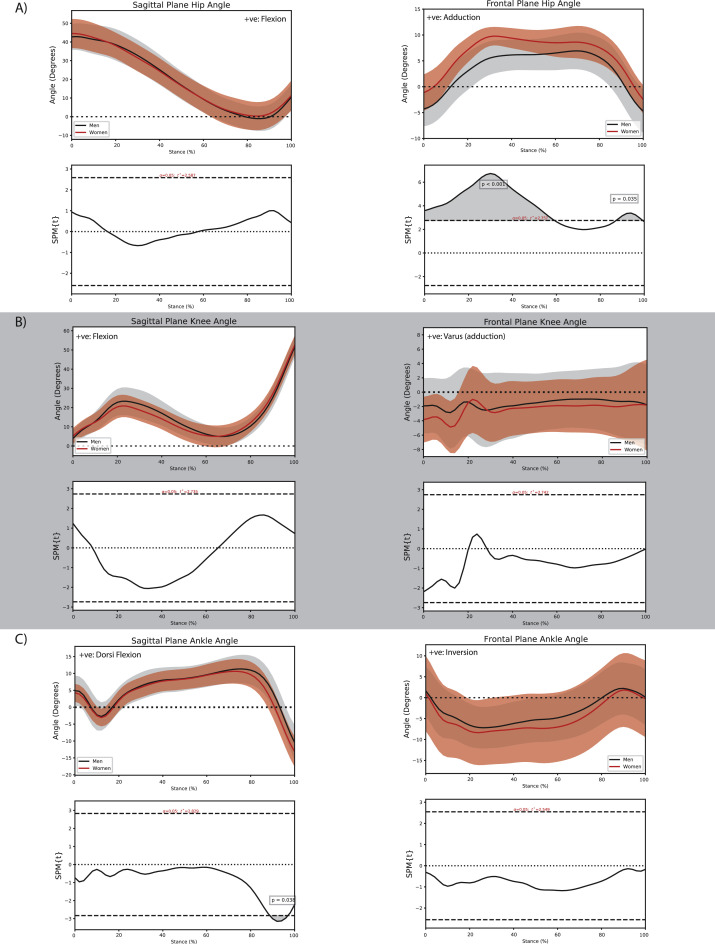
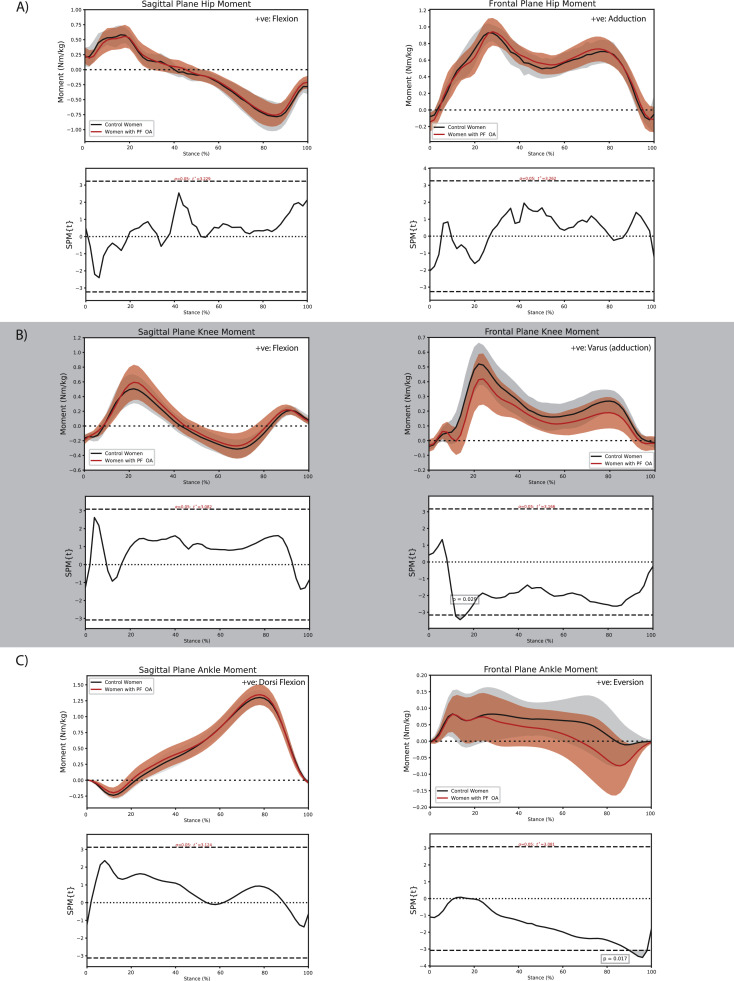
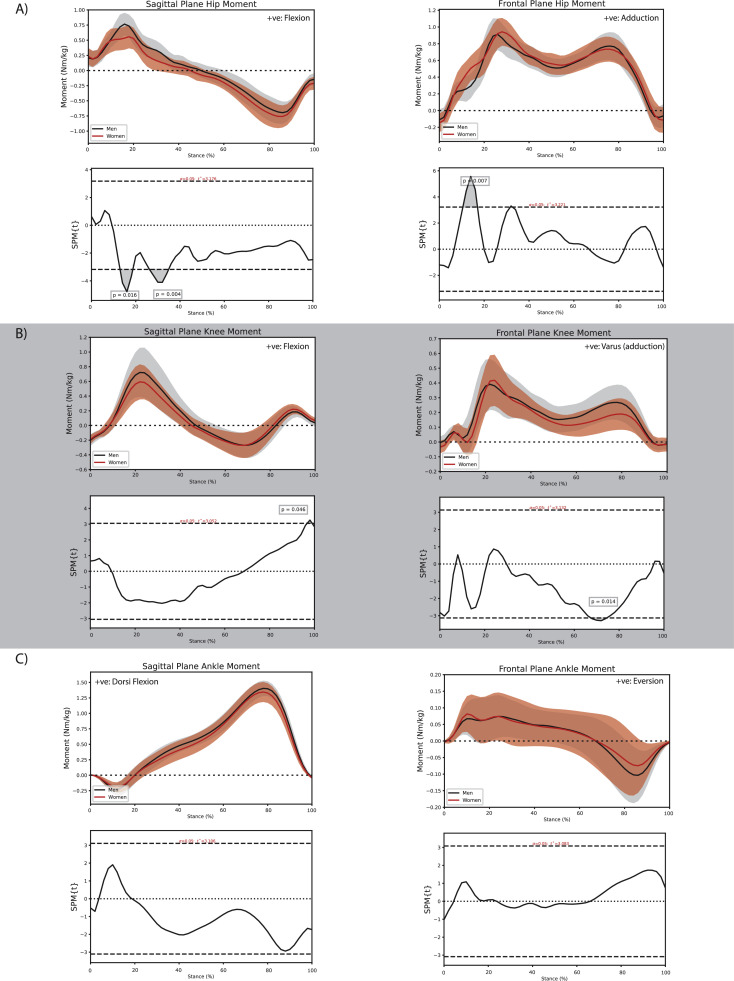
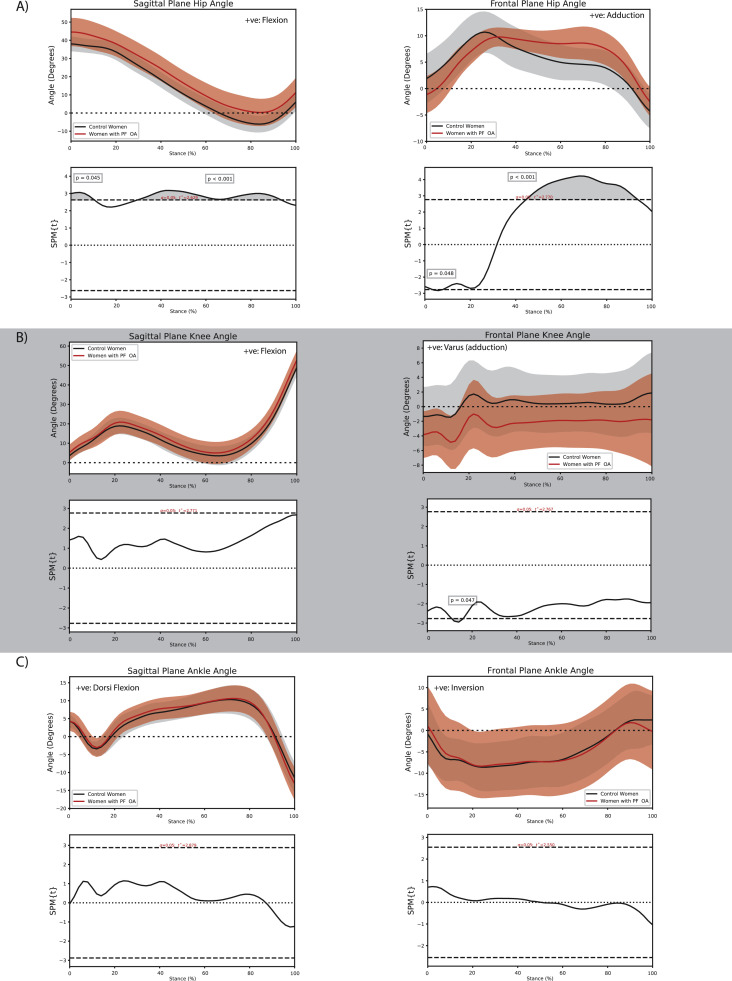
Women with PF OA walked with a greater hip adduction angle throughout stance (t > 2.757) and lower impulses for the hip flexion, knee flexion, and ankle dorsiflexion moments (adjusted mean differences [95% CI]:3.3 × 10 [-4.9 × 10, -1.6 × 10], -2.9 × 10 [-5.3 × 10, -0.4 × 10], -5.1 × 10 [-8.2 × 10, -2.0 × 10] Nms/kg, respectively) compared to men with PF OA. Compared to their asymptomatic peers, women with PF OA displayed a 5° offset towards greater hip flexion. Higher knee adduction moment impulse correlated with worse KOOS-ADL scores in men, not women.
Observed biomechanical differences were small in nature with moderate to weak relationship observed with the KOOS. Findings were not limited to the knee, indicating that women with PF OA display unique biomechanical features across the kinetic-chain.
髌股关节(PF)骨关节炎(OA)患者中,女性和男性在行走生物力学方面的差异可能导致PF OA患者持续症状的发生或进展。
评估PF OA女性患者的行走生物力学与以下两者的差异:(i)PFJ OA男性患者;(ii)无PF OA的女性患者。其次,探讨PF OA患者膝关节相关症状/功能与行走生物力学之间的关系,以及这些关系是否因性别而异。
纳入67例PF OA患者(43例女性)和14例无PF OA的女性。在行走过程中记录生物力学数据。使用膝关节损伤和骨关节炎疗效评分获取患者报告的症状和功能。使用统计参数映射评估连续生物力学数据的差异,使用线性模型评估离散数据和关系。
与PF OA男性患者相比,PF OA女性患者在整个站立期行走时髋关节内收角度更大(t>2.757),髋关节屈曲、膝关节屈曲和踝关节背屈力矩的冲量更低(调整后平均差异[95%CI]:分别为3.3×10[-4.9×10,-1.6×10]、-2.9×10[-5.3×10,-0.4×10]、-5.1×10[-8.2×10,-2.0×10]Nms/kg)。与无症状的同龄人相比,PF OA女性患者髋关节屈曲角度更大5°。较高的膝关节内收力矩冲量与男性而非女性较差的KOOS-ADL评分相关。
观察到的生物力学差异本质上较小,与KOOS的关系为中度至弱相关。研究结果不限于膝关节,表明PF OA女性患者在整个动力链中表现出独特的生物力学特征。