Hostrup Pernille E, Schmidt Tobias, Hellsten Simon B, Gerwig Rebekka H, Størling Joachim, Johannesen Jesper, Sulek Karolina, Hostrup Morten, Andersen Henrik U, Buschard Karsten, Hamid Yasmin, Pociot Flemming
Department of Clinical Research, Steno Diabetes Center Copenhagen, Copenhagen University Hospital, Herlev, Denmark.
Department of Paediatrics, Copenhagen University Hospital, Herlev and Gentofte, Denmark.
Diabetologia. 2025 Jan;68(1):29-40. doi: 10.1007/s00125-024-06290-6. Epub 2024 Oct 30.
AIMS/HYPOTHESIS: Fenofibrate, a peroxisome proliferator-activated receptor alpha agonist, shows some promise in alleviating beta cell stress and preserving beta cell function in preclinical studies of type 1 diabetes. The aim of this phase 2, placebo-controlled, double-blinded, randomised clinical trial was to investigate the efficacy and safety of fenofibrate in adults and adolescents with newly diagnosed type 1 diabetes.
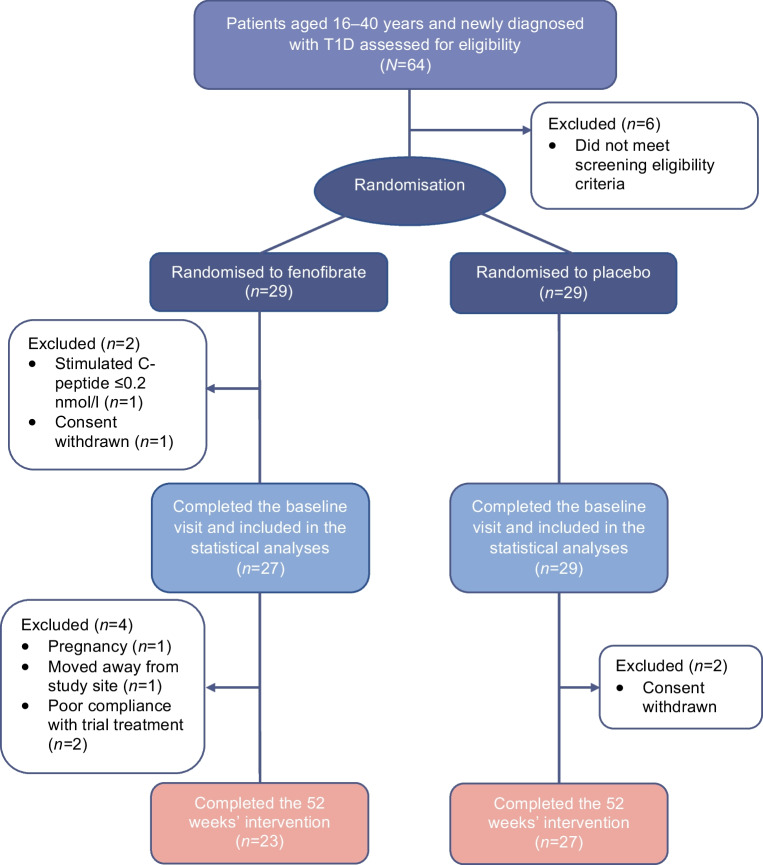
We enrolled 58 individuals (aged 16 to 40 years old) with newly diagnosed type 1 diabetes and randomised them to daily oral treatment with fenofibrate 160 mg or placebo for 52 weeks (in a block design with a block size of 4, assigned in a 1:1 ratio). Our primary outcome was change in beta cell function after 52 weeks of treatment, assessed by AUC for C-peptide levels following a 2 h mixed-meal tolerance test. Secondary outcomes included glycaemic control (assessed by HbA and continuous glucose monitoring), daily insulin use, and proinsulin/C-peptide (PI/C) ratio as a marker of beta cell stress. We assessed outcome measures before and after 4, 12, 26 and 52 weeks of treatment. Blinding was maintained for participants, their healthcare providers and all staff involved in handling outcome samples and assessment.
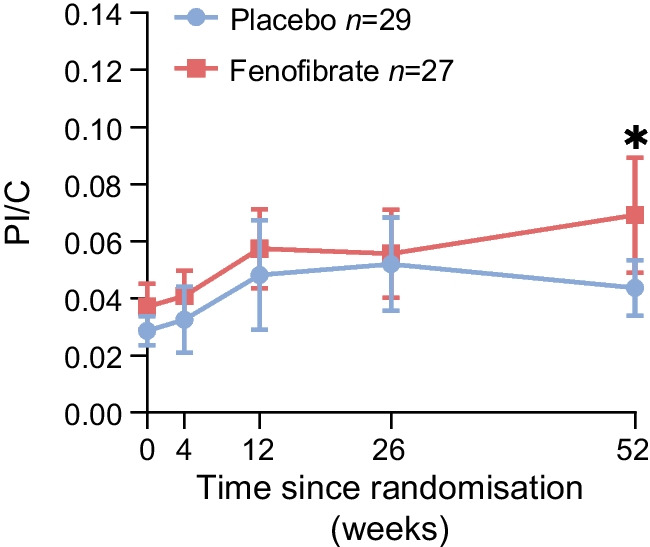
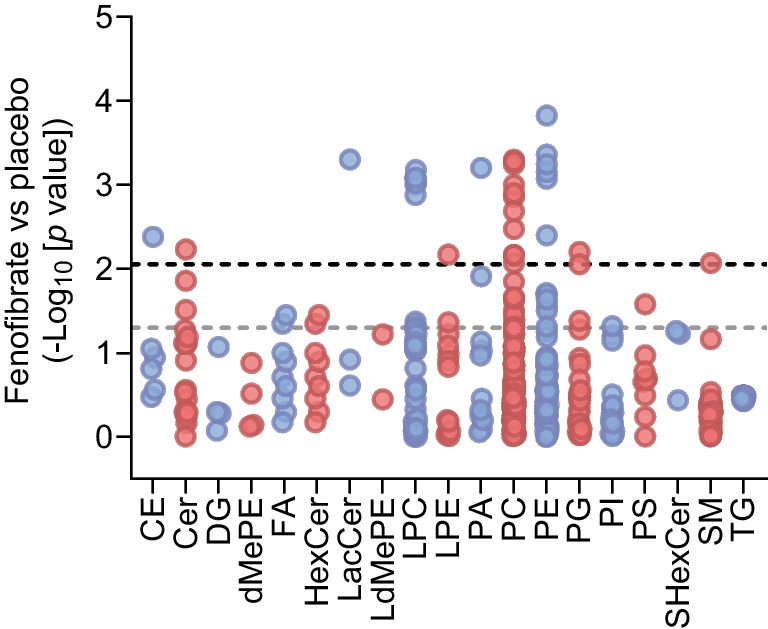
The statistical analyses for the primary outcome included 56 participants (n=27 in the fenofibrate group, after two withdrawals, and n=29 in the placebo group). We found no significant differences between the groups in either 2 h C-peptide levels (mean difference of 0.08 nmol/l [95% CI -0.05, 0.23]), insulin use or glycaemic control after 52 weeks of treatment. On the contrary, the fenofibrate group showed a higher PI/C ratio at week 52 compared with placebo (mean difference of 0.024 [95% CI 0.000, 0.048], p<0.05). Blood lipidome analysis revealed that fenofibrate repressed pathways involved in sphingolipid metabolism and signalling at week 52 compared with placebo. The 52 week intervention evoked few adverse events and no serious adverse events. Follow-up in vitro experiments in human pancreatic islets demonstrated a stress-inducing effect of fenofibrate.
CONCLUSIONS/INTERPRETATION: Contrary to the beneficial effects of fenofibrate found in preclinical studies, this longitudinal, randomised, placebo-controlled trial does not support the use of fenofibrate for preserving beta cell function in individuals with newly diagnosed type 1 diabetes.
EudraCT number: 2019-004434-41 FUNDING: This study was funded by the Sehested Hansens Foundation.
目的/假设:非诺贝特是一种过氧化物酶体增殖物激活受体α激动剂,在1型糖尿病的临床前研究中显示出缓解β细胞应激和维持β细胞功能的潜力。这项2期、安慰剂对照、双盲、随机临床试验的目的是研究非诺贝特在新诊断的1型糖尿病成人和青少年中的疗效和安全性。
我们招募了58例新诊断为1型糖尿病的患者(年龄在16至40岁之间)并将他们随机分为两组,一组每日口服160mg非诺贝特,另一组口服安慰剂,为期52周(采用区组设计,区组大小为4,按1:1比例分配)。我们的主要结局是治疗52周后β细胞功能变化,通过2小时混合餐耐量试验后C肽水平曲线下面积进行评估。次要结局包括血糖控制(通过糖化血红蛋白和持续葡萄糖监测评估)、每日胰岛素用量以及胰岛素原/C肽(PI/C)比值作为β细胞应激的标志物。我们在治疗4、12、26和52周前后评估结局指标。对参与者、他们的医疗服务提供者以及所有参与处理结局样本和评估的工作人员保持盲态。
主要结局的统计分析纳入了56名参与者(非诺贝特组27名[两名退出后],安慰剂组29名)。我们发现治疗52周后,两组间2小时C肽水平(平均差异为0.08nmol/l[95%可信区间-0.05,0.23])、胰岛素用量或血糖控制均无显著差异。相反,与安慰剂相比,非诺贝特组在第52周时PI/C比值更高(平均差异为0.024[95%可信区间0.000,0.048],p<0.05)血脂组分析显示,与安慰剂相比,非诺贝特在第52周时抑制了参与鞘脂代谢和信号传导的通路。52周的干预引发的不良事件较少,没有严重不良事件。在人胰岛中进行的后续体外实验证明了非诺贝特的应激诱导作用。
结论/解读:与临床前研究中发现的非诺贝特的有益作用相反,这项纵向、随机、安慰剂对照试验不支持使用非诺贝特来维持新诊断的1型糖尿病患者的β细胞功能。
EudraCT编号:2019-004434-41
本研究由Sehested Hansens基金会资助。