Department II Internal Medicine and Center for Molecular Medicine Cologne, University of Cologne, Faculty of Medicine and University Hospital Cologne, Cologne, Germany.
Cluster of Excellence Cellular Stress Responses in Aging- associated Diseases (CECAD), University of Cologne, Faculty of Medicine and University Hospital Cologne, Cologne, Germany.
Sci Rep. 2024 Oct 30;14(1):26099. doi: 10.1038/s41598-024-76768-1.
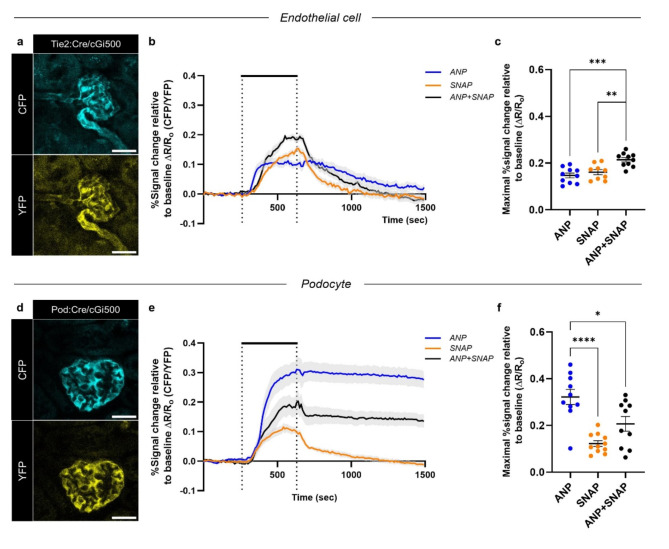
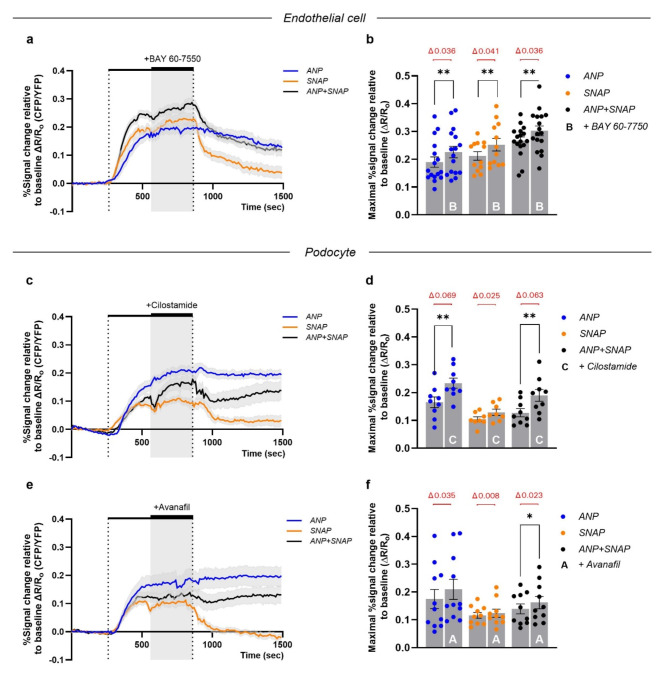
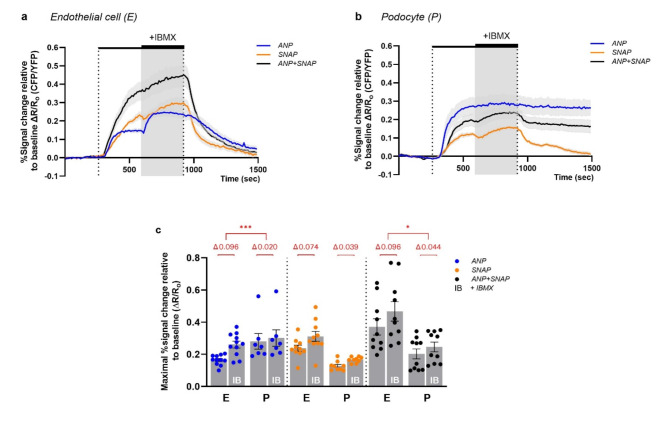
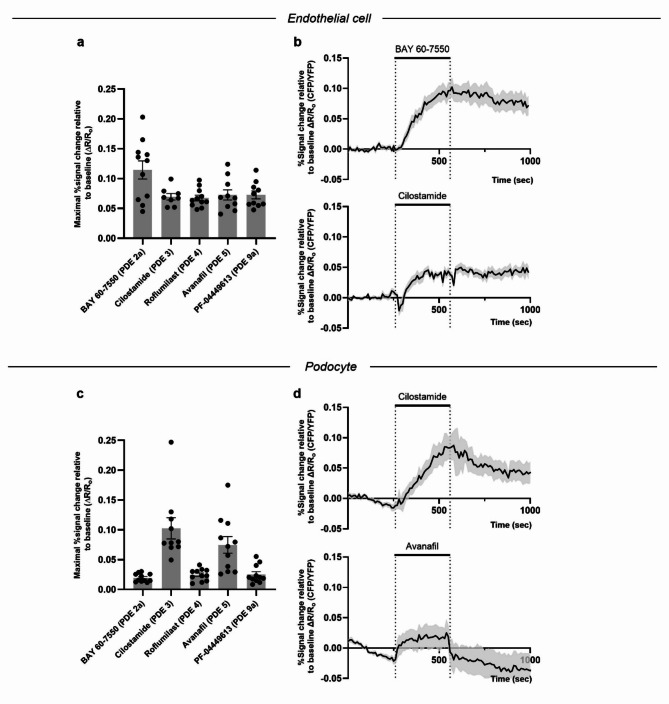
Recent clinical trials of drugs enhancing cyclic guanosine monophosphate (cGMP) signaling for cardiovascular diseases have renewed interest in cGMP biology within the kidney. However, the role of cGMP signaling in glomerular endothelial cells (GECs) and podocytes remains largely unexplored. Using acute kidney slices from mice expressing the FRET-based cGMP biosensor cGi500 in endothelial cells or podocytes enabled real-time visualization of cGMP. Stimulation with atrial natriuretic peptide (ANP) or SNAP (NO donor) and various phosphodiesterase (PDE) inhibitors elevated intracellular cGMP in both cell types. GECs showed a transient cGMP response upon particulate or soluble guanylyl cyclase activation, while the cGMP response in podocytes reached a plateau following ANP administration. Co-stimulation (ANP + SNAP) led to an additive response in GECs. The administration of PDE inhibitors revealed a broader basal PDE activity in GECs dominated by PDE2a. In podocytes, basal PDE activity was mainly restricted to PDE3 and PDE5 activity. Our data demonstrate the existence of both guanylyl cyclase pathways in GECs and podocytes with cell-specific differences in cGMP synthesis and degradation, potentially suggesting new therapeutic options for kidney diseases.
最近,一些临床试验表明,药物可以增强环鸟苷酸(cGMP)信号通路,从而治疗心血管疾病,这重新激发了人们对肾脏中 cGMP 生物学的兴趣。然而,cGMP 信号通路在肾小球内皮细胞(GEC)和足细胞中的作用在很大程度上仍未得到探索。利用在 GEC 或足细胞中表达基于 FRET 的 cGMP 生物传感器 cGi500 的急性肾切片,可实时可视化 cGMP。刺激心房利钠肽(ANP)或 SNAP(NO 供体)以及各种磷酸二酯酶(PDE)抑制剂可同时升高这两种细胞类型中的细胞内 cGMP。颗粒或可溶性鸟苷酸环化酶激活后,GEC 会出现短暂的 cGMP 反应,而在给予 ANP 后,足细胞中的 cGMP 反应达到平台期。共同刺激(ANP+SNAP)会导致 GEC 中的反应呈加性。给予 PDE 抑制剂后,GEC 中存在更为广泛的基础 PDE 活性,主要由 PDE2a 主导。在足细胞中,基础 PDE 活性主要局限于 PDE3 和 PDE5 活性。我们的数据表明,GEC 和足细胞中存在两种鸟苷酸环化酶途径,cGMP 的合成和降解存在细胞特异性差异,这可能为肾脏疾病提供新的治疗选择。