Department of Otorhinolaryngology-Head and Neck Surgery, Yonsei University Wonju College of Medicine, Ilsan-ro 20, Wonju, Republic of Korea.
Department of Medicine, The Graduate School of Yonsei University Wonju College of Medicine, Wonju, Republic of Korea.
Sci Rep. 2024 Oct 30;14(1):26138. doi: 10.1038/s41598-024-77459-7.
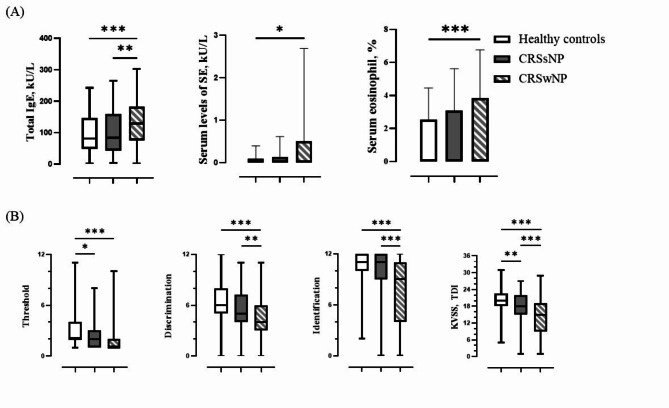
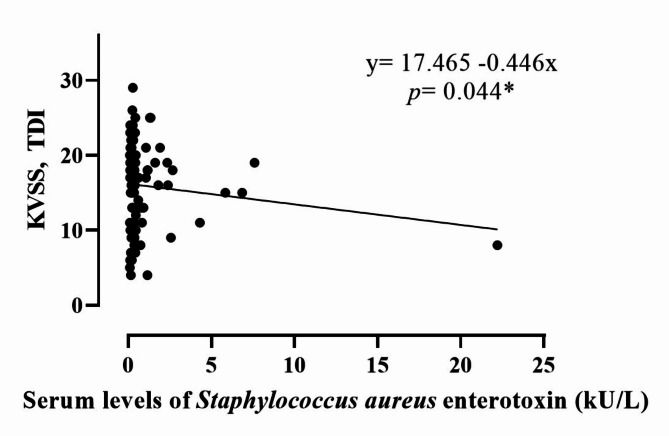
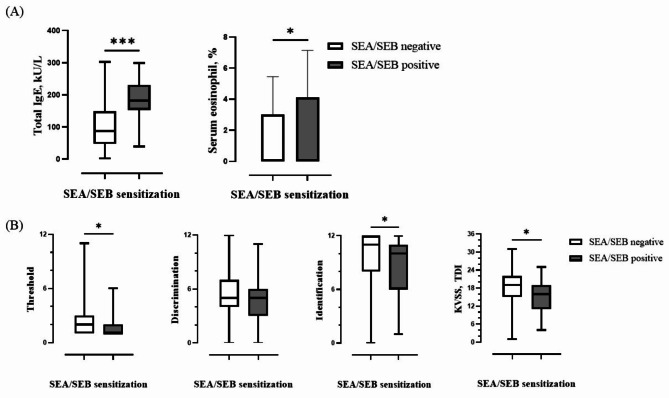
To investigate disparities in sensitisation to Staphylococcus aureus enterotoxin A/B (SEA/SEB) and olfactory function in patients with chronic rhinosinusitis (CRS) with nasal polyps (CRSwNP), those with CRS without nasal polyps (CRSsNP), and healthy controls who underwent septoplasty only. We retrospectively reviewed the medical records of 388 subjects aged ≥ 8 years, collected between January 2021 and June 2023. We analysed patient demographics, medical history, serum IgE levels against staphylococcal enterotoxins (SEs), and serum total IgE levels against inhalant allergens. We performed olfactory and taste function tests in the participants to evaluate the relationship between olfactory function and SEs. Of 388 patients enrolled, 145 were healthy controls, 111 had CRSsNP, and 133 had CRSwNP. The prevalence of SEA/SEB positivity was significantly higher among the patients with CRSwNP than among those in the CRSsNP and healthy controls. The olfactory test results showed significant differences among the groups; anosmia was observed in 9.7% of healthy controls, 22.7% of patients with CRSsNP, and 45.1% of patients with CRSwNP. Olfactory threshold deterioration was evident in patients with CRS. Distinction and identification were more impaired in patients with CRSwNP than in those of the other groups. Finally, the olfactory function scores decreased as the serum levels of SEs increased. Sinusitis patients seem to suffer from perceiving odours, and patients with CRSwNP have difficulty distinguishing odours. Olfactory function test scores decreased in patients with a history of asthma, and as serum levels of staphylococcus enterotoxin and blood eosinophil percentage increase. Furthermore, our result suggests a potential role for SE sensitisation and eosinophil percentage in deteriorating olfaction, especially in patients with CRSwNP.
为了研究慢性鼻-鼻窦炎伴鼻息肉(CRSwNP)、不伴鼻息肉(CRSsNP)患者与健康对照者(仅行鼻中隔成形术)之间金黄色葡萄球菌肠毒素 A/B(SEA/SEB)致敏和嗅觉功能的差异,我们回顾性分析了 2021 年 1 月至 2023 年 6 月间年龄≥8 岁的 388 例患者的病历资料。分析患者的人口统计学特征、病史、针对葡萄球菌肠毒素的血清 IgE 水平和针对吸入性过敏原的血清总 IgE 水平。我们对参与者进行嗅觉和味觉功能测试,以评估嗅觉功能与 SEs 之间的关系。在纳入的 388 例患者中,145 例为健康对照者,111 例为 CRSsNP 患者,133 例为 CRSwNP 患者。CRSwNP 患者 SEA/SEB 阳性率明显高于 CRSsNP 患者和健康对照者。嗅觉测试结果显示各组之间存在显著差异;健康对照组中嗅觉丧失的发生率为 9.7%,CRSsNP 患者为 22.7%,CRSwNP 患者为 45.1%。CRS 患者的嗅觉阈恶化。CRSwNP 患者的分辨和识别能力较其他两组受损更明显。最后,嗅觉功能评分随 SE 血清水平的升高而降低。鼻窦炎患者似乎难以感知气味,而 CRSwNP 患者难以辨别气味。有哮喘病史的患者嗅觉功能测试评分下降,且血清金黄色葡萄球菌肠毒素水平和血嗜酸性粒细胞百分比升高时评分也下降。此外,我们的结果提示 SE 致敏和嗜酸性粒细胞百分比在嗅觉恶化中可能起作用,尤其是在 CRSwNP 患者中。