Maniaki Diamantoula, Sickinger Annika, Barrios Leoní A, Aguilà David, Roubeau Olivier, Guyot Yannick, Riobé François, Maury Olivier, Abad Galán Laura, Aromí Guillem
Departament de Química Inorgànica i Orgànica, Universitat de Barcelona Diagonal 645 08028 Barcelona Spain
Institute of Nanoscience and Nanotechnology of the University of Barcelona (IN2UB) Barcelona Spain.
Chem Sci. 2024 Oct 18;15(44):18295-302. doi: 10.1039/d4sc03994g.
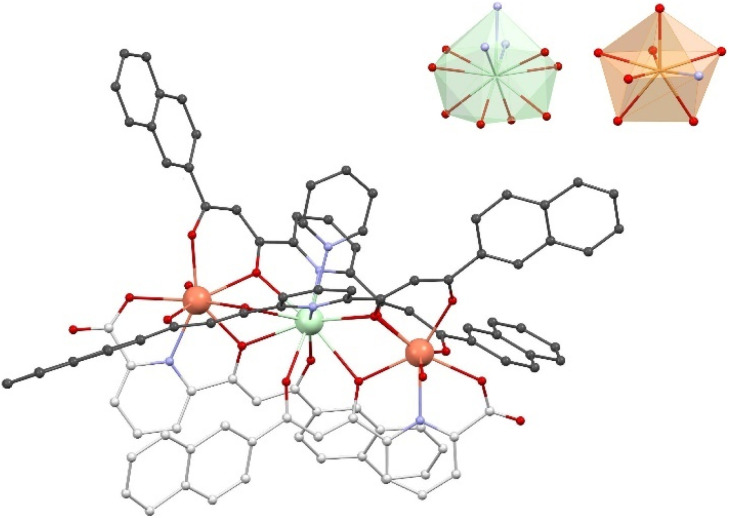
Developing controlled and reproducible molecular assemblies incorporating lanthanide centers is a crucial step for driving forward up- and down-conversion processes. This challenge calls for the development of strategies to facilitate the efficient segregation of different Ln metal ions into distinct positions within the molecule. The unique family of pure [LnLn'Ln] heterometallic coordination compounds previously developed by us represents an ideal platform for studying the desired Ln-to-Ln' energy transfer (ET). In this context, we report here the new pure one-step synthetically produced [ErNdEr] (3) complex, which allows for the first time at the molecular level to study the mechanisms behind Nd-to-Er energy transfer. To further assess the photophysical properties of this complex, the analogous [LuNdLu] (1) and [ErLaEr] (2) complexes have also been prepared and photophysically studied. Efficient sensitization the two β-diketones employed as main ligands was probed for both Nd and Er ions, resulting in highly resolved emission spectra and sufficiently long excited state lifetimes, which allowed further assessment of the Ln-to-Ln' ET. This intermetallic transfer was first detected by comparing the emission spectra of iso-absorbant solutions and demonstrated by comparing the lifetime values with or without the lanthanide quencher (Er), as well as with a deep analysis of the excitation spectrum of the three complexes. Thus, a very unique phenomenon was discovered, consisting of a mutual Nd-to-Er and Er-to-Nd ET with no net increase of brightness by any metal; while Nd transfers the energy received from the antenna to Er, the sensitization of the latter results in back-transfer to Nd into a non-emissive, thus silent, state.
开发包含镧系元素中心的可控且可重现的分子组装体是推动上转换和下转换过程向前发展的关键一步。这一挑战要求开发策略,以促进不同的镧系金属离子在分子内不同位置的有效分离。我们之前开发的独特的纯[LnLn'Ln]异金属配位化合物家族代表了研究所需的Ln到Ln'能量转移(ET)的理想平台。在此背景下,我们在此报告新的纯一步合成制备的[ErNdEr](3)配合物,它首次在分子水平上使我们能够研究Nd到Er能量转移背后的机制。为了进一步评估该配合物的光物理性质,还制备了类似的[LuNdLu](1)和[ErLaEr](2)配合物并对其进行了光物理研究。我们探究了用作主要配体的两种β-二酮对Nd和Er离子的有效敏化作用,从而得到了高分辨率的发射光谱和足够长的激发态寿命,这使得我们能够进一步评估Ln到Ln'的能量转移。这种金属间转移首先通过比较等吸收溶液的发射光谱检测到,并通过比较有或没有镧系猝灭剂(Er)时的寿命值以及对三种配合物的激发光谱进行深入分析来证明。因此,发现了一种非常独特的现象,即存在相互的Nd到Er和Er到Nd的能量转移,且任何一种金属的亮度都没有净增加;当Nd将从天线接收的能量转移给Er时,后者的敏化作用导致能量反向转移到Nd,使其进入非发射的、即沉默的状态。