Kamiue Masanori, Tsubahara Akio, Ito Tomotaka, Koike Yasuhiro
Doctoral Program in Rehabilitation, Graduate School of Health Science and Technology, Kawasaki University of Medical Welfare, Kurashiki, Okayama, Japan.
Department of Physical Therapy, Faculty of Rehabilitation, Kawasaki University of Medical Welfare, Kurashiki, Okayama, Japan.
Jpn J Compr Rehabil Sci. 2024 Oct 28;15:49-57. doi: 10.11336/jjcrs.15.49. eCollection 2024.
Kamiue M, Tsubahara A, Ito T, Koike Y. Effects of repetitive peripheral magnetic stimulation on knee joint extensor strength in older persons receiving day services. Jpn J Compr Rehabil Sci 2024; 15: 49-57.
To verify the effects of repetitive peripheral magnetic stimulation (rPMS) on knee joint extensor strength and motor ability in older adults receiving day services.
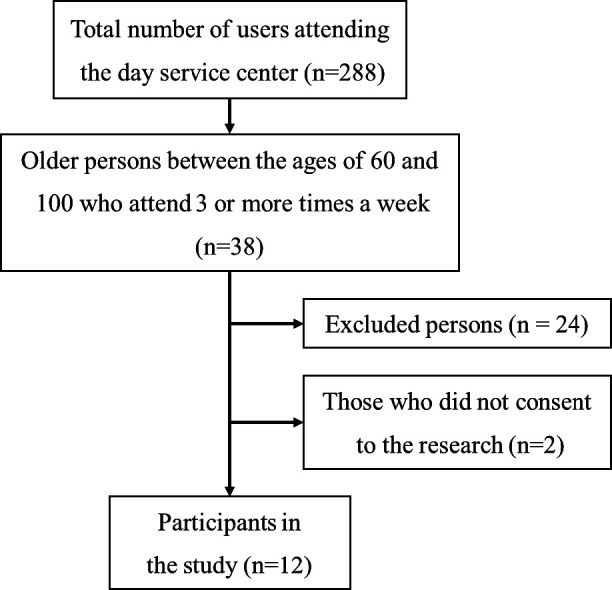
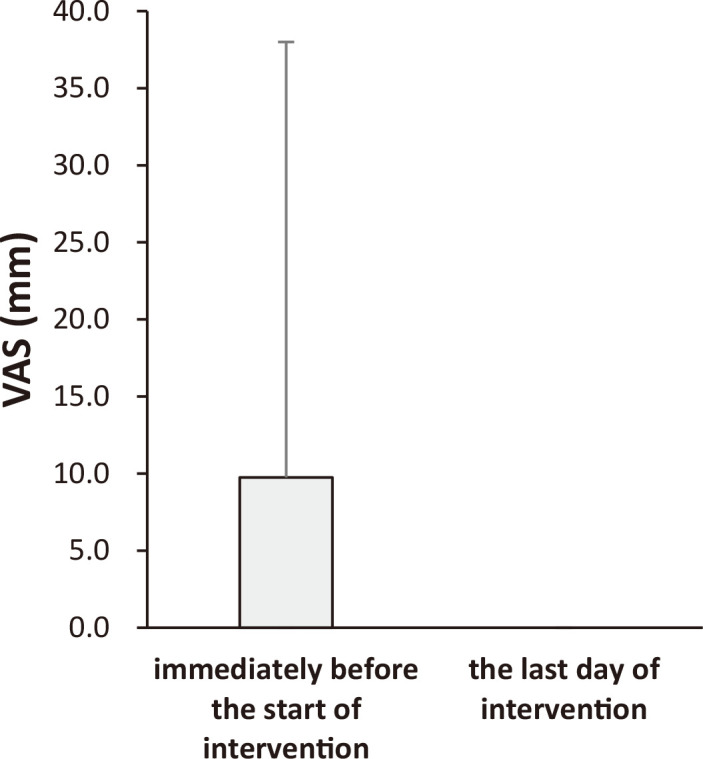
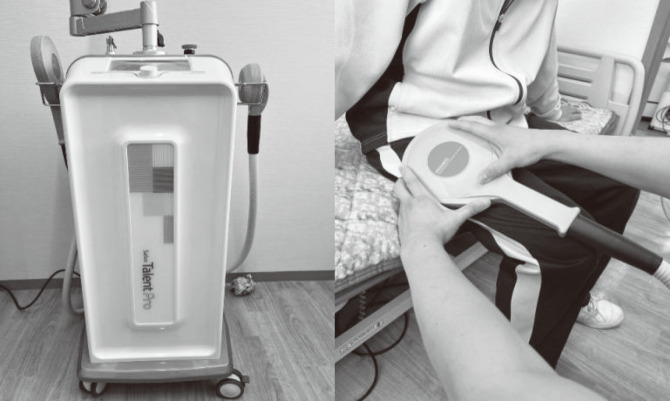
Thirty Hz rPMS using Talent Pro was applied to the bilateral vastus lateralis, vastus medialis, and rectus femoris of 12 older persons (mean age 83.8 ± 4.5 years) attending a day service center and receiving functional training by a physical therapist. The intervention was performed for 20 minutes per day, three times per week, for a total of 4 weeks. Evaluations before and after the intervention included maximum voluntary contraction (MVC), knee extensor torque induced by rPMS (rPMS-induced torque), pain (visual analog scale: VAS), thigh circumference, comfortable 5-m walking time, 30-second chair-stand test (CS-30), Timed-Up-and-Go Test (TUG), and Functional Reach Test (FRT). MVC and rPMS-induced torque were measured using the μ-Tas F-1.
MVC significantly increased in both lower limbs after the intervention (right/left: 72.4 ± 23.5 Nm/72.9 ± 23.0 Nm) compared with immediately before the intervention (right/left: 59.9 ± 17.2 Nm/64.5 ± 21.0 Nm). No significant changes were observed in MVC between one month before the intervention and immediately before the start of the intervention, and between the end of the intervention and one month after the end of the intervention. rPMS-induced torque, TUG, and CS-30 improved significantly after the intervention compared with immediately before the intervention.
Intervention using rPMS increases MVC- and rPMS-induced torque and improves motor ability in older adults. Because rPMS is a simple means of increasing muscle strength, it is expected to be widely used in the future.
上江卫 M、坪原 A、伊藤 T、小池 Y。重复外周磁刺激对接受日间服务的老年人膝关节伸肌力量的影响。《日本综合康复科学杂志》2024 年;15:49 - 57。
验证重复外周磁刺激(rPMS)对接受日间服务的老年人膝关节伸肌力量和运动能力的影响。
使用 Talent Pro 以 30 赫兹的频率对 12 名在日间服务中心接受物理治疗师功能训练的老年人(平均年龄 83.8 ± 4.5 岁)的双侧股外侧肌、股内侧肌和股直肌施加 rPMS。干预每天进行 20 分钟,每周 3 次,共 4 周。干预前后的评估包括最大自主收缩(MVC)、rPMS 诱发的膝关节伸肌扭矩(rPMS 诱发扭矩)、疼痛(视觉模拟评分法:VAS)、大腿围度、舒适状态下的 5 米步行时间、30 秒坐立试验(CS - 30)、定时起立行走测试(TUG)和功能性伸展测试(FRT)。使用 μ - Tas F - 1 测量 MVC 和 rPMS 诱发扭矩。
与干预前即刻相比,干预后双下肢的 MVC 均显著增加(右侧/左侧:72.4 ± 23.5 牛米/72.9 ± 23.0 牛米),干预前一个月与干预开始前即刻之间以及干预结束与干预结束后一个月之间,MVC 未观察到显著变化。与干预前即刻相比,干预后 rPMS 诱发扭矩、TUG 和 CS - 30 显著改善。
使用 rPMS 进行干预可增加 MVC 和 rPMS 诱发扭矩,并改善老年人的运动能力。由于 rPMS 是增加肌肉力量的一种简单方法,预计未来会得到广泛应用。