Suzuki Keita, Ito Tomotaka, Okada Yuji, Hiraoka Takashi, Hanayama Kozo, Tsubahara Akio
Department of Public Health, Graduate School of Advanced Preventive Medical Sciences, Kanazawa University, Kanazawa, Ishikawa, Japan.
Department of Rehabilitation, Faculty of Health Science and Technology, Kawasaki University of Medical Welfare, Kurashiki, Okayama, Japan.
Prog Rehabil Med. 2020 Apr 16;5:20200008. doi: 10.2490/prm.20200008. eCollection 2020.
The aim of this study was to investigate the effect of repetitive peripheral magnetic stimulation (rPMS) on muscle atrophy prevention in the rectus femoris muscle (RF) of the paretic limb in acute stroke patients.
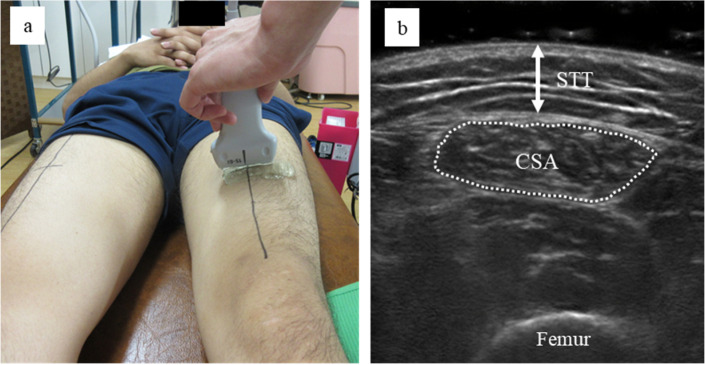
Twelve acute stroke patients with a National Institute of Health Stroke Scale score >5 and a motor score of the paretic lower limb >2 at admission were divided into an intervention group (rPMS: mean age, 75±6.4 years) and a conventional care group (non-rPMS: mean age, 62±11.8 years). Baseline measurements were performed within 4 days of stroke onset. In the rPMS group, treatment was applied to the paretic thigh only for 2 weeks, 5 days a week, in addition to conventional care. The cross-sectional area (CSA) of the RF was assessed in both limbs using ultrasound at baseline and 2 weeks later. Data on patient characteristics were collected from the clinical records to assess correlations with the CSA rate of change.
Patients in the rPMS group were significantly older. Although the CSA of the RF did not change significantly on either side in the rPMS group, there was a significant decrease in the CSA on the paretic side in the non-rPMS group. However, no significant difference was observed in the CSA rate of change in the rPMS and non-rPMS groups. The CSA rate of change on the paretic side correlated negatively with age in the rPMS group.
Our results suggest that rPMS prevents muscle atrophy more effectively in patients in their 60s than in patients more than 70 years old.
本研究旨在探讨重复外周磁刺激(rPMS)对急性脑卒中患者患侧肢体股直肌(RF)肌肉萎缩预防的效果。
12例急性脑卒中患者,入院时美国国立卫生研究院卒中量表评分>5分且患侧下肢运动评分>2分,分为干预组(rPMS:平均年龄75±6.4岁)和传统护理组(非rPMS:平均年龄62±11.8岁)。在卒中发作后4天内进行基线测量。在rPMS组中,除传统护理外,仅对患侧大腿进行治疗,每周5天,共2周。在基线和2周后使用超声评估双侧RF的横截面积(CSA)。从临床记录中收集患者特征数据,以评估与CSA变化率的相关性。
rPMS组患者年龄显著更大。虽然rPMS组双侧RF的CSA均无显著变化,但非rPMS组患侧的CSA显著降低。然而,rPMS组和非rPMS组的CSA变化率未观察到显著差异。rPMS组患侧的CSA变化率与年龄呈负相关。
我们的结果表明,rPMS对60多岁的患者预防肌肉萎缩比70岁以上的患者更有效。