
MYOFLAME-19随机对照试验的设计与原理:利用心血管磁共振终点指标进行心肌保护以减少新冠后炎症性心脏病
Design and rationale of MYOFLAME-19 randomised controlled trial: MYOcardial protection to reduce post-COVID inFLAMmatory heart disease using cardiovascular magnetic resonance Endpoints.
作者信息
Puntmann Valentina O, Beitzke Dietrich, Kammerlander Andreas, Voges Inga, Gabbert Dominik D, Doerr Marcus, Chamling Bishwas, Bozkurt Biykem, Kaski Juan Carlos, Spatz Erica, Herrmann Eva, Rohde Gernot, DeLeuw Philipp, Taylor Lenka, Windemuth-Kieselbach Christine, Harz Cornelia, Santiuste Marta, Schoeckel Laura, Hirayama Juliana, Taylor Peter C, Berry Colin, Nagel Eike
机构信息
Institute for Experimental and Translational Cardiovascular Imaging, DZHK Centre for Cardiovascular Imaging, Goethe University Frankfurt, Frankfurt am Main, Germany; German Centre for Cardiovascular Research - Partner Site Rhein-Main, Rhein-Main, Germany.
Department of Biomedical Imaging and Image-Guided Therapy, Division of Radiology and Nuclear Medicine, University Hospital Vienna, Vienna, Austria.
出版信息
J Cardiovasc Magn Reson. 2024 Oct 29;27(1):101121. doi: 10.1016/j.jocmr.2024.101121.
BACKGROUND
Cardiac symptoms due to postacute inflammatory cardiac involvement affect a broad segment of previously well people with only mild acute coronavirus disease 2019 (COVID-19) illness and without overt structural heart disease. Cardiovascular magnetic resonance (CMR) imaging can identify the underlying subclinical disease process, which is associated with chronic cardiac symptoms. Specific therapy directed at reducing postacute cardiac inflammatory involvement before development of myocardial injury and impairment is missing.
METHODS
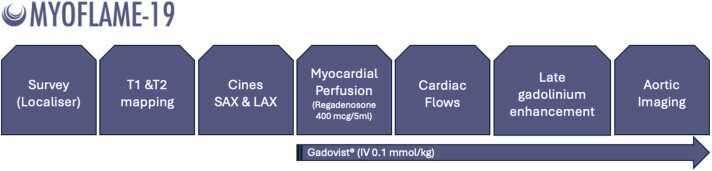
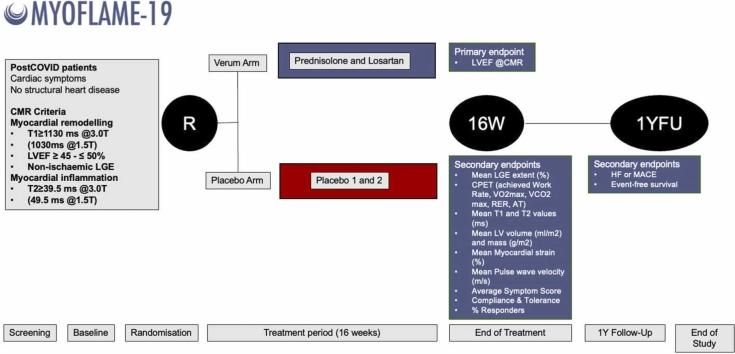
Prospective multicenter randomized placebo-controlled study of myocardial protection therapy (combined immunosuppressive/antiremodeling) of low-dose prednisolone and losartan. Consecutive symptomatic individuals with a prior COVID-19 infection, no pre-existing significant comorbidities or structural heart disease, undergo standardized assessments with questionnaires, CMR imaging, and cardiopulmonary exercise testing (CPET). Eligible participants fulfilling the criteria of subclinical post-COVID inflammatory heart involvement on baseline CMR examination are randomized to treatment with either verum or placebo for a total of 16 weeks (W16). Participants and investigators remain blinded to the group allocation throughout the study duration. The primary efficacy endpoint is the absolute change of left ventricular ejection fraction to baseline at W16, measured by CMR, between the verum treatment and placebo group by absolute difference, using unpaired t-test confirmatively at a significance level of 0.05 significance level. Secondary endpoints include assessment of changes of symptoms, CMR parameters, and CPET after W16, and frequency of major adverse cardiac events after 1 year. Safety data will be analyzed for frequency, severity, and types of adverse events (AEs) for all treatment groups. The proportion of AEs related to the contrast agent gadobutrol will also be analyzed. A calculated sample size is a total of 280 participants (accounting for 22 subjects (8%) drop out), randomized in 1:1 fashion to 140 in the verum and 140 placebo groups.
CONCLUSION
Myoflame-19 study will examine the efficacy of a myocardial protection therapy in symptomatic participants with post-COVID inflammatory cardiac involvement determined by CMR. The aim of the intervention is to reduce the symptoms and inflammatory myocardial injury, improve exercise tolerance, and preclude the development of cardiac impairment.
背景
急性炎症后心脏受累导致的心脏症状影响着广泛的既往健康人群,这些人仅患有轻度新型冠状病毒肺炎(COVID-19),且无明显结构性心脏病。心血管磁共振(CMR)成像可识别潜在的亚临床疾病过程,这与慢性心脏症状相关。目前缺乏在心肌损伤和功能障碍发生之前针对减轻急性炎症后心脏受累的特异性治疗方法。
方法
一项关于低剂量泼尼松龙和氯沙坦心肌保护治疗(联合免疫抑制/抗重塑)的前瞻性多中心随机安慰剂对照研究。对既往有COVID-19感染、无预先存在的严重合并症或结构性心脏病的连续有症状个体,采用问卷、CMR成像和心肺运动试验(CPET)进行标准化评估。符合基线CMR检查中亚临床COVID后炎症性心脏受累标准的合格参与者被随机分为接受真药或安慰剂治疗,共16周(W16)。在整个研究期间,参与者和研究者对分组情况保持盲态。主要疗效终点是通过CMR测量的W16时真药治疗组与安慰剂组左心室射血分数相对于基线的绝对变化,采用绝对差值,使用不成对t检验在0.05显著性水平进行确认性检验。次要终点包括W16后症状、CMR参数和CPET的变化评估,以及1年后主要不良心脏事件的发生率。将对所有治疗组不良事件(AE)的频率、严重程度和类型进行安全性数据分析。还将分析与造影剂钆布醇相关的AE比例。计算得出的样本量为总共280名参与者(考虑到22名受试者(8%)退出),以1:1的方式随机分为真药组140名和安慰剂组140名。
结论
Myoflame-19研究将检验心肌保护治疗对CMR确定的有症状的COVID后炎症性心脏受累参与者的疗效。干预的目的是减轻症状和炎症性心肌损伤,提高运动耐量,并预防心脏功能障碍的发生。
 Zotero 插件