Cancer Epidemiology & Biostatistics Department, National Cancer Institute, Cairo University, Cairo, Egypt.
Nursing Faculty, Alexandria University, Alexandria, Egypt.
BMC Med Educ. 2024 Oct 31;24(1):1244. doi: 10.1186/s12909-024-06201-8.
Artificial intelligence (AI) is one of the sectors of medical research that is expanding the fastest right now in healthcare. AI has rapidly advanced in the field of medicine, helping to treat a variety of illnesses and reducing the number of diagnostic and follow-up errors.
This study aims to assess the perception and attitude towards artificial intelligence (AI) among medical students & house officers in Egypt.
An online cross-sectional study was done using a questionnaire on the Google Form website. The survey collected demographic data and explored participants' perception, attitude & potential barriers towards AI.
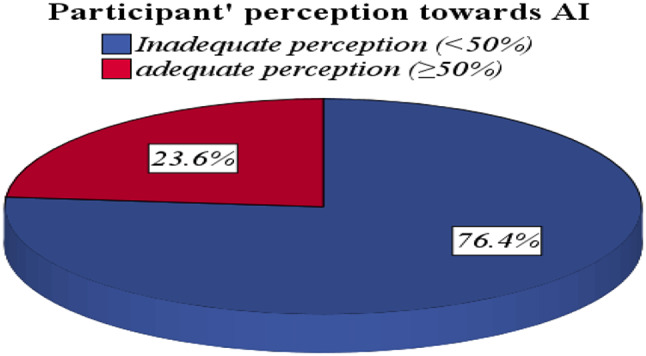
There are 1,346 responses from Egyptian medical students (25.8%) & house officers (74.2%). Most participants have inadequate perception (76.4%) about the importance and usage of AI in the medical field, while the majority (87.4%) have a negative attitude. Multivariate analysis revealed that age is the only independent predictor of AI perception (AOR = 1.07, 95% CI 1.01-1.13). However, perception level and gender are both independent predictors of attitude towards AI (AOR = 1.93, 95% CI 1.37-2.74 & AOR = 1.80, 95% CI 1.30-2.49, respectively).
The study found that medical students and house officers in Egypt have an overall negative attitude towards the integration of AI technologies in healthcare. Despite the potential benefits of AI-driven digital medicine, most respondents expressed concerns about the practical application of these technologies in the clinical setting. The current study highlights the need to address the concerns of medical students and house officers towards AI integration in Egypt. A multi-pronged approach, including education, targeted training, and addressing specific concerns, is necessary to facilitate the wider adoption of AI-enabled healthcare.
人工智能(AI)是目前医疗保健领域发展最快的医学研究领域之一。AI 在医学领域迅速发展,有助于治疗各种疾病,并减少诊断和随访错误的数量。
本研究旨在评估埃及医学生和住院医师对人工智能(AI)的认知和态度。
使用 Google 表单网站上的问卷进行了一项在线横断面研究。该调查收集了人口统计学数据,并探讨了参与者对 AI 的认知、态度和潜在障碍。
共有 1346 名来自埃及医学生(25.8%)和住院医师(74.2%)的参与者做出了回应。大多数参与者对 AI 在医学领域的重要性和使用认知不足(76.4%),而大多数人(87.4%)持负面态度。多变量分析显示,年龄是 AI 认知的唯一独立预测因素(AOR=1.07,95%CI 1.01-1.13)。然而,认知水平和性别都是对 AI 态度的独立预测因素(AOR=1.93,95%CI 1.37-2.74 和 AOR=1.80,95%CI 1.30-2.49)。
本研究发现,埃及的医学生和住院医师对将 AI 技术整合到医疗保健中总体持负面态度。尽管 AI 驱动的数字医学具有潜在的好处,但大多数受访者对这些技术在临床环境中的实际应用表示担忧。本研究强调了需要解决埃及医学生和住院医师对 AI 整合的担忧。需要采取多管齐下的方法,包括教育、有针对性的培训和解决具体问题,以促进更广泛地采用 AI 支持的医疗保健。