Vermeulen Helene, Catry Boudewijn, Catteau Lucy, Hens Niel
Interuniversity Institute for Biostatistics and statistical Bioinformatics (I-BIOSTAT), Data Science Institute (DSI), Hasselt University, Hasselt, Belgium.
Department of Epidemiology and public health, Sciensano, Brussels, Belgium.
Arch Public Health. 2024 Oct 31;82(1):197. doi: 10.1186/s13690-024-01427-w.
A rebound in antibiotic consumption has been observed in the European community at the end of the COVID-19 pandemic. Here we evaluate the extent of this increase, when it exactly occurred, and how the seasonality in antibiotic use changed during the late-pandemic period.
Data on community antibiotic consumption were available from the European Surveillance of Antimicrobial Consumption Network for 28 European countries between 2015 and 2022. Antibiotic consumption was expressed as defined daily doses per 1000 inhabitants per day (DID). The evolution in antibiotic use was investigated using non-linear changepoint mixed models for quarterly and yearly data.
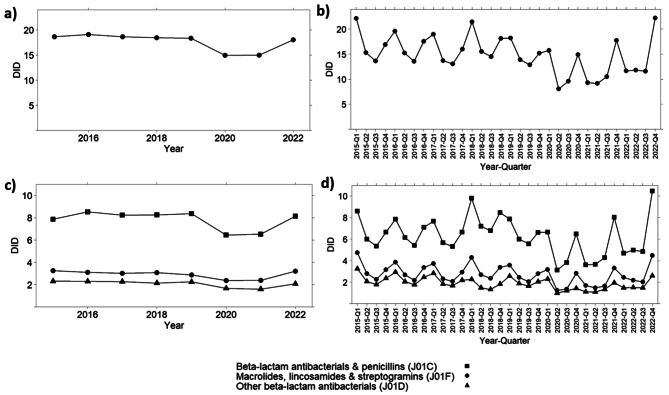
An increase in overall antibiotic consumption was found in Europe between 2021 and 2022, mainly due to an increase in the consumption of penicillins, macrolides, lincosamides and streptogramins, and other β-lactam antibacterials. The analysis of quarterly data estimated a gradual increase in overall antibiotic consumption of 0.55 DID per quarter, as of the second quarter of 2020 and a decrease in seasonal variation of 1.64 DID between the first and second quarter of 2020. The changepoint analysis of yearly data estimated an increase of 3.33 DID in overall antibiotic consumption between 2021 and 2022.
A gradual but significant rebound in the use of antibiotics was found in Europe, along with a decrease in its seasonal variation. The rapid rise in antibiotic consumption above pre-pandemic levels in several countries underlines the importance of continued antimicrobial stewardship.
在新冠疫情结束时,欧洲共同体出现了抗生素消费反弹的情况。在此,我们评估了这种增长的程度、确切发生时间以及在疫情后期抗生素使用的季节性变化情况。
欧洲抗菌药物消费监测网络提供了2015年至2022年期间28个欧洲国家社区抗生素消费的数据。抗生素消费以每1000居民每天的限定日剂量(DID)表示。使用非线性变点混合模型对季度和年度数据进行调查,以研究抗生素使用的演变情况。
2021年至2022年期间,欧洲整体抗生素消费有所增加,主要是由于青霉素、大环内酯类、林可酰胺类和链阳菌素类以及其他β-内酰胺类抗菌药物的消费增加。对季度数据的分析估计,自2020年第二季度起,整体抗生素消费每季度逐渐增加0.55 DID,且2020年第一季度和第二季度之间季节性变化减少了1.64 DID。对年度数据的变点分析估计,2021年至2022年期间整体抗生素消费增加了3.33 DID。
欧洲发现抗生素使用出现了逐渐但显著的反弹,同时季节性变化有所减少。几个国家抗生素消费迅速超过疫情前水平,这凸显了持续进行抗菌药物管理的重要性。