Futamura Akihiko, Koseki Takenao, Iida Junichi, Suzuki Akito, Muroi Nobuyuki, Myotoku Michiaki, Maki Hiroki, Mizutani Kazuhisa, Ogino Hikaru, Taniguchi Yasuki, Higashi Keiichiro, Usui Masanobu
Department of Pharmacy, Fujita Health University Nanakuri Memorial Hospital, 424-1, Oodori, Tsu, Mie, 514-1295, Japan.
Department of Pharmacotherapeutics and Informatics, Fujita Health University School of Medicine, 1-98, Dengakugakubo, Kutsukake-Cho, Toyoake, Aichi, 470-1192, Japan.
J Pharm Health Care Sci. 2024 Oct 31;10(1):67. doi: 10.1186/s40780-024-00389-z.
This study aimed to clarify the effectiveness of nutrition support team (NST) facilities for preventing central line-associated bloodstream infection (CLABSI).
We retrospectively analyzed the incidence of CLABSI as well as the presence or absence of additional medical fees for NST activity between 2019 and 2021, including the period before and after the COVID-19 pandemic. Subsequently, we performed between-group comparisons of the CLABSI incidence. CLABSI rates were compared based on cumulative per 1000 catheter uses during the relevant period.
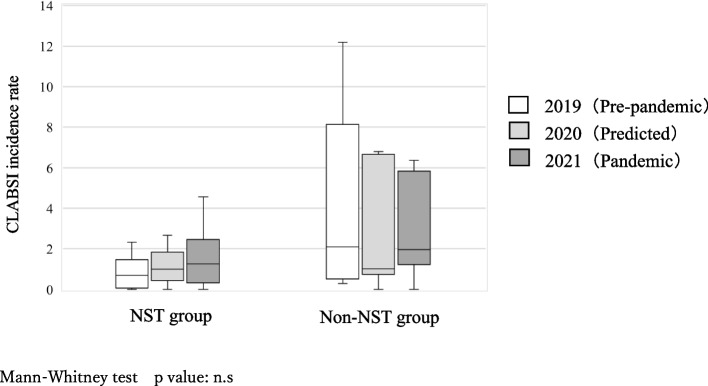
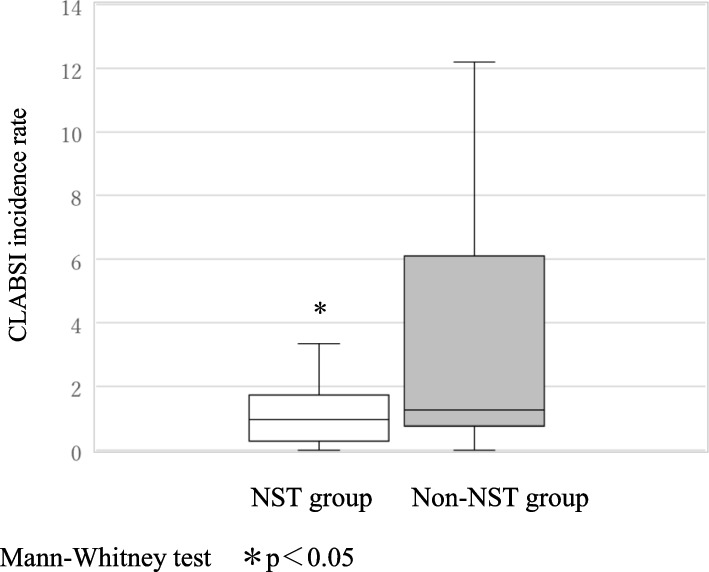
Among 47 facilities that were registered for participation, there were 34 and 13 facilities with and without additional medical fees for NST activity (NST and non-NST groups, respectively). The CLABSI incidence rate was significantly lower in the NST group 0.96 [0.28-1.73] than in the non-NST group 1.25 [075-6.10] (p < 0.05). Before the pandemic, the NST group had a lower CLABSI rate per 1000 catheter uses than the non-NST group 2019: 0.70 [0.12-1.26] vs 2.10 [0.62-5.97]. During the pandemic, the CLABSI incidence showed no significant between-group difference 2020: 0.99 [0.51-1.61] vs 1.01 [0.80-4.16]; 2021: 1.24 [0.44-2.35] vs 1.96 [1.23-5.31]; however, the CLABSI rates in the NST group remained low.
During the COVID-19 pandemic, the incidence of CLABSI was lower in the NST group than in the non-NST group, indicating the effectiveness of NST in preventing the occurrence of CLABSI.
本研究旨在阐明营养支持团队(NST)设施在预防中心静脉导管相关血流感染(CLABSI)方面的有效性。
我们回顾性分析了2019年至2021年期间CLABSI的发生率以及NST活动的额外医疗费用情况,包括新冠疫情前后的时间段。随后,我们对CLABSI发生率进行了组间比较。CLABSI发生率是根据相关期间每1000次导管使用的累积发生率进行比较的。
在登记参与的47个机构中,有34个和13个机构分别有和没有NST活动的额外医疗费用(分别为NST组和非NST组)。NST组的CLABSI发生率0.96[0.28 - 1.73]显著低于非NST组的1.25[0.75 - 6.10](p < 0.05)。在疫情之前,NST组每1000次导管使用的CLABSI发生率低于非NST组2019年:0.70[0.12 - 1.26]对2.10[0.62 - 5.97]。在疫情期间,CLABSI发生率在组间没有显著差异2020年:0.99[0.51 - 1.61]对1.01[0.80 - 4.16];2021年:1.24[0.44 - 2.35]对1.96[1.23 - 5.31];然而,NST组的CLABSI发生率仍然较低。
在新冠疫情期间,NST组的CLABSI发生率低于非NST组,表明NST在预防CLABSI发生方面是有效的。