Chowdhury Sukanta, Hossain Mohammad Enayet, Hasan Rashedul, Miah Mojnu, Biswas Sajal Kanti, Hasan Md Mahmudul, Ghosh Probir Kumar, Ami Jenifar Quaiyum, Saha Akash, Ghosh Sumon, Rahman Mahmudur, Chowdhury Fahmida, Rahman Mohammed Ziaur
International Centre for Diarrheal Diseases Research, Bangladesh (icddr,b), Dhaka, Bangladesh.
Department of Chemistry and Biochemistry, New Mexico State University, Las Cruces, NM, USA.
One Health Outlook. 2024 Nov 1;6(1):26. doi: 10.1186/s42522-024-00119-3.
Bangladesh has reported > 560 H5N1 outbreaks in poultry and eight human cases since 2007. Commercial chicken farms were mostly affected. Commercial chicken farms across the country use imported vaccines against H5N1 virus; however, these vaccines did not use local circulatory isolates of H5N1virus. Vaccination may have limited effectiveness in chicken because of the mismatch in terms of subtypes and clades. To test this, we conducted a mixed-method study to assess the impact of ongoing vaccination against H5N1 virus on H5N1 viral shedding through freshly dropped feces of chickens raised in commercial farms that exclusively vaccinated or did not vaccinate their chickens.
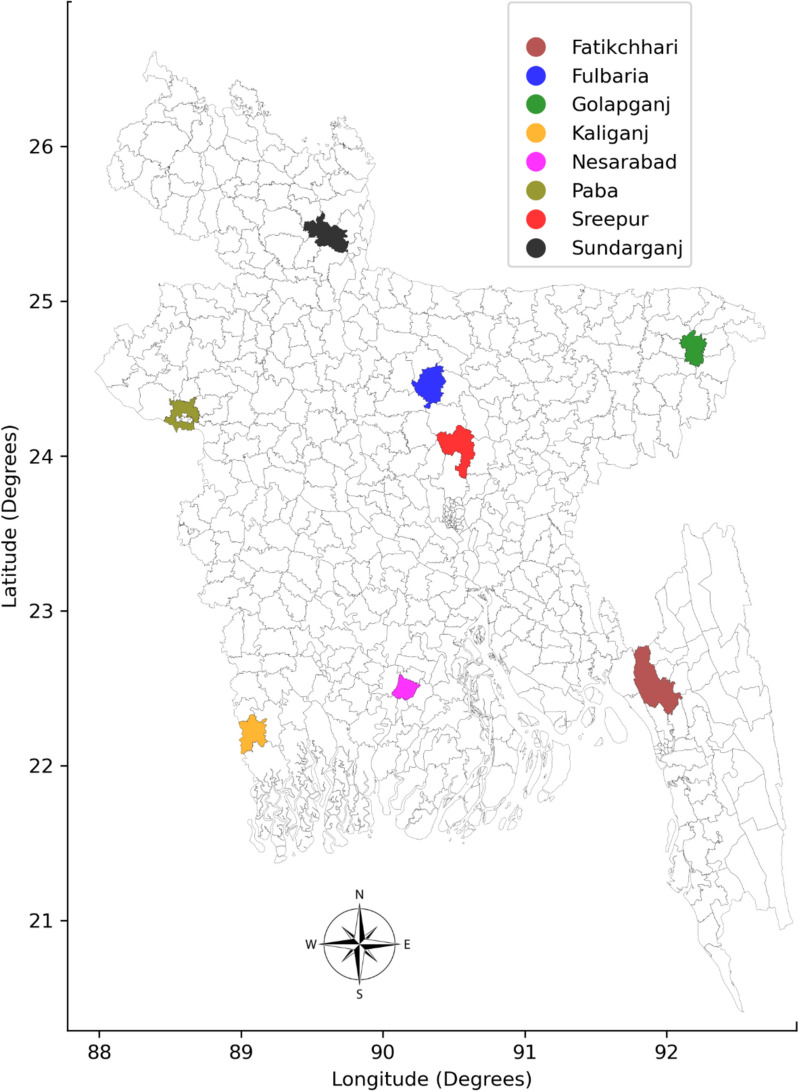
Initially, we collected vaccination coverage data from all active farms in a subdistrict of each of eight division. In each district, 25 vaccinated and 25 non-vaccinated chicken farms were selected randomly for sample collection. All samples were tested to detect avian influenza viruses using rRT-PCR.
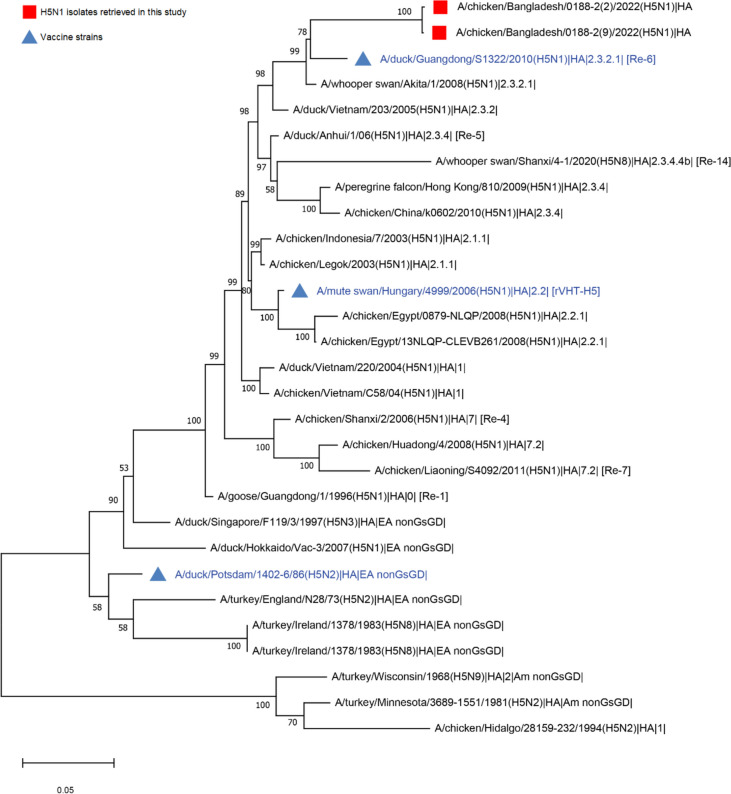
A total of 5092 poultry farms were surveyed; among them 1284 (25%) chicken farms administered vaccine against H5N1 virus. In total 21 of 400 tested farms (5%) had chicken feces samples that tested positive for AIVs; of these three were positive for H5N1 subtype of clade 2.3.2.1. Out of three H5N1 positive farms, 1 (33%) was vaccinated and 2 (67%) were unvaccinated. The chicken farms that administered vaccine against H5N1 was found protective for the detection of H5N1 viral RNA (aOR 0.39, 95% CI: 0.32-0.48). The H5N1 isolates of clade 2.3.2.1 sequenced in this study formed a cluster with the vaccine strain A/duck/Guangdong/S1322/2010 (H5N1) [Re-6].
The overall low vaccination coverage with low detection of H5N1 virus in commercial chickens makes it difficult to assess the effectiveness of the vaccine in reducing H5N1 viral shedding.
自2007年以来,孟加拉国已报告超过560起家禽H5N1疫情和8例人类病例。商业养鸡场受影响最为严重。该国的商业养鸡场使用进口的H5N1病毒疫苗;然而,这些疫苗并未采用当地流行的H5N1病毒分离株。由于亚型和进化枝不匹配,疫苗对鸡的有效性可能有限。为了验证这一点,我们开展了一项混合方法研究,以评估针对H5N1病毒进行的现行疫苗接种对商业农场中仅接种或未接种疫苗的鸡新排出粪便中H5N1病毒 shedding的影响。
最初,我们从八个行政区中每个行政区的一个分区内所有活跃农场收集疫苗接种覆盖率数据。在每个区,随机选择25个接种疫苗的养鸡场和25个未接种疫苗的养鸡场进行样本采集。所有样本均使用逆转录-实时荧光定量聚合酶链反应(rRT-PCR)检测禽流感病毒。
共调查了5092家家禽养殖场;其中1284家(25%)养鸡场接种了H5N1病毒疫苗。在400个检测的养殖场中,共有21家(5%)的鸡粪便样本检测出禽流感病毒呈阳性;其中3家的2.3.2.1进化枝H5N1亚型呈阳性。在3家H5N1呈阳性的养殖场中,1家(33%)接种了疫苗,2家(67%)未接种疫苗。发现接种H5N1疫苗的养鸡场对检测H5N1病毒RNA具有保护作用(校正比值比为0.39,95%置信区间:0.32 - 0.48)。本研究中测序的2.3.2.1进化枝H5N1分离株与疫苗株A/鸭/广东/S1322/2010(H5N1)[Re-6]形成一个聚类。
商业养鸡场总体疫苗接种覆盖率较低,且H5N1病毒检测率较低,因此难以评估疫苗在减少H5N1病毒 shedding方面的有效性。