a Department of Infectious Diseases , St. Jude Children's Research Hospital , Memphis , TN , USA.
b Department of Zoology , Jahangirnagar University , Dhaka , Bangladesh.
Emerg Microbes Infect. 2019;8(1):650-661. doi: 10.1080/22221751.2019.1605845.
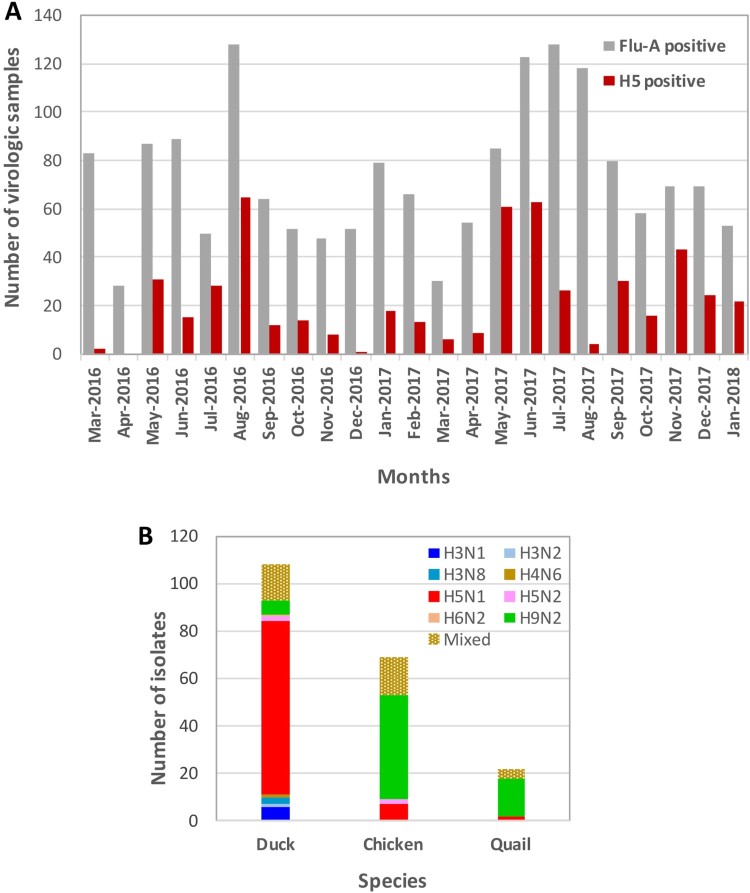
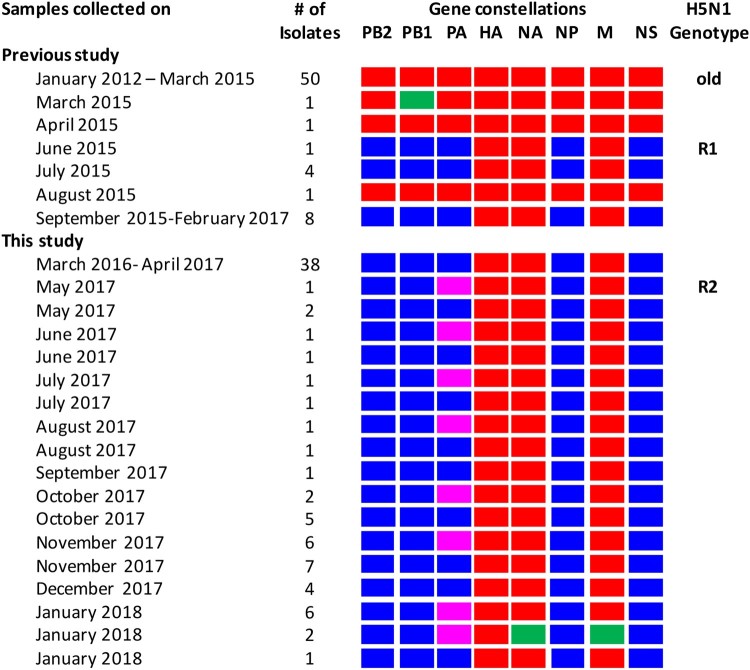
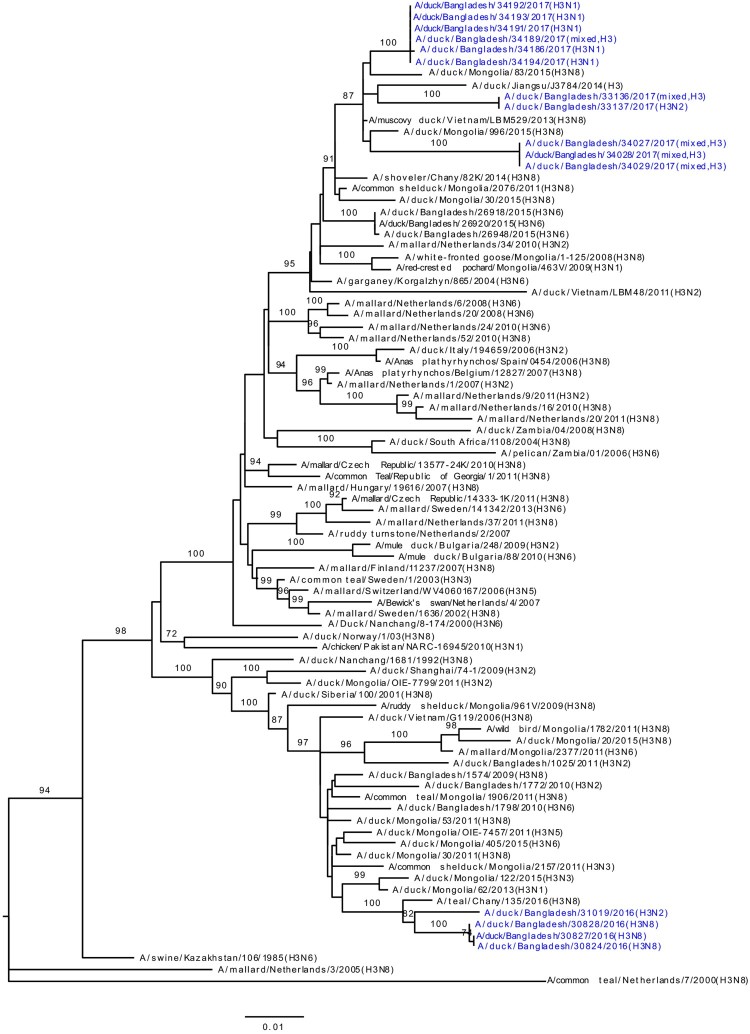
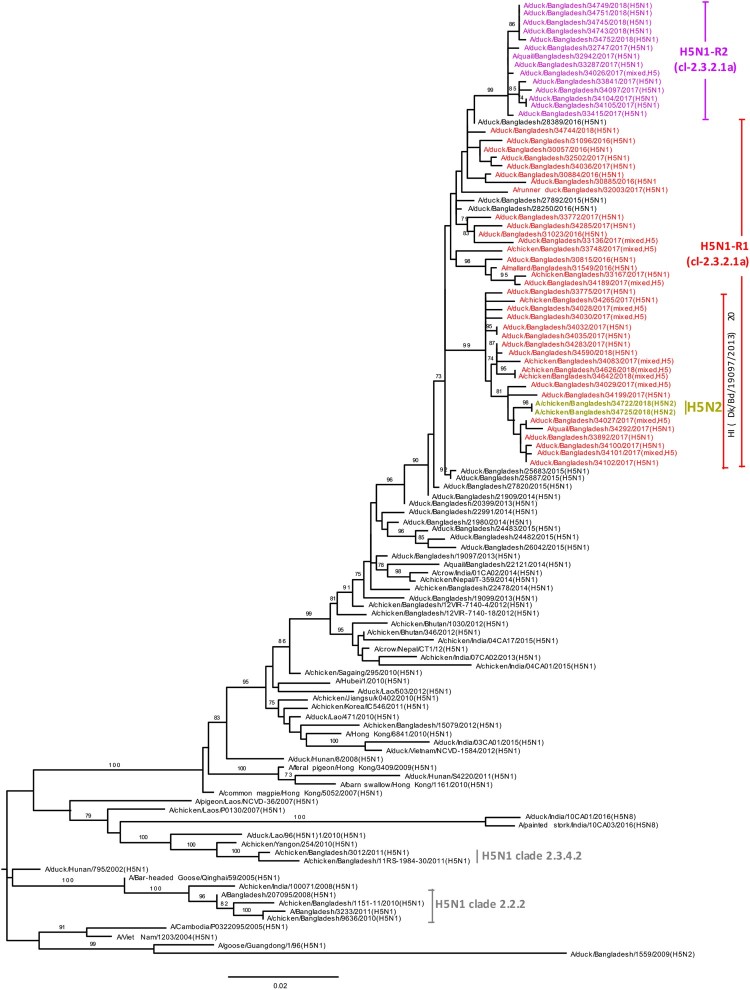
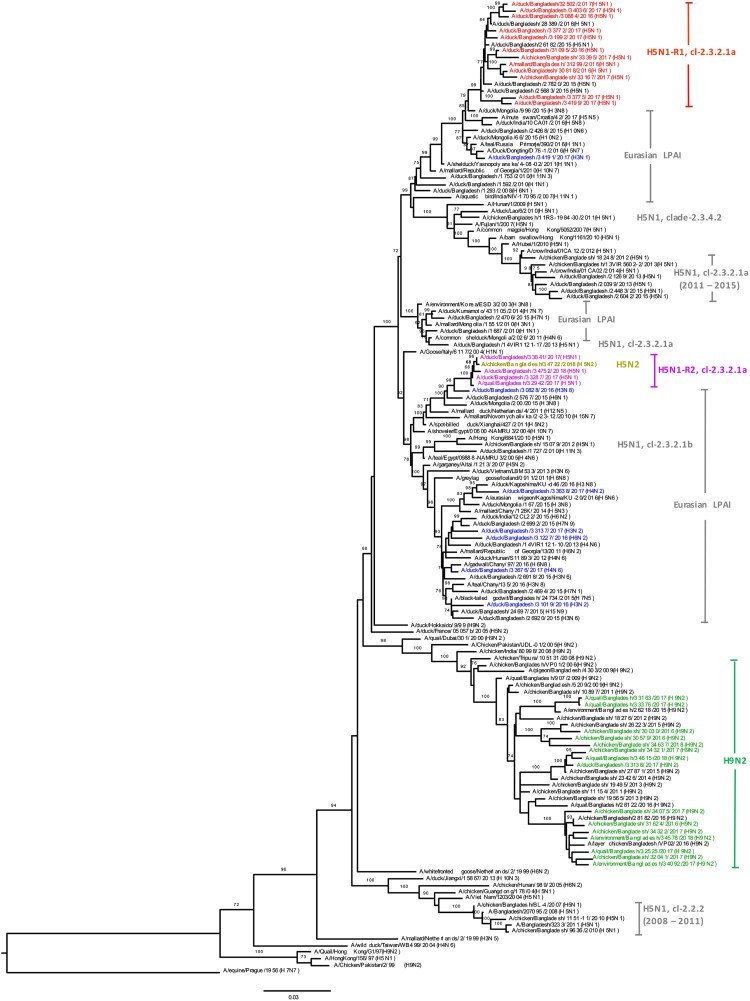
Since November 2008, we have conducted active avian influenza surveillance in Bangladesh. Clades 2.2.2, 2.3.4.2, and 2.3.2.1a of highly pathogenic avian influenza H5N1 viruses have all been identified in Bangladeshi live poultry markets (LPMs), although, since the end of 2014, H5N1 viruses have been exclusively from clade 2.3.2.1a. In June 2015, a new reassortant H5N1 virus (H5N1-R1) from clade 2.3.2.1a was identified, containing haemagglutinin, neuraminidase, and matrix genes of H5N1 viruses circulating in Bangladesh since 2011, plus five other genes of Eurasian-lineage low pathogenic avian influenza A (LPAI) viruses. Here we report the status of circulating avian influenza A viruses in Bangladeshi LPMs from March 2016 to January 2018. Until April 2017, H5N1 viruses exclusively belonged to H5N1-R1 clade 2.3.2.1a. However, in May 2017, we identified another reassortant H5N1 (H5N1-R2), also of clade 2.3.2.1a, wherein the PA gene segment of H5N1-R1 was replaced by that of another Eurasian-lineage LPAI virus related to A/duck/Bangladesh/30828/2016 (H3N8), detected in Bangladeshi LPM in September 2016. Currently, both reassortant H5N1-R1 and H5N1-R2 co-circulate in Bangladeshi LPMs. Furthermore, some LPAI viruses isolated from LPMs during 2016-2017 were closely related to those from ducks in free-range farms and wild birds in Tanguar haor, a wetland region of Bangladesh where ducks have frequent contact with migratory birds. These data support a hypothesis where Tanguar haor-like ecosystems provide a mechanism for movement of LPAI viruses to LPMs where reassortment with poultry viruses occurs adding to the diversity of viruses at this human-animal interface.
自 2008 年 11 月以来,我们一直在孟加拉国开展积极的禽流感监测。在孟加拉国的活禽市场(LPMs)中,已经发现了高致病性禽流感 H5N1 病毒的 2.2.2、2.3.4.2 和 2.3.2.1a 分支,但自 2014 年底以来,H5N1 病毒一直来自 2.3.2.1a 分支。2015 年 6 月,从 2.3.2.1a 分支中鉴定出一种新的重配 H5N1 病毒(H5N1-R1),其血凝素、神经氨酸酶和基质基因来自孟加拉国自 2011 年以来流行的 H5N1 病毒,另外还有 5 个欧亚谱系低致病性禽流感 A(LPAI)病毒的其他基因。在这里,我们报告了 2016 年 3 月至 2018 年 1 月期间孟加拉国 LPM 中循环的禽流感 A 病毒的状况。直到 2017 年 4 月,H5N1 病毒仅属于 H5N1-R1 2.3.2.1a 分支。然而,在 2017 年 5 月,我们鉴定出另一种重配的 H5N1(H5N1-R2),也属于 2.3.2.1a 分支,其中 H5N1-R1 的 PA 基因片段被另一种与 2016 年 9 月在孟加拉国 LPM 中检测到的 A/duck/Bangladesh/30828/2016(H3N8)欧亚谱系 LPAI 病毒取代。目前,重组 H5N1-R1 和 H5N1-R2 都在孟加拉国 LPM 中共同循环。此外,2016-2017 年从 LPM 中分离出的一些 LPAI 病毒与自由放养农场的鸭子和孟加拉国 Tanguar haor 湿地地区的野鸟中的病毒密切相关,鸭子经常与候鸟接触。这些数据支持了一个假设,即 Tanguar haor 样生态系统提供了一种机制,将 LPAI 病毒转移到 LPMs 中,在那里与家禽病毒发生重配,增加了该人类-动物界面病毒的多样性。