Department of Hematology, Pitié Salpêtrière University Hospital, Sorbonne University, Paris, France.
Department of Pathology, Tenon Hospital, Sorbonne University, Paris, France.
Am J Case Rep. 2024 Nov 1;25:e944681. doi: 10.12659/AJCR.944681.
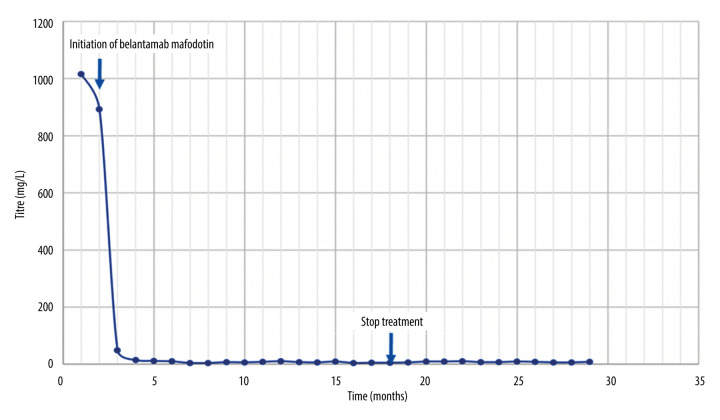
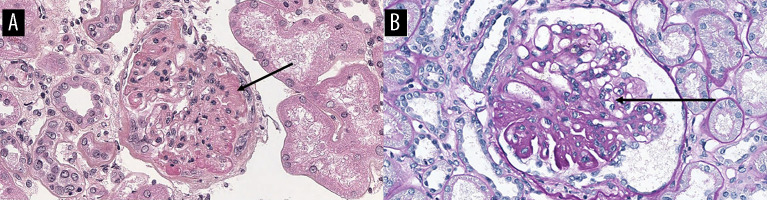
BACKGROUND Focal segmental glomerulosclerosis (FSGS) very rarely occurs in patients with multiple myeloma. Much more common are renal impairments secondary to monoclonal light-chain tubulopathy, AL amyloidosis, light-chain deposition disease, and the so-called monoclonal gammopathy of renal significance. CASE REPORT We report the case of a 79-year-old myeloma patient without noticeable medical problems but with a long history of myeloma treatment beginning 13 years ago. In the ninth line of therapy, he was successfully treated with belamaf mafodotin, an anti-BCMA monoclonal antibody coupled to monomethyl auristatin F. After 1.5 years of treatment, without any eye toxicity, and while he was in complete hematologic remission, he experienced a very severe COVID-19 infection followed 1 month later by a nephrotic syndrome. The renal biopsy revealed a FSGS not otherwise specified. He was successfully treated symptomatically. One and a half years later, and without treatment for 1 year, he is still in hematologic remission, with a remaining renal insufficiency. CONCLUSIONS Our patient had a particularly long response to belamaf mafodotin of more than 2.5 years, which is still ongoing. This is particularly remarkable because the very unusual acute renal impairment was not myeloma related. This is a very rare case of FSGS in a myeloma patient, potentially linked to a COVID-19 infection considering the chronology of the events and the immunosuppressive status secondary to the malignancy and its treatment.
局灶节段性肾小球硬化症(FSGS)在多发性骨髓瘤患者中非常罕见。更为常见的是继发于单克隆轻链管型肾病、AL 淀粉样变性、轻链沉积病和所谓的具有肾意义的单克隆丙种球蛋白病的肾功能损害。
我们报告了一例 79 岁的骨髓瘤患者,他没有明显的健康问题,但有 13 年前开始的骨髓瘤治疗的长期病史。在第九线治疗中,他成功地接受了 belamaf mafodotin 治疗,这是一种与单甲基奥瑞他汀 F 偶联的抗 BCMA 单克隆抗体。治疗 1.5 年后,他没有出现任何眼毒性,并且在完全血液学缓解的情况下,他经历了一次非常严重的 COVID-19 感染,1 个月后出现肾病综合征。肾活检显示为特发性 FSGS。他成功地接受了对症治疗。1 年半后,在未接受治疗的情况下,他仍处于血液学缓解状态,但仍存在肾功能不全。
我们的患者对 belamaf mafodotin 的反应特别长,超过 2.5 年,并且仍在继续。这特别值得注意,因为非常罕见的急性肾功能损害与骨髓瘤无关。这是一例多发性骨髓瘤患者发生 FSGS 的罕见病例,考虑到事件的时间顺序和继发于恶性肿瘤及其治疗的免疫抑制状态,这可能与 COVID-19 感染有关。