Department of Rehabilitation Medicine, Tongxiang First People's Hospital, Tongxiang, Zhejiang, China.
Brain Behav. 2024 Nov;14(11):e70117. doi: 10.1002/brb3.70117.
Upper limb rehabilitation robot is a relatively new technology, but its effectiveness remains debatable due to the inconsistent results of clinical trials. This article intends to assess how upper limb rehabilitation robots help the functional recovery of stroke patients.
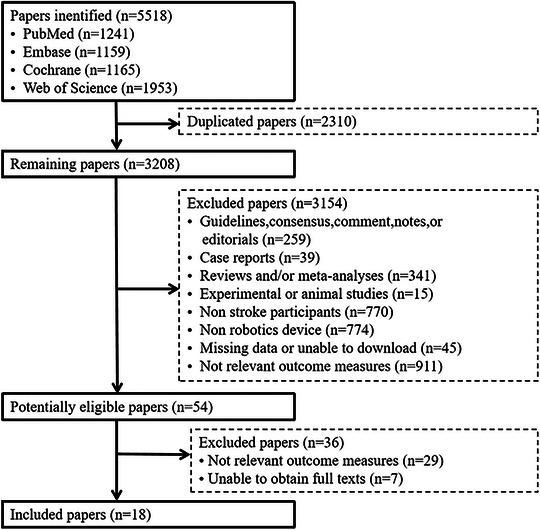
PubMed, Embase, Cochrane Library, and Web of Science databases were searched for eligible studies to explore the effect of upper limb rehabilitation robots on upper limb motor function, muscle tone, and daily living activities.
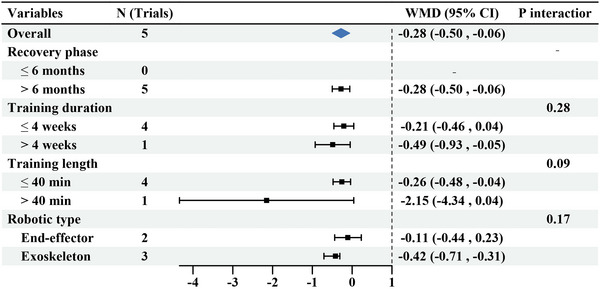
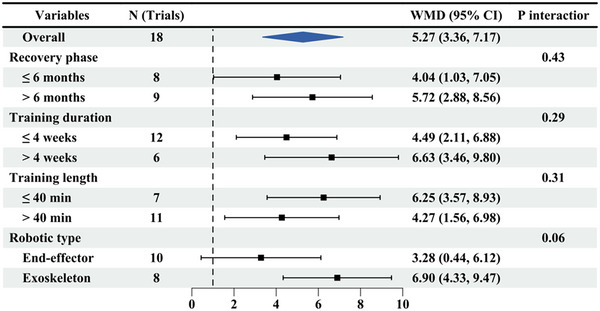
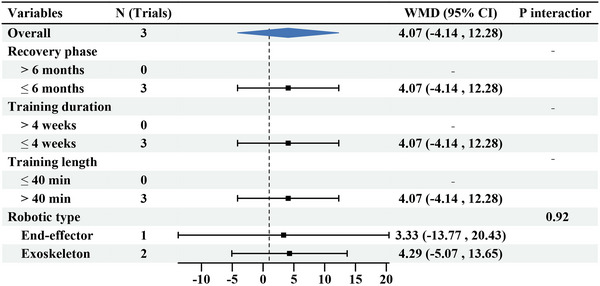
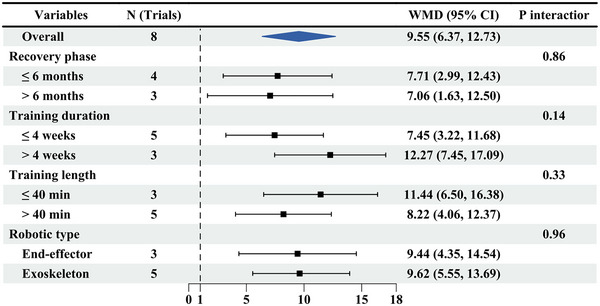
Eighteen trials with 573 stroke patients met the inclusion criteria. The results showed that compared to conventional rehabilitation training, patients who received upper limb robotic therapy (RT) had significantly improved Fugl-Meyer Upper Extremity Motor Assessment (FMA-UE) scores (weighted mean differences [WMD]: 5.27, 95% confidence intervals [CI]: 3.36, 7.17), Action Research Arm Test (ARAT) scores (WMD: 4.07, 95% CI: -4.14, 12.28), Modified Barthel Index (MBI) scores (WMD: 9.55, 95% CI: 6.37, 12.73), and modified Ashworth Scale (MAS) scores (WMD: -0.28, 95% CI: -0.50, 0.06), with no significant heterogeneity.
Upper limb robot-assisted training is superior to conventional training in terms of improving upper limb motor impairment, ability to perform daily living activities, and muscle tone recovery, which supports the application of robots in clinical practice.
上肢康复机器人是一项相对较新的技术,但由于临床试验结果不一致,其有效性仍存在争议。本文旨在评估上肢康复机器人如何帮助脑卒中患者的功能恢复。
检索 PubMed、Embase、Cochrane 图书馆和 Web of Science 数据库,以寻找评估上肢康复机器人对上肢运动功能、肌肉张力和日常生活活动影响的相关研究。
纳入的 18 项试验共 573 例脑卒中患者。结果显示,与常规康复训练相比,接受上肢机器人治疗(RT)的患者上肢运动功能 Fugl-Meyer 上肢运动评估(FMA-UE)评分(加权均数差 [WMD]:5.27,95%置信区间 [CI]:3.36,7.17)、动作研究上肢测试(ARAT)评分(WMD:4.07,95% CI:-4.14,12.28)、改良巴氏指数(MBI)评分(WMD:9.55,95% CI:6.37,12.73)和改良 Ashworth 量表(MAS)评分(WMD:-0.28,95% CI:-0.50,0.06)均有显著改善,且无明显异质性。
上肢机器人辅助训练在改善上肢运动功能障碍、日常生活活动能力和肌肉张力恢复方面优于常规训练,支持机器人在临床实践中的应用。