Ou Wei-Fan, Hsu Kuo-Hsuan, Tseng Jeng-Sen, Lee Po-Hsin, Chen Kun-Chieh, Huang Yen-Hsiang, Chang Gee-Chen, Yang Tsung-Ying
Department of Chest Medicine, Taichung Veterans General Hospital, Taichung, Taiwan.
Lung Cancer Comprehensive Care and Research Center, Taichung Veterans General Hospital, Taichung, Taiwan.
Ther Adv Med Oncol. 2024 Oct 17;16:17588359241290718. doi: 10.1177/17588359241290718. eCollection 2024.
Bevacizumab is extensively used in the treatment of advanced non-small-cell lung cancer (NSCLC). Numerous clinical trials have proven the clinical efficacies of bevacizumab biosimilars (BB).
Our study aimed to compare the clinical outcomes between bevacizumab reference product (RP) and BB among advanced NSCLC patients in a real-world setting.
We retrospectively analyzed stage IV metastatic NSCLC patients who were treated with bevacizumab as part of a combination therapy. Patients were categorized into chemotherapy (CT) and epidermal growth factor receptor-tyrosine kinase inhibitor (EGFR-TKI) groups. We compared the patients' characteristics, treatment efficacy, and adverse events between RP and BB in the two treatment groups.
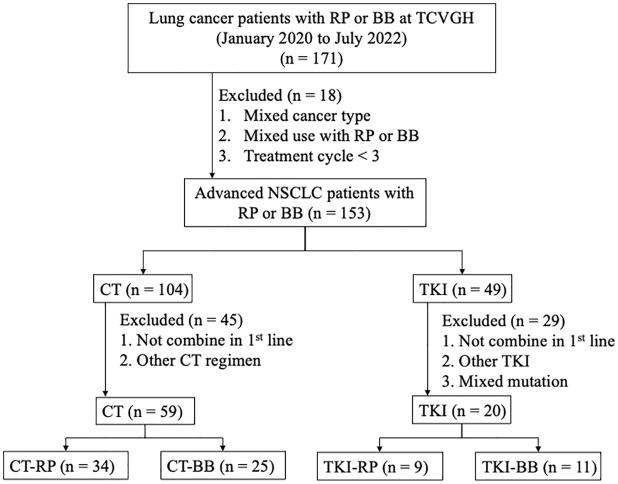
From January 2020 to July 2022, a total of 171 patients who underwent combination therapy with bevacizumab were screened. Seventy-nine of these patients met the study's inclusion criteria and were enrolled in the final analysis. We utilized the Kaplan-Meier method to estimate progression-free survival (PFS) and the log-rank test to compare PFS between groups. The Cox proportional hazards model was used to identify predictors of PFS.
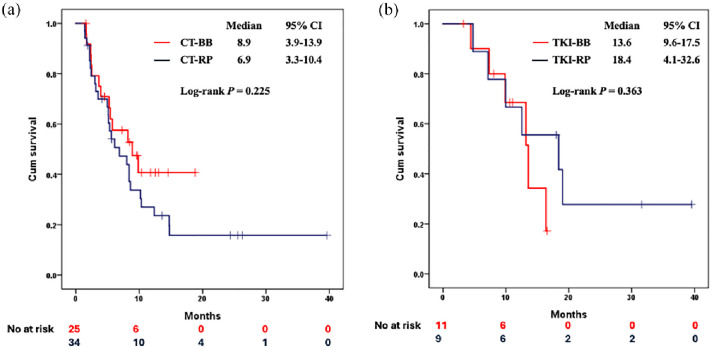
Within the CT cohort, 34 patients were treated with RP in combination with platinum and pemetrexed, and 25 patients received a combination regimen with BB. The median PFS was 6.9 months in the RP group and 8.9 months in the BB group ( = 0.255). Within the EGFR-TKI cohort, 20 patients with -mutant NSCLC received first-line treatment with EGFR-TKI plus bevacizumab. Of these patients, 9 were treated with a combination regimen that included RP, and 11 patients received EGFR-TKI in combination with BB. The median PFS was 18.4 months for the RP group and 13.6 months for the BB group ( = 0.363).
In our advanced NSCLC patients, we found no difference in clinical outcomes when receiving treatment with RP or BB. Given a combination regimen, BB was as effective as RP together with either CT or EGFR-TKIs.
贝伐单抗广泛用于治疗晚期非小细胞肺癌(NSCLC)。众多临床试验已证实贝伐单抗生物类似药(BB)的临床疗效。
我们的研究旨在比较在真实世界环境中晚期NSCLC患者使用贝伐单抗参比产品(RP)和BB后的临床结局。
我们回顾性分析了接受贝伐单抗联合治疗的IV期转移性NSCLC患者。患者被分为化疗(CT)组和表皮生长因子受体酪氨酸激酶抑制剂(EGFR-TKI)组。我们比较了两个治疗组中RP和BB患者的特征、治疗疗效及不良事件。
2020年1月至2022年7月,共筛选出171例接受贝伐单抗联合治疗的患者。其中79例患者符合研究纳入标准并纳入最终分析。我们采用Kaplan-Meier法估计无进展生存期(PFS),并使用对数秩检验比较组间PFS。采用Cox比例风险模型确定PFS的预测因素。
在CT队列中,34例患者接受RP联合铂类和培美曲塞治疗,25例患者接受BB联合治疗方案。RP组的中位PFS为6.9个月,BB组为8.9个月(P = 0.255)。在EGFR-TKI队列中,20例携带EGFR突变的NSCLC患者接受EGFR-TKI联合贝伐单抗一线治疗。其中,9例患者接受含RP的联合治疗方案,11例患者接受EGFR-TKI联合BB治疗。RP组中位PFS为18.4个月,BB组为13.6个月(P = 0.363)。
在我们的晚期NSCLC患者中,接受RP或BB治疗后的临床结局无差异。在联合治疗方案中,BB与RP联合CT或EGFR-TKI一样有效。