Moeyersoms Acadia H M, Knechtel Kendall W, Rong Andrew J, Gallo Ryan A, Zhang Michelle, Marsh Harper M, Sargi Zoukaa B, Leibowitz Jason M, Civantos Francisco J, Weed Donald T, Dubovy Sander R, Tse David T, Pelaez Daniel
Dr. Nasser Ibrahim Al-Rashid Orbital Vision Research Center, Bascom Palmer Eye Institute, Miller School of Medicine, University of Miami, Miami, FL 33136, USA.
Sylvester Comprehensive Cancer Center, Miller School of Medicine, University of Miami, Miami, FL 33136, USA.
medRxiv. 2024 Oct 17:2024.10.15.24315549. doi: 10.1101/2024.10.15.24315549.
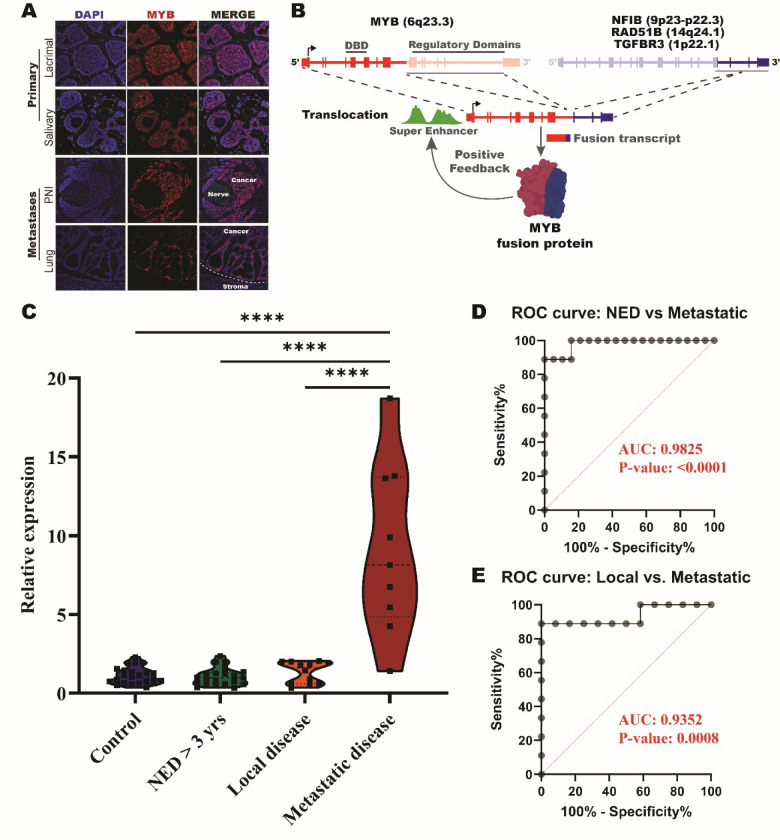
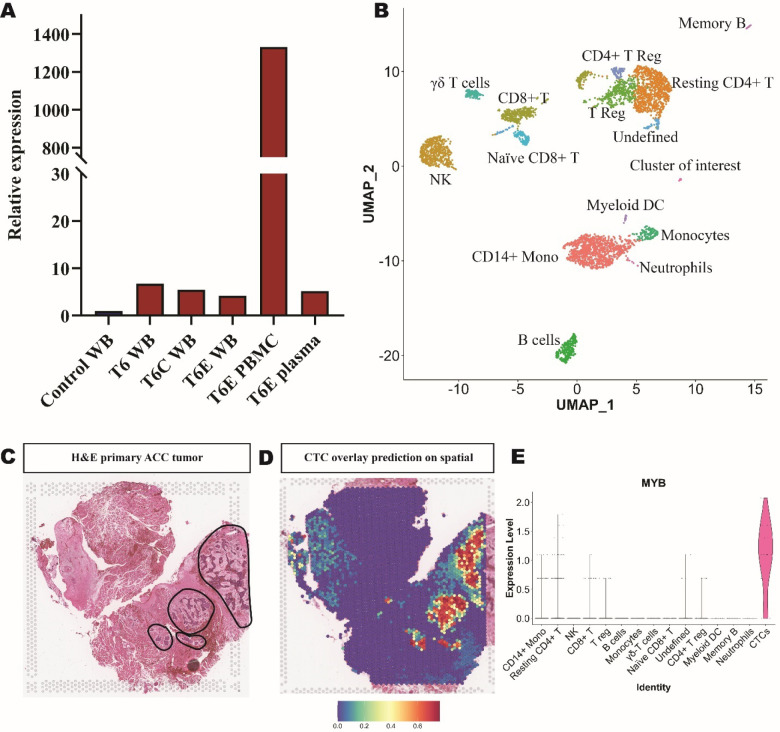
Adenoid cystic carcinoma (ACC) is a rare and lethal malignancy that originates in secretory glands of the head and neck. A prominent molecular feature of ACC is the overexpression of the proto-oncogene MYB. ACC has a poor long-term survival due to its high propensity for recurrence and protracted metastasis. Currently, clinical technologies lack the efficiency to distinguish patient prognosis prior to its redevelopment. We hypothesize that metastatic ACC can be detected by monitoring tumor-specific MYB expression in patients' blood. We developed a quantitative polymerase chain reaction (qPCR) assay for MYB transcripts and screened blood samples from four patient cohorts: no history or evidence of ACC (n=23), past history of ACC and no evidence of disease (NED) for greater than three years (n=15), local ACC (n=6), and metastatic ACC (n=5). Our assay detected significantly elevated levels of MYB transcripts in the metastatic ACC cohort (p < 0.01). Receiver operating characteristic (ROC) curves comparing metastatic to NED and metastatic to local disease were significant, with p values < 0.0001 and 0.0008, respectively. Single-cell RNA sequencing (scRNA-seq) of blood from metastatic ACC identified a cluster of circulating tumor cells (CTCs) expressing MYB. Here, we report a sensitive, cost-effective, and minimally invasive diagnostic test that leverages tumor-specific signatures to screen for metastatic ACC disease, potentially enhancing detection earlier than the current clinical standard.
腺样囊性癌(ACC)是一种罕见的致命性恶性肿瘤,起源于头颈部的分泌腺。ACC的一个显著分子特征是原癌基因MYB的过表达。由于ACC具有高复发倾向和长期转移的特点,其长期生存率较低。目前,临床技术在疾病复发前缺乏区分患者预后的效率。我们假设转移性ACC可以通过监测患者血液中肿瘤特异性MYB表达来检测。我们开发了一种针对MYB转录本的定量聚合酶链反应(qPCR)检测方法,并对四个患者队列的血液样本进行了筛查:无ACC病史或证据者(n = 23)、有ACC病史且无疾病证据(NED)超过三年者(n = 15)、局部ACC患者(n = 6)和转移性ACC患者(n = 5)。我们的检测方法在转移性ACC队列中检测到MYB转录本水平显著升高(p < 0.01)。比较转移性与NED以及转移性与局部疾病的受试者工作特征(ROC)曲线具有显著性,p值分别< 0.0001和0.