Weber Ceri J, Weitzel Alexander J, Liu Alexander Y, Gacasan Erica G, Sah Robert L, Cooper Kimberly L
Department of Cell and Developmental Biology, University of California, San Diego, 9500 Gilman Drive, La Jolla, CA 92093, USA.
Shu Chien-Gene Lay Department of Bioengineering, University of California San Diego, La Jolla, California, USA.
bioRxiv. 2024 Oct 26:2024.10.25.620311. doi: 10.1101/2024.10.25.620311.
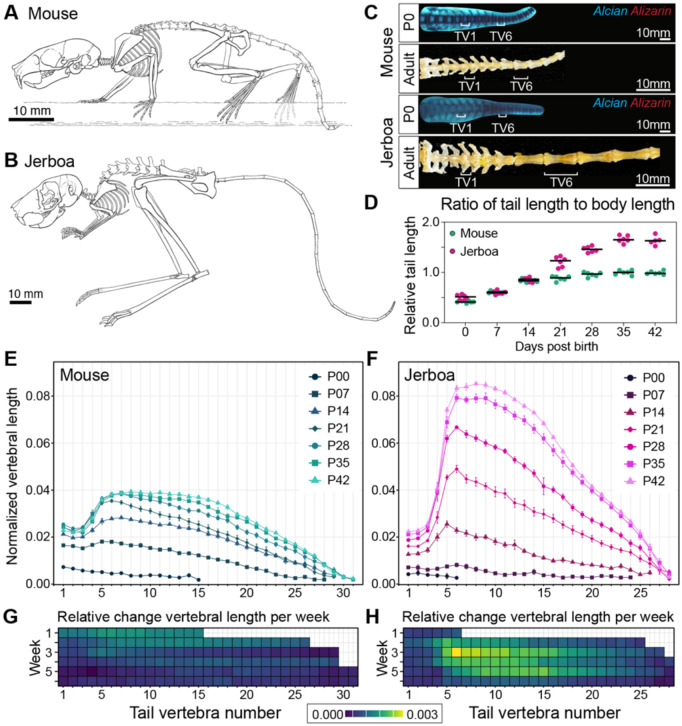
Despite the functional importance of the vertebral skeleton, little is known about how individual vertebrae elongate or achieve disproportionate lengths as in the giraffe neck. Rodent tails are an abundantly diverse and more tractable system to understand mechanisms of vertebral growth and proportion. In many rodents, disproportionately long mid-tail vertebrae form a 'crescendo-decrescendo' of lengths in the tail series. In bipedal jerboas, these vertebrae grow exceptionally long such that the adult tail is 1.5x the length of a mouse tail, relative to body length, with four fewer vertebrae. How do vertebrae with the same regional identity elongate differently from their neighbors to establish and diversify adult proportion? Here, we find that vertebral lengths are largely determined by differences in growth cartilage height and the number of cells progressing through endochondral ossification. Hypertrophic chondrocyte size, a major contributor to differential elongation in mammal limb bones, differs only in the longest jerboa mid-tail vertebrae where they are exceptionally large. To uncover candidate molecular mechanisms of disproportionate vertebral growth, we performed intersectional RNA-Seq of mouse and jerboa tail vertebrae with similar and disproportionate elongation rates. Many regulators of posterior axial identity and endochondral elongation are disproportionately differentially expressed in jerboa vertebrae. Among these, the inhibitory natriuretic peptide receptor C (NPR3) appears in multiple studies of rodent and human skeletal proportion suggesting it refines local growth rates broadly in the skeleton and broadly in mammals. Consistent with this hypothesis, NPR3 loss of function mice have abnormal tail and limb proportions. Therefore, in addition to genetic components of the complex process of vertebral evolution, these studies reveal fundamental mechanisms of skeletal growth and proportion.
尽管脊椎骨骼具有重要的功能,但对于单个椎骨如何伸长或像长颈鹿脖子那样达到不成比例的长度,我们知之甚少。啮齿动物的尾巴是一个更加多样化且易于研究的系统,有助于理解椎骨生长和比例的机制。在许多啮齿动物中,不成比例的长尾椎骨在尾椎系列中形成了一个“渐强-渐弱”的长度变化。在双足跳鼠中,这些椎骨长得格外长,以至于成年跳鼠尾巴的长度相对于体长是小鼠尾巴的1.5倍,且椎骨数量少四个。具有相同区域特征的椎骨如何与其相邻椎骨不同程度地伸长,从而形成并多样化成年个体的比例呢?在这里,我们发现椎骨长度在很大程度上由生长软骨高度的差异以及经历软骨内成骨的细胞数量决定。肥大软骨细胞大小是哺乳动物肢体骨骼差异伸长的主要因素,仅在跳鼠最长的中尾椎骨中有所不同,这些椎骨中的肥大软骨细胞格外大。为了揭示椎骨不成比例生长的候选分子机制,我们对小鼠和跳鼠的尾椎进行了交叉RNA测序,这些尾椎具有相似和不成比例的伸长率。许多后轴特征和软骨内伸长的调节因子在跳鼠椎骨中存在不成比例的差异表达。其中,抑制性利钠肽受体C(NPR3)在多项关于啮齿动物和人类骨骼比例的研究中出现,这表明它在骨骼以及哺乳动物中广泛调节局部生长速率。与这一假设一致,NPR3功能缺失的小鼠尾巴和肢体比例异常。因此,除了椎骨进化复杂过程的遗传成分外,这些研究还揭示了骨骼生长和比例的基本机制。