Jones Matthew G, Sun Dawei, Min Kyung Hoi Joseph, Colgan William N, Tian Luyi, Weir Jackson A, Chen Victor Z, Koblan Luke W, Yost Kathryn E, Mathey-Andrews Nicolas, Russell Andrew J C, Stickels Robert R, Balderrama Karol S, Rideout William M, Chang Howard Y, Jacks Tyler, Chen Fei, Weissman Jonathan S, Yosef Nir, Yang Dian
Center for Personal Dynamic Regulomes, Stanford University, Stanford, CA, USA.
These authors contributed equally.
bioRxiv. 2024 Oct 24:2024.10.21.619529. doi: 10.1101/2024.10.21.619529.
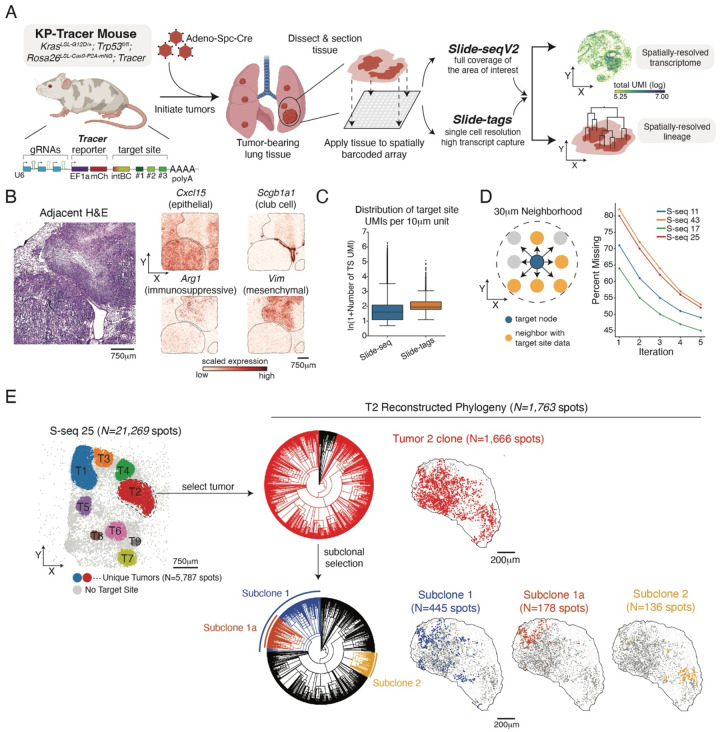
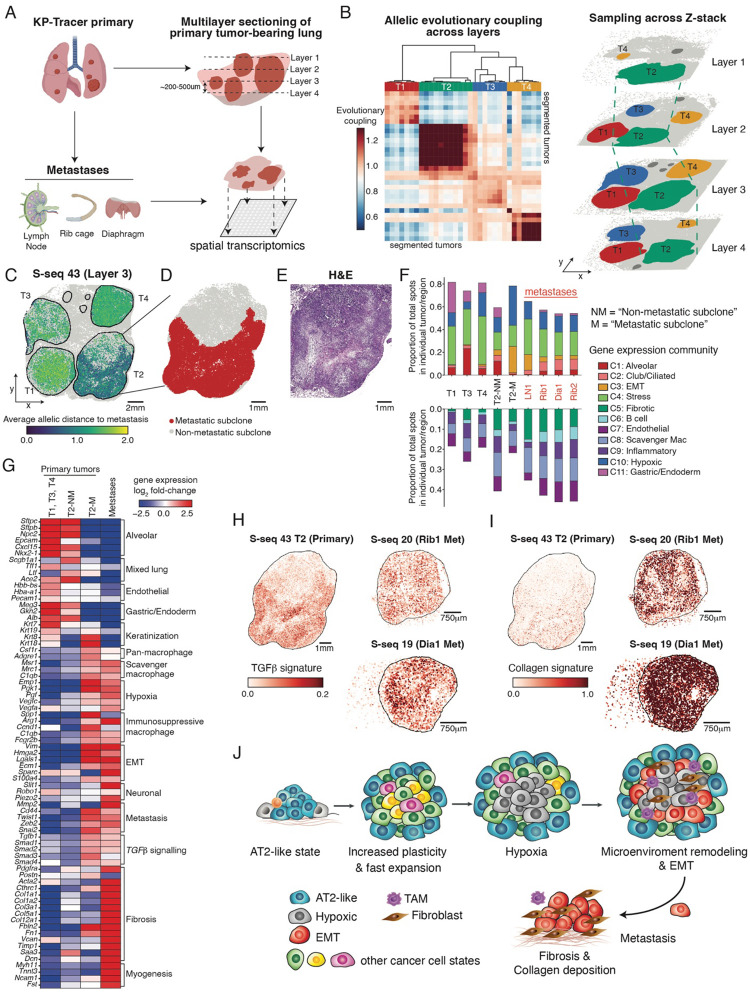
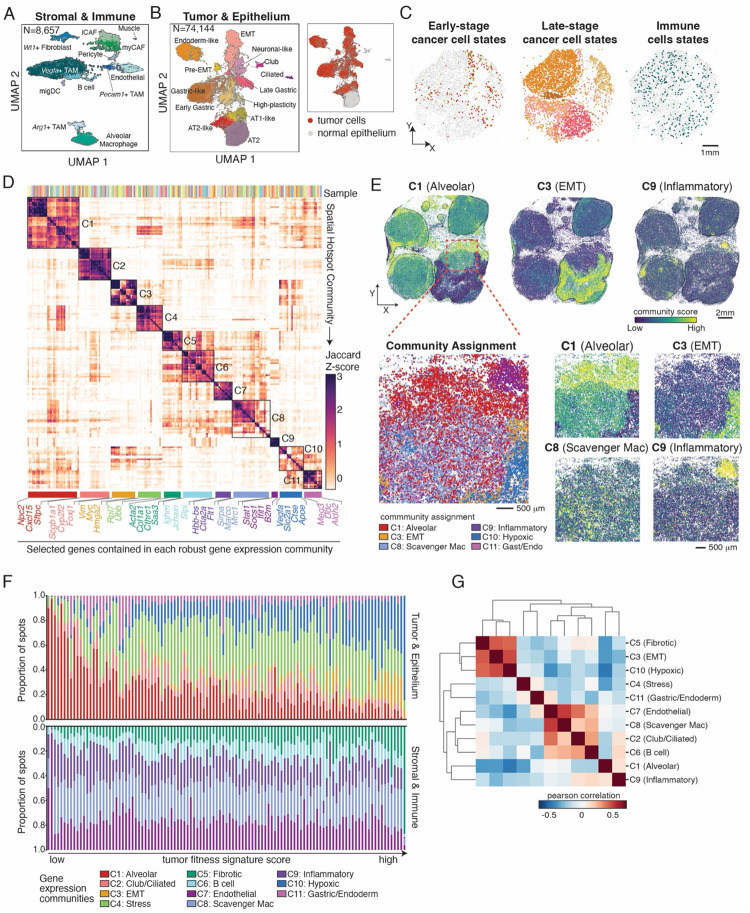
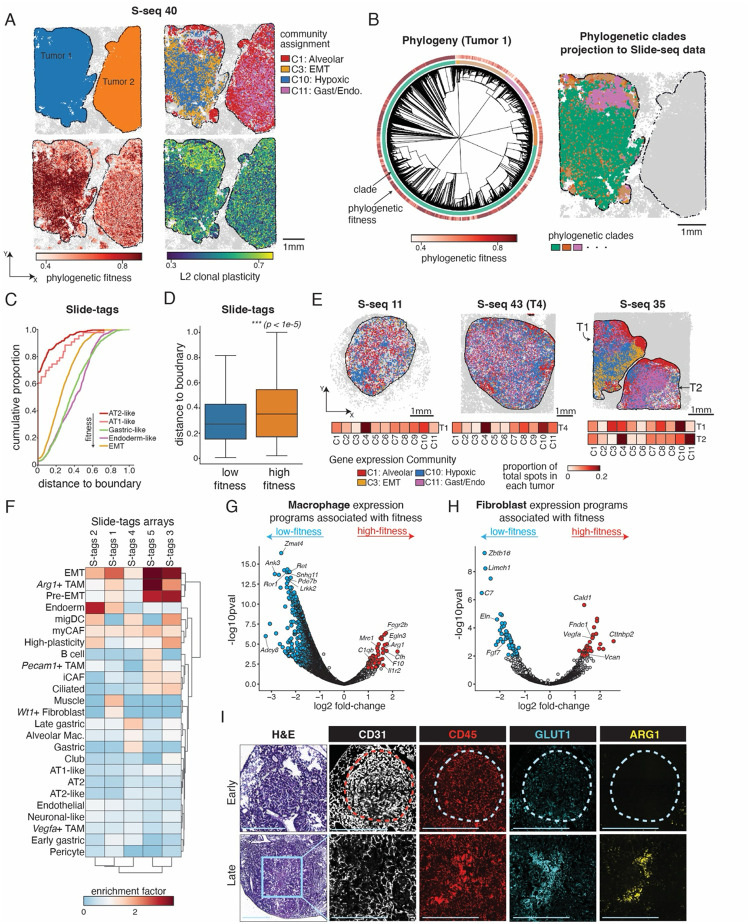
Tumor progression is driven by dynamic interactions between cancer cells and their surrounding microenvironment. Investigating the spatiotemporal evolution of tumors can provide crucial insights into how intrinsic changes within cancer cells and extrinsic alterations in the microenvironment cooperate to drive different stages of tumor progression. Here, we integrate high-resolution spatial transcriptomics and evolving lineage tracing technologies to elucidate how tumor expansion, plasticity, and metastasis co-evolve with microenvironmental remodeling in a -driven mouse model of lung adenocarcinoma. We find that rapid tumor expansion contributes to a hypoxic, immunosuppressive, and fibrotic microenvironment that is associated with the emergence of pro-metastatic cancer cell states. Furthermore, metastases arise from spatially-confined subclones of primary tumors and remodel the distant metastatic niche into a fibrotic, collagen-rich microenvironment. Together, we present a comprehensive dataset integrating spatial assays and lineage tracing to elucidate how sequential changes in cancer cell state and microenvironmental structures cooperate to promote tumor progression.
肿瘤进展是由癌细胞与其周围微环境之间的动态相互作用驱动的。研究肿瘤的时空演变可以为癌细胞的内在变化与微环境的外在改变如何协同驱动肿瘤进展的不同阶段提供关键见解。在这里,我们整合了高分辨率空间转录组学和进化谱系追踪技术,以阐明在一个驱动的肺腺癌小鼠模型中,肿瘤扩张、可塑性和转移如何与微环境重塑共同进化。我们发现,快速的肿瘤扩张导致了低氧、免疫抑制和纤维化的微环境,这与促转移癌细胞状态的出现有关。此外,转移瘤源自原发性肿瘤的空间受限亚克隆,并将远处的转移微环境重塑为纤维化、富含胶原蛋白的微环境。我们共同展示了一个综合数据集,整合了空间分析和谱系追踪,以阐明癌细胞状态和微环境结构的顺序变化如何协同促进肿瘤进展。