Department of Genome Sciences, University of Washington, Seattle, WA, USA.
Molecular Engineering and Sciences Institute, University of Washington, Seattle, WA, USA.
Nature. 2024 Aug;632(8027):1073-1081. doi: 10.1038/s41586-024-07706-4. Epub 2024 Jul 17.
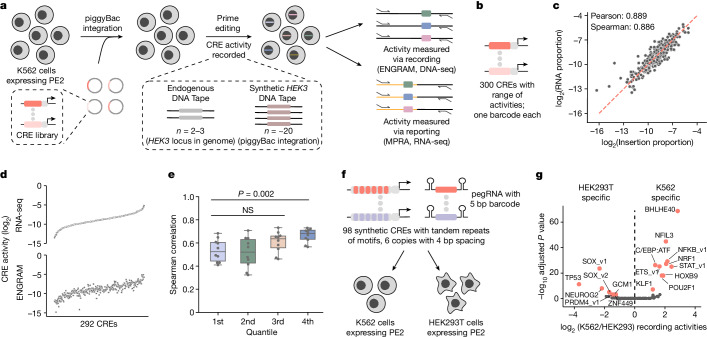
Measurements of gene expression or signal transduction activity are conventionally performed using methods that require either the destruction or live imaging of a biological sample within the timeframe of interest. Here we demonstrate an alternative paradigm in which such biological activities are stably recorded to the genome. Enhancer-driven genomic recording of transcriptional activity in multiplex (ENGRAM) is based on the signal-dependent production of prime editing guide RNAs that mediate the insertion of signal-specific barcodes (symbols) into a genomically encoded recording unit. We show how this strategy can be used for multiplex recording of the cell-type-specific activities of dozens to hundreds of cis-regulatory elements with high fidelity, sensitivity and reproducibility. Leveraging signal transduction pathway-responsive cis-regulatory elements, we also demonstrate time- and concentration-dependent genomic recording of WNT, NF-κB and Tet-On activities. By coupling ENGRAM to sequential genome editing via DNA Typewriter, we stably record information about the temporal dynamics of two orthogonal signalling pathways to genomic DNA. Finally we apply ENGRAM to integratively record the transient activity of nearly 100 transcription factor consensus motifs across daily windows spanning the differentiation of mouse embryonic stem cells into gastruloids, an in vitro model of early mammalian development. Although these are proof-of-concept experiments and much work remains to fully realize the possibilities, the symbolic recording of biological signals or states within cells, to the genome and over time, has broad potential to complement contemporary paradigms for how we make measurements in biological systems.
基因表达或信号转导活性的测量通常采用需要在感兴趣的时间范围内破坏或活细胞成像的方法来进行。在这里,我们展示了一种替代范例,其中可以稳定地将此类生物活性记录到基因组中。基于信号依赖性产生的转录活性的增强子驱动的基因组记录(ENGRAM)是基于信号特异性的引物编辑指导 RNA 的产生,该 RNA 介导将信号特异性条形码(符号)插入基因组编码的记录单元中。我们展示了如何使用这种策略以高保真度、灵敏度和可重复性对数十到数百个顺式调控元件的细胞类型特异性活性进行多重记录。利用信号转导途径响应的顺式调控元件,我们还证明了 WNT、NF-κB 和 Tet-On 活性的时间和浓度依赖性的基因组记录。通过将 ENGRAM 与通过 DNA 打字机进行的连续基因组编辑相耦合,我们将关于两个正交信号通路的时间动态的信息稳定地记录到基因组 DNA 上。最后,我们将 ENGRAM 应用于整合记录在体外模型中,即胚胎干细胞向原肠胚样体分化过程中跨越每日窗口的近 100 个转录因子共识基序的瞬时活性。尽管这些都是概念验证实验,还有很多工作要做才能充分实现这些可能性,但在细胞内、基因组中和随时间对生物信号或状态进行符号记录具有广泛的潜力,可以补充我们在生物系统中进行测量的现有范式。