Pineau Rozenn M, Mock Karen E, Morris Jesse, Kraklow Vachel, Brunelle Andrea, Pageot Aurore, Ratcliff William C, Gompert Zachariah
School of Biological Sciences, Georgia Institute of Technology, Atlanta, USA.
University of Chicago, Chicago, USA.
bioRxiv. 2024 Oct 24:2024.10.19.619233. doi: 10.1101/2024.10.19.619233.
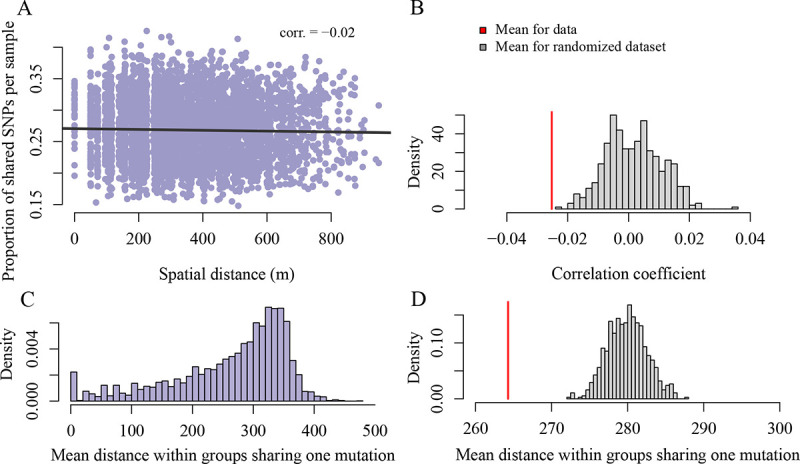
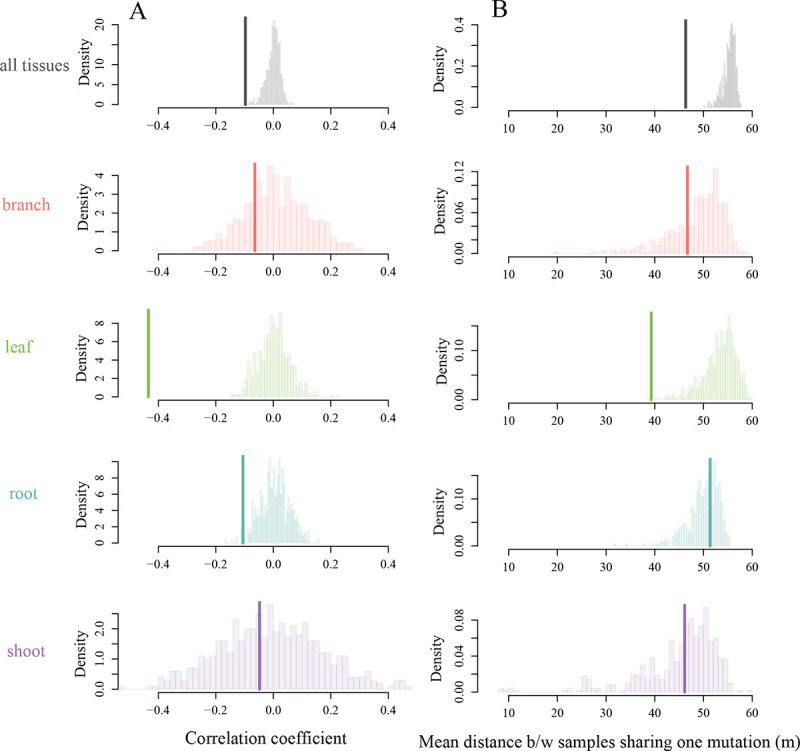
Understanding how mutations arise and spread through individuals and populations is fundamental to evolutionary biology. Most organisms have a life cycle with unicellular bottlenecks during reproduction. However, some organisms like plants, fungi, or colonial animals can grow indefinitely, changing the manner in which mutations spread throughout both the individual and the population. Furthermore, clonally reproducing organisms may also achieve exceedingly long lifespans, making somatic mutation an important mechanism of creating heritable variation for Darwinian evolution by natural selection. Yet, little is known about intra-organism mutation rates and evolutionary trajectories in long-lived species. Here, we study the Pando aspen clone, the largest known quaking aspen () clone founded by a single seedling and thought to be one of the oldest studied organisms. Aspen reproduce vegetatively via new root-borne stems forming clonal patches, sometimes spanning several hectares. To study the evolutionary history of the Pando clone, we collected and sequenced over 500 samples from Pando and neighboring clones, as well as from various tissue types within Pando, including leaves, roots, and bark. We applied a series of filters to distinguish somatic mutations from the pool of both somatic and germline mutations, incorporating a technical replicate sequencing approach to account for uncertainty in somatic mutation detection. Despite root spreading being spatially constrained, we observed only a modest positive correlation between genetic and spatial distance, suggesting the presence of a mechanism preventing the accumulation and spread of mutations across units. Phylogenetic models estimate the age of the clone to between ~16,000-80,000 years. This age is generally corroborated by the near-continuous presence of aspen pollen in a lake sediment record collected from Fish Lake near Pando. Overall, this work enhances understanding of mutation accumulation and dispersal within and between ramets of long-lived, clonally-reproducing organisms.
了解突变如何在个体和种群中产生并传播是进化生物学的基础。大多数生物在繁殖过程中有单细胞瓶颈的生命周期。然而,一些生物,如植物、真菌或群体动物可以无限生长,改变了突变在个体和种群中传播的方式。此外,克隆繁殖的生物也可能具有极长的寿命,使体细胞突变成为通过自然选择进行达尔文进化创造可遗传变异的重要机制。然而,对于长寿物种体内的突变率和进化轨迹知之甚少。在这里,我们研究了潘多山杨克隆体,它是已知最大的颤杨()克隆体,由一棵幼苗建立,被认为是研究最久的生物之一。山杨通过新的根生茎进行无性繁殖,形成克隆斑块,有时跨越数公顷。为了研究潘多克隆体的进化历史,我们从潘多及其邻近克隆体以及潘多内的各种组织类型(包括叶子、根和树皮)中收集并测序了500多个样本。我们应用了一系列筛选方法,从体细胞和生殖细胞突变库中区分出体细胞突变,采用技术重复测序方法来解释体细胞突变检测中的不确定性。尽管根系扩展在空间上受到限制,但我们仅观察到遗传距离和空间距离之间存在适度的正相关,这表明存在一种机制可以阻止突变在各单元间的积累和传播。系统发育模型估计该克隆体的年龄在约16000 - 80000年之间。从潘多附近的鱼湖收集的湖泊沉积物记录中几乎连续存在的山杨花粉,总体上证实了这个年龄。这项工作增强了我们对长寿、克隆繁殖生物的分株内和分株间突变积累和扩散的理解。