Nichol Grace K, Lado Paula, Snyman Louwrens P, Dergousoff Shaun J, Weese J Scott, Greer Amy L, Clow Katie M
Department of Population Medicine, Ontario Veterinary College, University of Guelph, Guelph, ON, Canada.
Center for Vector-Borne Infectious Diseases, Colorado State University, Fort Collins, CO, USA.
J Med Entomol. 2025 Jan 13;62(1):123-129. doi: 10.1093/jme/tjae133.
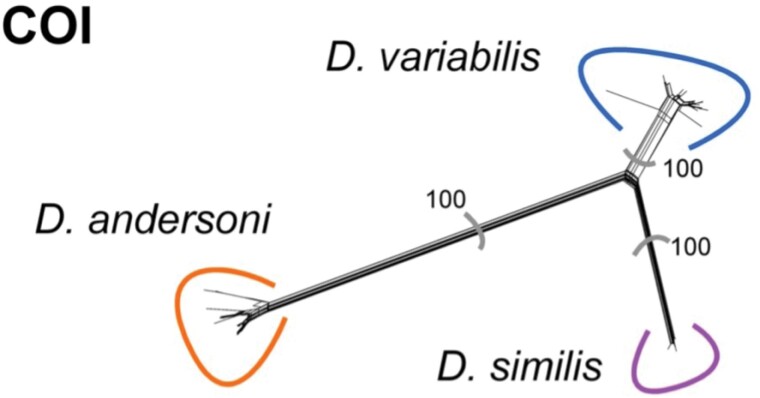
Numerous tick species are undergoing significant range expansion in Canada, including several Dermacentor spp Koch (Acari: Ixodidae). With the recent description of Dermacentor similis Lado in the western United States, additional research is required to determine the current range of this species. Five hundred ninety-eight Dermacentor spp. were collected from companion animals in the western Canadian provinces of British Columbia, Alberta, and Saskatchewan. Ticks were morphologically identified to species, followed by PCR and gel electrophoresis of the ITS-2 partial gene target (n = 595). Ninety-seven percent (n = 579/595) generated valid banding patterns. The banding pattern for the majority (74%, n = 206/278) of Dermacentor spp. from southern British Columbia was consistent with D. variabilis (Say), while 26% (n = 72/278) was consistent with D. andersoni Stiles. For samples from Alberta, 38% (n = 3/8) had banding patterns consistent with D. variabilis and 63% (n = 5/8) with D. andersoni. All (n = 293) ticks from Saskatchewan had banding patterns consistent with D. variabilis. After the description of D. similis was published, DNA sequencing of mitochondrial (16S rDNA gene, COI gene) and nuclear (ITS-2) markers was used to confirm the identity of 40 samples. Twenty-seven samples that had banding patterns consistent with D. variabilis from British Columbia were confirmed to be D. similis. One sample from Alberta and five from Saskatchewan were confirmed to be D. variabilis and seven samples from British Columbia were D. andersoni. The ITS-2 amplicons were not useful for differentiating between D. variabilis and D. similis. These results provide evidence of D. similis in western Canada and highlight that sequences of the mitochondrial genes are effective for distinguishing D. andersoni, D. variabilis, and D. similis.
加拿大有许多蜱虫种类正在经历显著的分布范围扩张,包括几种革蜱属(Dermacentor spp Koch,蜱螨亚纲:硬蜱科)。随着美国西部草原革蜱(Dermacentor similis Lado)的最新描述,需要进行更多研究来确定该物种目前的分布范围。从加拿大西部的不列颠哥伦比亚省、艾伯塔省和萨斯喀彻温省的伴侣动物身上采集了598只革蜱属蜱虫。蜱虫通过形态学鉴定到种,随后对ITS-2部分基因靶点进行PCR和凝胶电泳(n = 595)。97%(n = 579/595)产生了有效的条带模式。来自不列颠哥伦比亚省南部的大多数(74%,n = 206/278)革蜱属蜱虫的条带模式与变异革蜱(D. variabilis,Say)一致,而26%(n = 72/278)与安氏革蜱(D. andersoni,Stiles)一致。对于来自艾伯塔省的样本,38%(n = 3/8)的条带模式与变异革蜱一致,63%(n = 5/8)与安氏革蜱一致。来自萨斯喀彻温省的所有(n = 293)蜱虫的条带模式都与变异革蜱一致。在草原革蜱的描述发表后,利用线粒体(16S rDNA基因、COI基因)和核(ITS-2)标记的DNA测序来确认40个样本的身份。来自不列颠哥伦比亚省的27个条带模式与变异革蜱一致的样本被确认为草原革蜱。来自艾伯塔省的1个样本和萨斯喀彻温省的5个样本被确认为变异革蜱,来自不列颠哥伦比亚省的7个样本为安氏革蜱。ITS-2扩增子对于区分变异革蜱和草原革蜱没有用处。这些结果提供了加拿大西部存在草原革蜱的证据,并强调线粒体基因序列对于区分安氏革蜱、变异革蜱和草原革蜱是有效的。