Onoue Takeshi, Matthews Andrew H, Vakilpour Azin, Kang Yu, Lefebvre Bénédicte, Smith Amanda M, McCurdy Shannon R, Fradley Michael G, Carver Joseph, Chittams Jesse, Scherrer-Crosbie Marielle
Division of Cardiovascular Diseases, Department of Medicine, Hospital of the University of Pennsylvania, 3400 Spruce Street, Philadelphia, Pennsylvania, 19104, USA.
Abramson Cancer Center, Hospital of the University of Pennsylvania, Philadelphia, Pennsylvania, USA.
Cardiooncology. 2024 Nov 1;10(1):75. doi: 10.1186/s40959-024-00275-5.
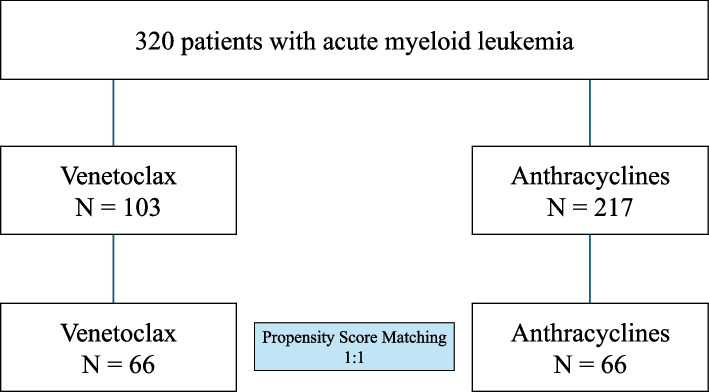
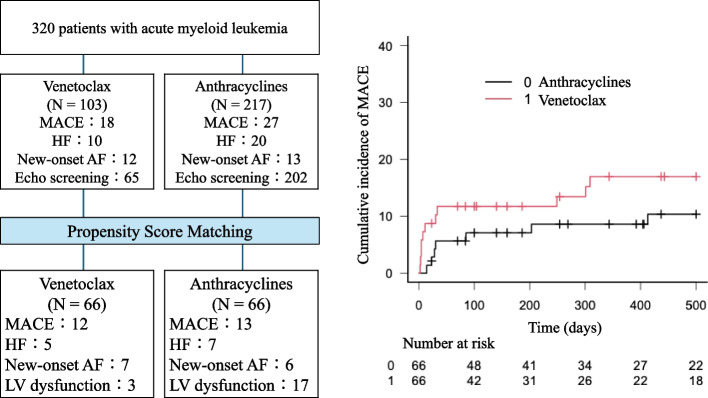
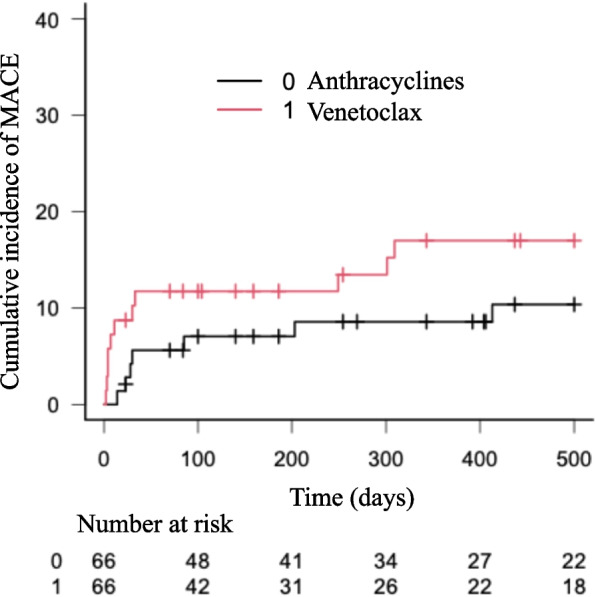
Venetoclax is a promising drug for patients with acute myeloid leukemia (AML) ineligible for anthracycline-based treatments. In rats, venetoclax is reported to cause myocardial injury. Our objectives were to report the frequency of cardiovascular (CV) events in patients treated with venetoclax, and, subsequently, to compare CV outcomes in matched patients treated with venetoclax or anthracyclines. Patients diagnosed with AML and treated with venetoclax or anthracyclines from January 2017 to July 2021 were identified. Major adverse cardiac events (MACE, including new-onset heart failure (HF), acute myocardial infarction, new onset atrial fibrillation (AF)) were recorded. Propensity-score method was then used to compare patients treated with venetoclax or anthracyclines. Patients treated with venetoclax (n=103) were older, with more hyperlipidemia than patients treated with anthracyclines (n=217). However, only 63% of patients treated with venetoclax underwent echocardiographic screening (vs. 93% of patients treated with anthracyclines, P< 0.001). Eighteen patients with venetoclax (17%) and 27 patients with anthracyclines (12%) developed MACE, including 10 % of new HF in each group. The median time to MACE was 8 days (interquartile range 5-98 days). In the matched cohort (n=132 patients), the cumulative incidence of MACE at one year was not different (17.5 % venetoclax, 9.2% anthracyclines, p =0.27). Thus, MACE incidence is similar in matched patients receiving venetoclax or anthracyclines. Close CV monitoring during the early phase of treatment may be helpful in patients treated with venetoclax.
维奈托克对于不符合蒽环类药物治疗条件的急性髓系白血病(AML)患者来说是一种很有前景的药物。据报道,在大鼠中,维奈托克会导致心肌损伤。我们的目标是报告接受维奈托克治疗的患者中心血管(CV)事件的发生率,随后比较接受维奈托克或蒽环类药物治疗的匹配患者的CV结局。确定了2017年1月至2021年7月期间被诊断为AML并接受维奈托克或蒽环类药物治疗的患者。记录主要不良心脏事件(MACE,包括新发心力衰竭(HF)、急性心肌梗死、新发房颤(AF))。然后使用倾向评分法比较接受维奈托克或蒽环类药物治疗的患者。接受维奈托克治疗的患者(n = 103)比接受蒽环类药物治疗的患者(n = 217)年龄更大,高脂血症更多。然而,接受维奈托克治疗的患者中只有63%接受了超声心动图筛查(相比之下,接受蒽环类药物治疗的患者为93%,P < 0.001)。18例接受维奈托克治疗的患者(17%)和27例接受蒽环类药物治疗的患者(12%)发生了MACE,每组新发HF的比例均为10%。发生MACE的中位时间为8天(四分位间距5 - 98天)。在匹配队列(n = 132例患者)中,一年时MACE的累积发生率没有差异(维奈托克组为17.5%,蒽环类药物组为9.2%,p = 0.27)。因此,接受维奈托克或蒽环类药物治疗的匹配患者中MACE的发生率相似。在接受维奈托克治疗的患者中,治疗早期密切的CV监测可能会有帮助。