Division of Nursing and Reproductive Health, Department of Health, Medicine and Caring Sciences, Linköping University, Linköping, Sweden.
Department of Psychiatry, Ryhov County Hospital, Jönköping, Sweden.
Nurs Open. 2024 Nov;11(11):e70068. doi: 10.1002/nop2.70068.
To describe psychiatric nursing staff´s experiences of working with suicide risk assessment instruments.
Around the world, approximately 720,000 people die by suicide each year, of which almost 20% have an ongoing contact with specialist psychiatry during their last month alive. To identify which patients have an increased risk of suicide is a highly important task for nursing staff. Suicidal behaviour is complex and unpredictable. Nursing staff work closely with patients in everyday psychiatric care and often possess unique patient knowledge. These professionals must therefore be able to know when a patient's eventual suicidality requires further attention and efforts.
A descriptive qualitative study.
Convenience sampling including nursing staff with more than 2 years of experience in specialist psychiatry. The data collection took place through semi-structured interviews and was then analysed according to conventional content analysis.
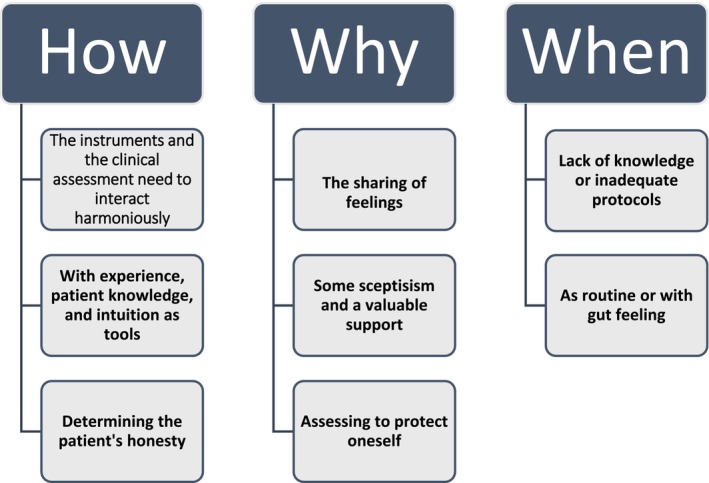
The nursing staff felt that a natural conversation is superior suicide risk assessment instruments and that experience and patient knowledge are the primary factors for facilitating a suicide risk assessment. This meant that some nursing staff rarely used suicide risk assessment instruments, although they sometimes could be a useful support in the conversation and provided a sense of personal security when documenting results.
Suicide risk assessment instrument can be significant and helpful in certain cases, but the essential components of a suicide risk assessment consist of a conversation to understand the meaning of suicide from the patient's perspective.
Psychiatric nursing staff contributed to this study by sharing their experiences through interviews.
描述精神科护理人员在使用自杀风险评估工具方面的经验。
在全球范围内,每年约有 72 万人自杀,其中近 20%的人在生命的最后一个月与专科精神病学有持续接触。识别哪些患者有更高的自杀风险对于护理人员来说是一项非常重要的任务。自杀行为是复杂且不可预测的。护理人员在日常精神科护理中与患者密切合作,通常拥有独特的患者知识。因此,这些专业人员必须能够知道何时患者的最终自杀意念需要进一步关注和努力。
描述性定性研究。
便利抽样包括在专科精神病学领域有超过 2 年经验的护理人员。通过半结构化访谈进行数据收集,然后根据常规内容分析进行分析。
护理人员认为自然对话优于自杀风险评估工具,经验和患者知识是促进自杀风险评估的主要因素。这意味着一些护理人员很少使用自杀风险评估工具,尽管它们有时可以在对话中提供有用的支持,并在记录结果时提供个人安全感。
在某些情况下,自杀风险评估工具可能具有重要意义和帮助,但自杀风险评估的基本组成部分包括对话,以从患者的角度理解自杀的含义。
精神科护理人员通过访谈分享他们的经验为这项研究做出了贡献。