Malatiali Slava, Oriowo Mabayoje
Department of Physiology, College of Medicine, Kuwait University, PO Box 24923, Safat, 13110, Kuwait.
Department of Pharmacology, College of Medicine, Kuwait University, PO Box 24923, Safat, 13110, Kuwait.
Thyroid Res. 2024 Nov 4;17(1):22. doi: 10.1186/s13044-024-00211-w.
Studies have shown that renal hypertrophy seen in experimental hyperthyroidism induced by thyroxine (T4) is due to angiotensin (Ang) II. However, other renal effects of Ang II in experimental hyperthyroidism have not been investigated. In addition, Ang 1-7 is believed to be protective against renal injury, but its possible role in thyroxine-induced renal injury is not known. The aim of this study is to elaborate the role of Ang II in thyroxine-induced renal injury and the possible protective role of Ang 1-7. We hypothesize that Ang 1-7 will be as protective against thyroxine-induced renal injury as the use of an ACE inhibitor or an Ang II receptor blocker.
Adult Sprague Dawley rats were used in this study and were divided into 5 groups: (1) Control (treated with vehicle), (2) Treated with thyroxine (T4, 100 µg/kg), (3) Treated with T4 and Ang 1-7 (500 µg/kg), (4) Treated with T4 and captopril (20 mg/kg), and (5) Treated with T4 and losartan (10 mg/kg). Parameters tested after fourteen days of treatment were creatinine clearance, protein excretion rate, glomerular volume, renal ACE1 and ACE2 protein expression. Data were compared using One-way-ANOVA followed by Tukey's HSD post hoc test.
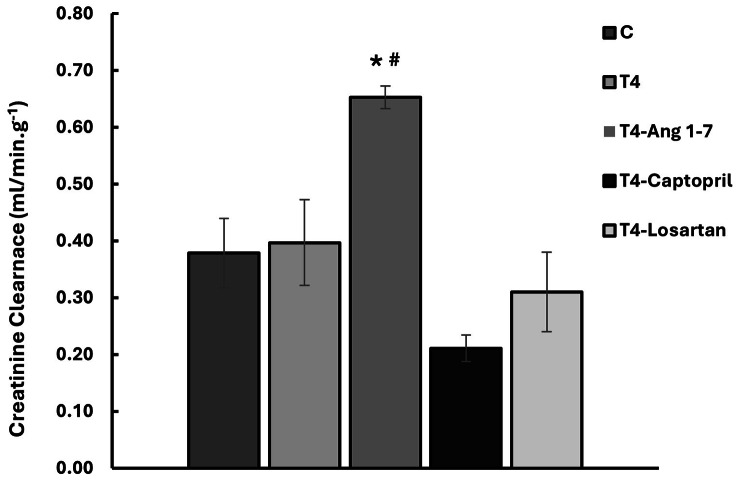
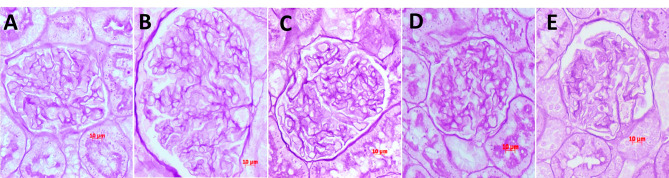
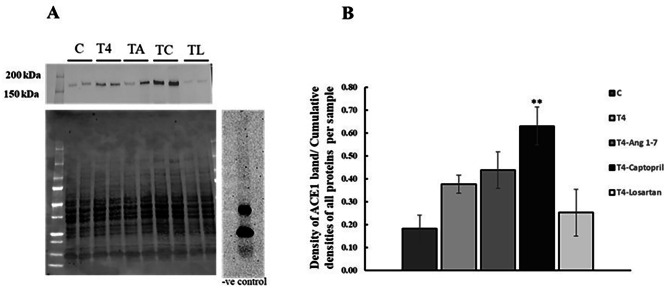
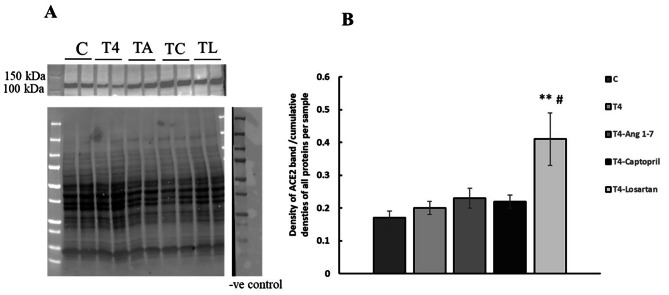
Thyroxine caused glomerular hypertrophy and proteinuria but had no effect on glomerular filtration rate (GFR). Glomerular hypertrophy was prevented by losartan and captopril, but not by Ang 1-7. Captopril and losartan had no effect on GFR; however, Ang 1-7 caused an increase in GFR in T4-treated rats. The increase in protein excretion rate was prevented by losartan but not by captopril or Ang 1-7. Renal expression of ACE1 protein was not altered in any of the treatment groups except in captopril treated rats were ACE1 expression was increased. Renal ACE2 protein expression was only increased in T4-losartan-treated rats and not affected by any of the other treatments.
We conclude that losartan was more protective than captopril against thyroxine-induced renal changes while Ang 1-7 offered no protection.
研究表明,甲状腺素(T4)诱导的实验性甲状腺功能亢进中出现的肾肥大是由血管紧张素(Ang)II引起的。然而,实验性甲状腺功能亢进中Ang II的其他肾脏效应尚未得到研究。此外,Ang 1-7被认为对肾损伤具有保护作用,但其在甲状腺素诱导的肾损伤中的可能作用尚不清楚。本研究的目的是阐述Ang II在甲状腺素诱导的肾损伤中的作用以及Ang 1-7可能的保护作用。我们假设Ang 1-7对甲状腺素诱导的肾损伤的保护作用与使用血管紧张素转换酶(ACE)抑制剂或Ang II受体阻滞剂相当。
本研究使用成年Sprague Dawley大鼠,将其分为5组:(1)对照组(用赋形剂处理),(2)用甲状腺素(T4,100μg/kg)处理,(3)用T4和Ang 1-7(500μg/kg)处理,(4)用T4和卡托普利(20mg/kg)处理,(5)用T4和氯沙坦(10mg/kg)处理。治疗14天后检测的参数包括肌酐清除率、蛋白排泄率、肾小球体积、肾ACE1和ACE2蛋白表达。数据采用单因素方差分析,随后进行Tukey's HSD事后检验。
甲状腺素导致肾小球肥大和蛋白尿,但对肾小球滤过率(GFR)无影响。氯沙坦和卡托普利可预防肾小球肥大,但Ang 1-7不能。卡托普利和氯沙坦对GFR无影响;然而,Ang 1-7使T4处理的大鼠的GFR增加。氯沙坦可预防蛋白排泄率的增加,但卡托普利或Ang 1-7不能。除卡托普利处理的大鼠中ACE1表达增加外,任何治疗组的肾ACE1蛋白表达均未改变。肾ACE2蛋白表达仅在T4-氯沙坦处理的大鼠中增加,不受其他任何处理的影响。
我们得出结论,氯沙坦对甲状腺素诱导的肾脏变化的保护作用比卡托普利更强,而Ang 1-7没有保护作用。