He Lei, Wang Jian, Peñuelas Josep, Zohner Constantin M, Crowther Thomas W, Fu Yongshuo, Zhang Wenxin, Xiao Jingfeng, Liu Zhihua, Wang Xufeng, Li Jia-Hao, Li Xiaojun, Peng Shouzhang, Xie Yaowen, Ye Jian-Sheng, Zhou Chenghu, Li Zhao-Liang
State Key Laboratory of Efficient Utilization of Arid and Semi-arid Arable Land in Northern China, Institute of Agricultural Resources and Regional Planning, Chinese Academy of Agricultural Sciences, Beijing 100081, China.
College of Earth and Environment Sciences, Lanzhou University, Lanzhou 730000, China.
PNAS Nexus. 2024 Oct 23;3(11):pgae477. doi: 10.1093/pnasnexus/pgae477. eCollection 2024 Nov.
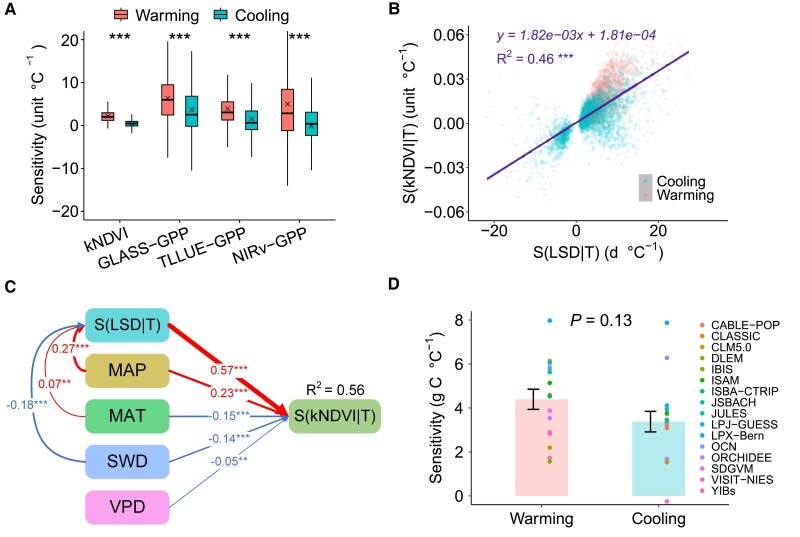
Widespread autumn cooling occurred in the northern hemisphere (NH) during the period 2004-2018, primarily due to the strengthening of the Pacific Decadal Oscillation and Siberian High. Yet, while there has been considerable focus on the warming impacts, the effects of natural cooling on autumn leaf senescence and plant productivity have been largely overlooked. This gap in knowledge hinders our understanding of how vegetation adapts and acclimates to complex climate change. In this study, we utilize over 36,000 in situ phenological time series from 11,138 European sites dating back to the 1950s, and 30 years of satellite greenness data (1989-2018), to demonstrate that leaf senescence dates (LSD) in northern forests responded more strongly to warming than to cooling in autumn. Specifically, a 1 °C increase in temperature caused 7.5 ± 0.2 days' delay in LSD, whereas a 1 °C decrease led to an advance of LSD with 3.3 ± 0.1 days ( < 0.001). This asymmetry in temperature effects on LSD is attributed to greater preoverwintering plant-resource acquisition requirements, lower frost risk, and greater water availability under warming than cooling conditions. These differential LSD responses highlight the nonlinear impact of temperature on autumn plant productivity, which current process-oriented models fail to accurately capture. Our findings emphasize the need to account for the asymmetric effects of warming and cooling on leaf senescence in model projections and in understanding vegetation-climate feedback mechanisms.
2004年至2018年期间,北半球出现了广泛的秋季降温,主要原因是太平洋年代际振荡和西伯利亚高压增强。然而,尽管人们相当关注变暖的影响,但自然降温对秋季叶片衰老和植物生产力的影响在很大程度上被忽视了。这一知识空白阻碍了我们对植被如何适应和适应复杂气候变化的理解。在本研究中,我们利用了来自11138个欧洲站点、可追溯到20世纪50年代的36000多个原位物候时间序列,以及30年的卫星绿度数据(1989 - 2018年),来证明北方森林中的叶片衰老日期(LSD)在秋季对变暖的响应比对降温的响应更强烈。具体而言,温度每升高1°C,LSD延迟7.5±0.2天,而温度每降低1°C,LSD提前3.3±0.1天(<0.001)。温度对LSD影响的这种不对称性归因于越冬前植物资源获取需求更大、霜冻风险更低以及变暖条件下比降温条件下有更多的水分供应。这些不同的LSD响应突出了温度对秋季植物生产力的非线性影响,而当前以过程为导向的模型未能准确捕捉到这一点。我们的研究结果强调,在模型预测和理解植被 - 气候反馈机制时,需要考虑变暖和降温对叶片衰老的不对称影响。