S Arulprakash, Sujitha Nirmal, Maria Lovling, M Vijayakarthikeyan, Sharon P Minthami
Community Medicine, Vinayaka Mission's Kirupananda Variyar Medical College & Hospitals, Vinayaka Mission's Research Foundation, Salem, IND.
Community Medicine, Vinayaka Mission's Kirupananda Variyar Medical College & Hospitals, Salem, IND.
Cureus. 2024 Oct 4;16(10):e70864. doi: 10.7759/cureus.70864. eCollection 2024 Oct.
Tuberculosis is the second leading infectious killer disease, mainly transmitted through undiagnosed presumptive and inadequately treated pulmonary tuberculosis (PTB) cases in the community.
This study was conducted to assess the knowledge, attitude, and practices (KAP) related to respiratory hygiene and sputum disposal methods and to estimate the proportion of presumptive PTB cases among patients with clinical features of respiratory manifestations.
A hospital-based cross-sectional study was conducted among 80 adult patients with respiratory manifestations at an urban health centre in Goa using a validated, pre-tested, semi-structured questionnaire by interview method.
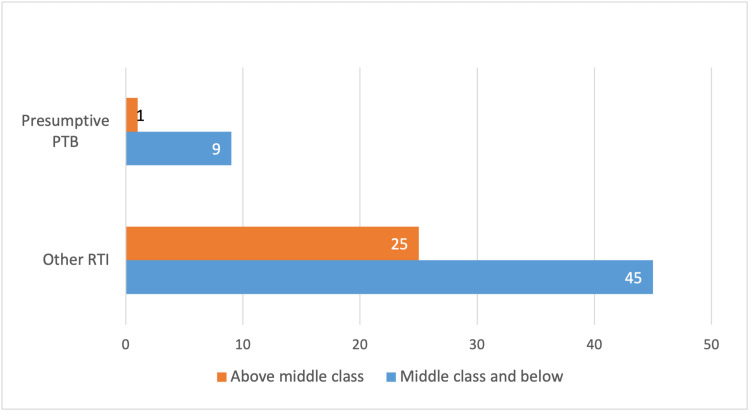
Among 80 study participants, 10 (12.5%) presumptive PTB cases were found. The knowledge regarding the exact cause and transmission of tuberculosis was 55% (44) and 72.4% (58), respectively. Around 32.5% (26) of participants were not following cough etiquette and they studied only up to middle school. Regarding the attitude towards ideal sputum disposal methods, more than three-fourths (81.3%, 65) of the responses were towards unsafe sputum disposal methods.
There is a need for health education regarding proper respiratory hygiene and sputum disposal methods, especially among patients with low educational and socio-economic groups.
结核病是第二大致命传染性疾病,主要通过社区中未经诊断的疑似肺结核病例以及治疗不充分的肺结核(PTB)病例传播。
本研究旨在评估与呼吸卫生和痰液处理方法相关的知识、态度和行为(KAP),并估计具有呼吸道症状临床特征的患者中疑似PTB病例的比例。
在果阿邦一个城市卫生中心,采用经过验证、预先测试的半结构化问卷,通过访谈法对80名有呼吸道症状的成年患者进行了一项基于医院的横断面研究。
在80名研究参与者中,发现了10例(12.5%)疑似PTB病例。关于结核病的确切病因和传播的知识知晓率分别为55%(44人)和72.4%(58人)。约32.5%(26人)的参与者未遵循咳嗽礼仪,且他们的学历仅为初中。关于理想痰液处理方法的态度,超过四分之三(81.3%,65人)的回答倾向于不安全的痰液处理方法。
有必要针对正确的呼吸卫生和痰液处理方法开展健康教育,尤其是在教育程度和社会经济地位较低的患者中。