Ethiopian Public Health Institute, Tuberculosis/HIV Research Directorate, PO Box 1242, Addis Ababa, Ethiopia.
BMC Health Serv Res. 2020 May 19;20(1):445. doi: 10.1186/s12913-020-05284-5.
Health seeking behavior is one of the challenges affecting tuberculosis (TB) control program because of its high risk to prolonged diseases transmission and poor treatment outcome. Although there are few primary studies that reported diversified magnitudes of health seeking behavior among presumptive TB patients in Ethiopia, there is no review study that attempted to summarize the available evidence. Thus, this review was aimed to estimate the proportion of health care seeking behavior from health facility and to summarize the reasons why individuals with presumptive TB are not seeking health care in Ethiopia.
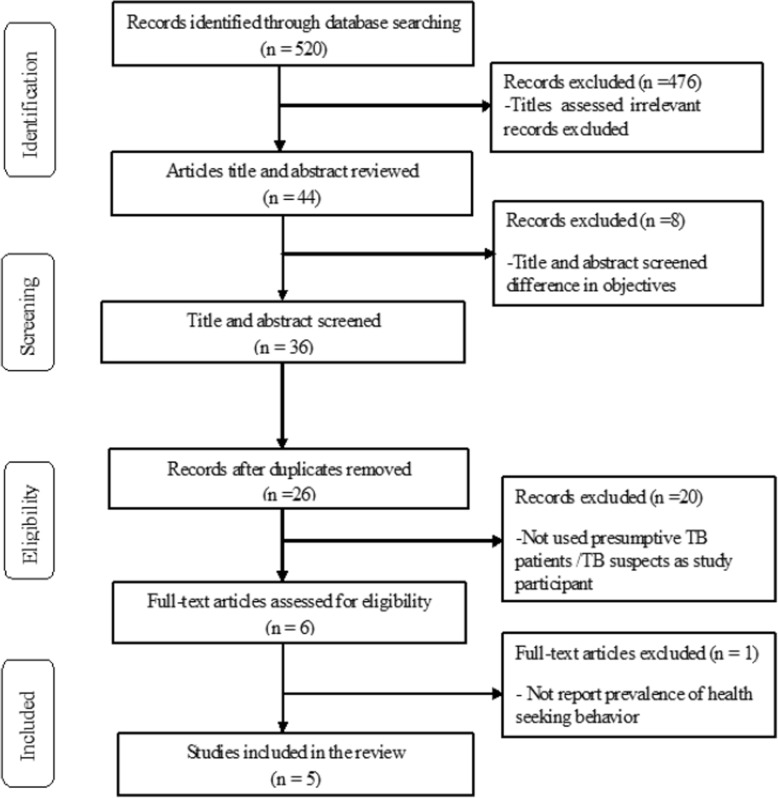
A systematic review and meta-analysis study was conducted on primary studies that reported proportion of health seeking behavior among presumptive TB patients. Electronic databases: PubMed, Google Scholar and Science Direct were searched to retrieve studies published in English language from Ethiopia without restricting publication year. In addition, bibliographies of included studies were also screened to retrieve potential studies. The keywords "health seeking", "health seeking behavior", "TB suspects" and "presumptive TB" were used both in Medical Subject Heading (MeSH) and free text. Random effects meta-analysis model was used to estimate the pooled proportions of health care seeking and not seeking behaviors. Stata version 14 was used for data analysis.
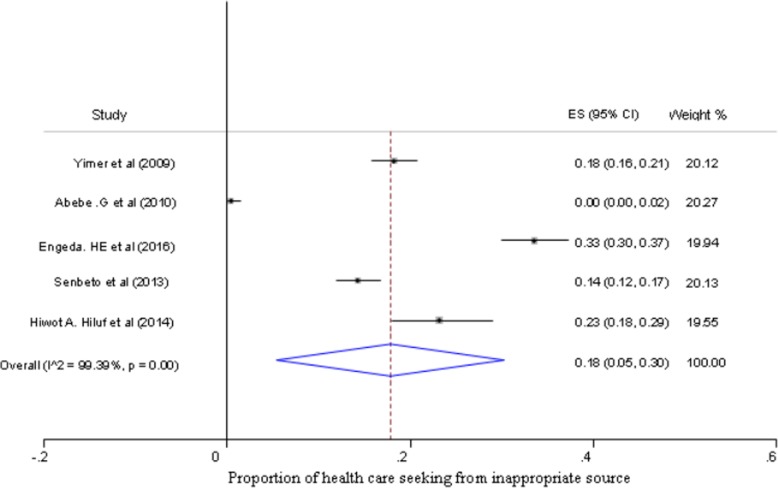
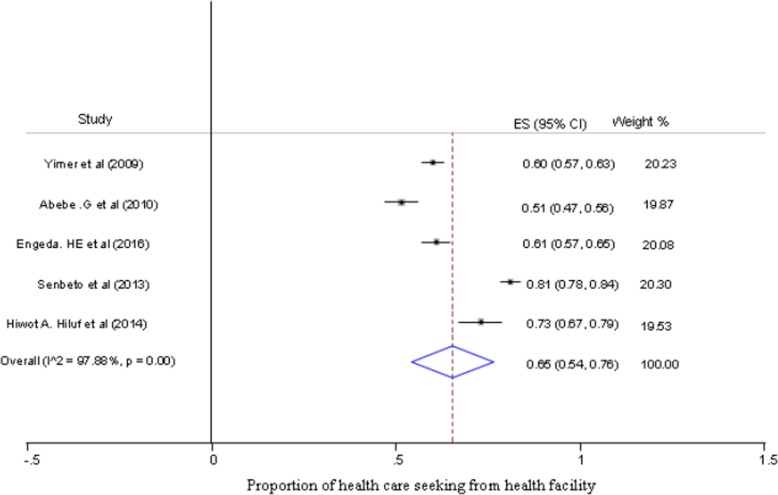
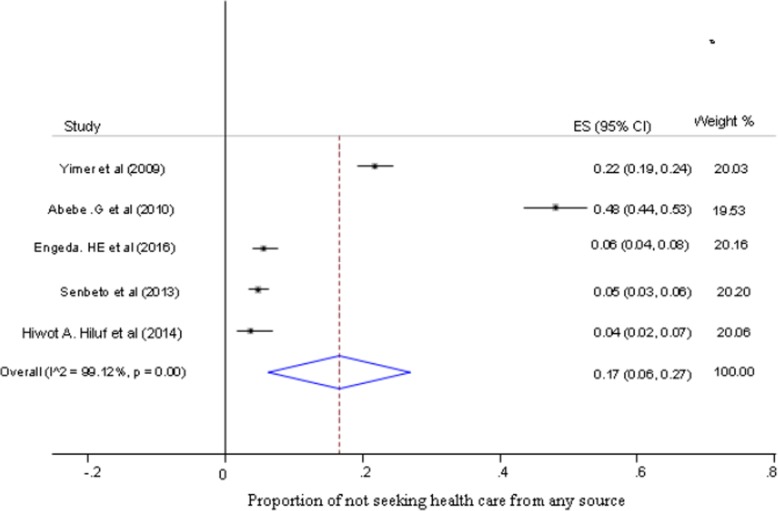
Five studies which involved 3230 patients with presumptive TB were included into this review. The pooled estimated proportion of health care seeking behavior among presumptive TB patients from health facilities was 65% (95% CI, 54-76%), while the pooled proportion of not seeking health care from any sources was 17% (95% CI;6-27%). In addition, 18% (95% CI; 5-30%) of presumptive TB patients were seeking health care from inappropriate sources. Being female, younger age, low income status, absence of previous TB treatment history, low education status were the risk factors that associated with low health care seeking behavior.
Considerable proportion of patients with presumptive TB were not seeking health care from health facilities or seeks care from inappropriate sources in Ethiopia. Implementing efforts that could improve health care seeking behavior is vital to prevent prolonged disease transmission through immediate treatment commencement.
求医行为是影响结核病(TB)控制项目的挑战之一,因为它会导致疾病传播时间延长和治疗效果不佳的风险较高。尽管有一些初步研究报告了埃塞俄比亚疑似结核病患者求医行为的多样性程度,但没有综述研究试图总结现有证据。因此,本综述旨在估计从医疗机构寻求医疗保健的比例,并总结埃塞俄比亚疑似结核病患者不寻求医疗保健的原因。
对报告疑似结核病患者求医行为比例的初步研究进行了系统综述和荟萃分析。电子数据库:PubMed、Google Scholar 和 Science Direct 被用来检索发表在英语语言的研究,没有限制发表年份。此外,还对纳入研究的参考文献进行了筛选,以检索潜在的研究。使用“健康寻求”、“健康寻求行为”、“TB 疑似患者”和“疑似结核病”的关键词在医学主题词(MeSH)和自由文本中进行检索。使用随机效应荟萃分析模型估计卫生保健寻求和不寻求行为的汇总比例。Stata 版本 14 用于数据分析。
本综述纳入了 5 项研究,共涉及 3230 名疑似结核病患者。从医疗机构寻求医疗保健的疑似结核病患者的汇总估计比例为 65%(95%CI,54-76%),而不寻求任何来源医疗保健的比例为 17%(95%CI,6-27%)。此外,18%(95%CI,5-30%)的疑似结核病患者从不合适的来源寻求医疗保健。女性、年龄较小、收入较低、无既往结核病治疗史、受教育程度较低是与低医疗保健寻求行为相关的危险因素。
在埃塞俄比亚,相当比例的疑似结核病患者没有从医疗机构寻求医疗保健,或者从不合适的来源寻求医疗保健。为了防止通过及时开始治疗来延长疾病传播,努力提高医疗保健寻求行为至关重要。