Schindler Michael, Xu Jie, Hochella Michael F
Department of Earth Sciences, University of Manitoba, Winnipeg, MB R3T2N2 Canada.
School of Molecular Science, Arizona State University, Tempe, AZ 85287 USA.
Commun Earth Environ. 2024;5(1):646. doi: 10.1038/s43247-024-01823-8. Epub 2024 Nov 1.
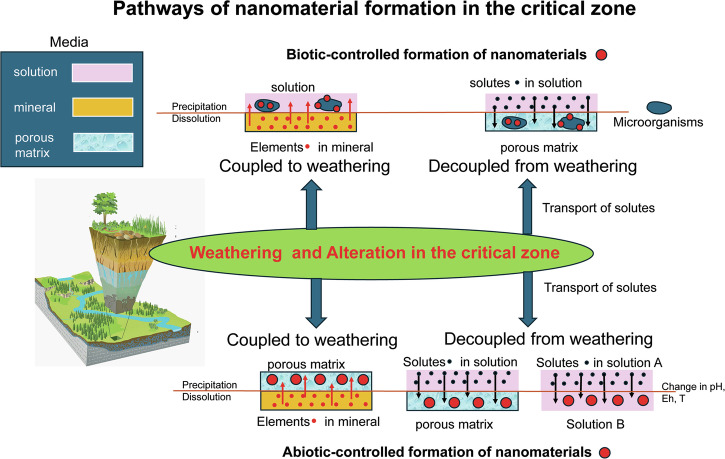
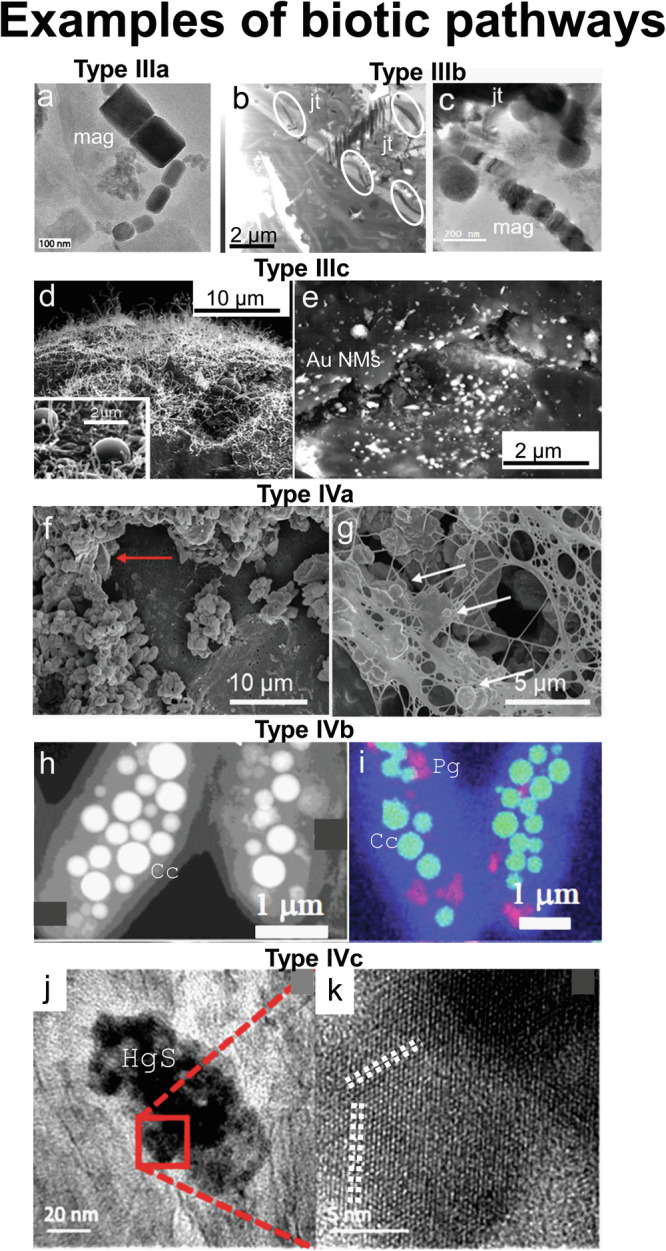
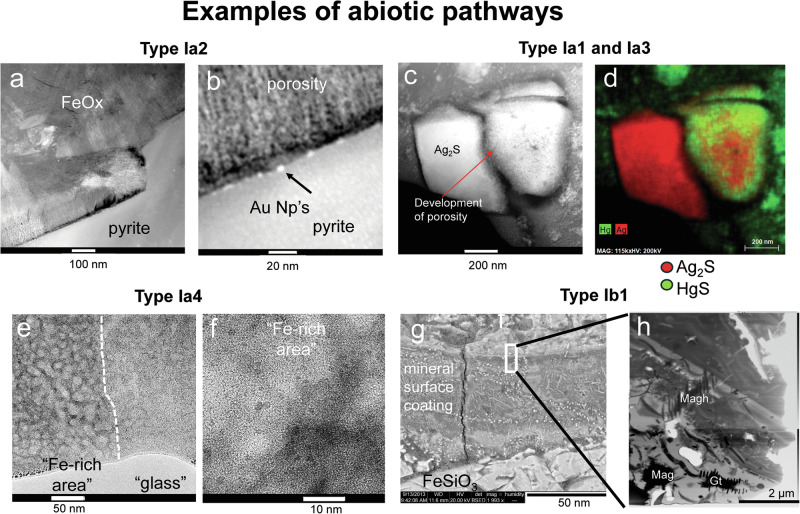
Nanomaterials have unique properties and play critical roles in the budget, cycling, and chemical processing of elements on Earth. An understanding of the cycling of nanomaterials can be greatly improved if the pathways of their formation are clearly recognized and understood. Here, we show that nanomaterial formation pathways mediated by aqueous fluids can be grouped into four major categories, abiotic and biotic processes coupled and decoupled from weathering processes. These can be subdivided in 18 subcategories relevant to the critical zone, and environments such as ocean hydrothermal vents and the upper mantle. Similarly, pathways in the gas phase such as volcanic fumaroles, wildfires and particle formation in the stratosphere and troposphere can be grouped into two major groups and five subcategories. In the most fundamental sense, both aqueous-fluid and gaseous pathways provide an understanding of the formation of all minerals which are inherently based on nanoscale precursors and reactions.
纳米材料具有独特的性质,在地球上元素的预算、循环和化学加工过程中发挥着关键作用。如果能够清楚地认识和理解纳米材料的形成途径,那么对其循环的认识将会得到极大的提升。在此,我们表明,由流体介导的纳米材料形成途径可分为四大类,即与风化过程耦合和解耦的非生物和生物过程。这些大类可进一步细分为18个与关键带以及海洋热液喷口和上地幔等环境相关的子类别。同样,气相途径,如火山喷气孔、野火以及平流层和对流层中的颗粒物形成,可分为两大组和五个子类别。从最基本的意义上讲,流体途径和气态途径都有助于理解所有矿物的形成,而这些矿物本质上都是基于纳米级前驱体和反应形成的。